


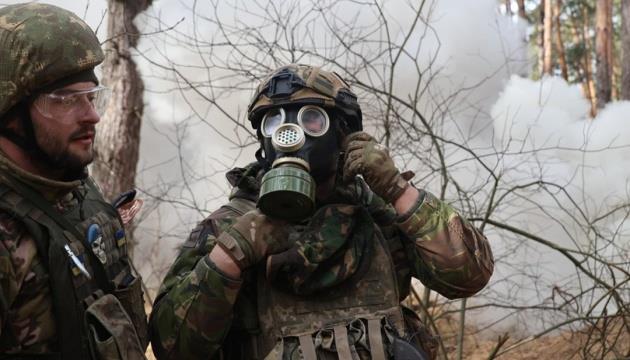
Russian Colonel Suspected Of Ordering Use Of Chemical Weapons Against Ukrainian Troops


According to him, the case is the result of work by prosecutors from the Prosecutor General's Office and investigators from the Security Service of Ukraine's Main Investigative Directorate, in cooperation with the Organization for the Prohibition of Chemical Weapons (OPCW).
The suspect is Pyotr Popov, commander of the 345th Air Assault Regiment of the 104th Guards Air Assault Division of the Russian Armed Forces.
According to the investigation, in autumn 2024, he planned and ordered his subordinates to use grenades containing the hazardous chemical agent CS against Ukrainian border guards in Dnipropetrovsk region.
"Acting on his orders, from September 2024 to January 2025, Russian troops dropped at least seven such grenades on positions held by the 8th Border Guard Detachment of the State Border Guard Service of Ukraine near the settlements of Illinka in the Nikopol district and Marivka in the Synelnykove district, Dnipropetrovsk region. The use of these weapons in warfare is prohibited under international law," Kovalskyi said.
Read also: Nearly 14,000 Russian chemical attacks against Ukrainian forces recorded since February 2022Ukrainian law enforcement authorities examined physical and digital evidence and established the origin of the munitions, the circumstances in which they were used, and the involvement of Russian military personnel.
On November 17, the OPCW published the findings of the Ukrainian criminal investigation and circulated them among all states parties to the Chemical Weapons Convention. The Organization's Technical Secretariat confirmed that the procedures used by the Ukrainian side to collect, document and preserve the relevant evidence complied with OPCW standards.
"This is an important assessment of the professional work of our prosecutors, investigators and experts, as well as the result of effective international cooperation. Today, we have not only documented facts of Russia's use of chemical weapons, but also a specific suspicion against a member of the Russian military command for issuing the relevant criminal orders. Every such order has a specific person behind it. And our main task is to prove that person's guilt in court," Kovalskyi said.

Legal Disclaimer:
MENAFN provides the
information “as is” without warranty of any kind. We do not accept any
responsibility or liability for the accuracy, content, images, videos,
licenses, completeness, legality, or reliability of the information
contained in this article. If you have any complaints or copyright issues
related to this article, kindly contact the provider above.


Comments
No comment