


Japan To Conduct Military Drills At Indian Firing Ranges: What Jaishankar's Tokyo Visit Means For India's Defence Agenda


The proposed arrangement, which includes training involving surface-to-ship missiles, marks a significant expansion of military cooperation between the two countries as they seek to strengthen deterrence and security in the Indo-Pacific.
The development was among the key outcomes of the fourth India-Japan Foreign and Defence Ministers' Dialogue, or 2+2 meeting, held in Tokyo on Thursday.
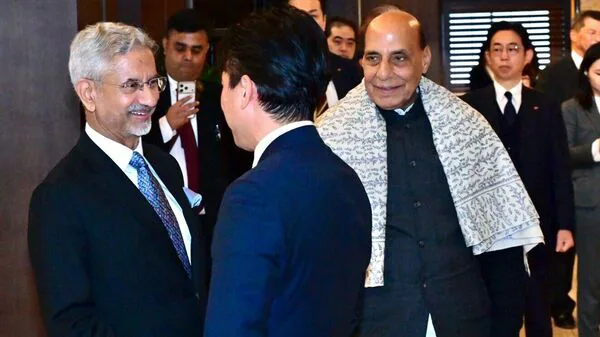
External Affairs Minister S Jaishankar and Defence Minister Rajnath Singh met their Japanese counterparts, Foreign Minister Toshimitsu Motegi and Defence Minister Shinjiro Koizumi, to review the strategic partnership and identify new areas of defence cooperation.
The two sides welcomed the signing of a Letter of Intent (LoI) on the utilisation of firing ranges in India by Japan's Self-Defence Forces. They agreed to accelerate coordination between their defence authorities to operationalise the arrangement.
Japan's military drills in India: Why it mattersThe proposed access to Indian firing ranges is significant because it would allow Japan's Self-Defence Forces to undertake live-fire training in India for the first time, including exercises involving surface-to-ship missiles.
Beyond expanding training opportunities, the arrangement points to growing interoperability between the two militaries and a willingness to deepen operational cooperation.
It also comes as both countries seek to strengthen their strategic coordination amid growing security uncertainties across the Indo-Pacific
The ministers also agreed to make bilateral military exercises more complex, integrate unmanned systems and pursue bilateral and multilateral drills at short notice.
The expansion builds on the first-ever visit of Japanese Air Self-Defence Force fighter aircraft to India for the 'Veer Guardian 26' air exercise. The two sides also welcomed the first trilateral naval Passage Exercise (PASSEX ) involving India, Japan and Indonesia in February 2026.
From military exercises to defence manufacturingIndia and Japan are also looking to expand their partnership beyond joint exercises towards defence production, technology and industrial collaboration.
The ministers reaffirmed their commitment to strengthening defence industrial cooperation under the framework of 'Design with Japan, Make in India'.
Also Read | On Cam: Jaishankar In Japan Flags Growing Weaponisation Of Global Supply ChainsThe two countries expressed interest in exploring joint development opportunities in naval shipbuilding and design, alongside cooperation to strengthen mine countermeasure capabilities.
They also looked forward to early formulation of arrangements related to the UNICORN project and India's Acceptance of Necessity (AoN) by February 2027.
These initiatives reflect an effort to connect India's domestic defence manufacturing ambitions with Japan's technological and industrial capabilities.
Maritime security takes centre stageMaritime cooperation emerged as another major pillar of the discussions, with both countries agreeing to translate their recently signed Memorandum of Arrangement on Maritime Security Cooperation into concrete outcomes.
The Indian Navy and Japan Maritime Self-Defence Force will explore greater cooperation in Maritime and Air Domain Awareness (MDA), search and rescue operations, information sharing, humanitarian assistance and disaster relief.
The emphasis on maritime security is particularly relevant given the importance of sea lanes, freedom of navigation and regional stability in the Indo-Pacific.
The ministers also welcomed expanding cooperation between the two countries' coast guards. India is scheduled to host the fifth Coast Guard Global Summit in February 2027, an initiative launched by the Japan Coast Guard.
What Jaishankar's Japan visit means for the Indo-PacificThe fourth 2+2 dialogue comes against the backdrop of an increasingly complex regional security environment. India and Japan reiterated their commitment to a free, open and rules-based international order, respect for national sovereignty and territorial integrity, and peaceful resolution of disputes.
Both sides also highlighted the alignment between India's Indo-Pacific Oceans Initiative (IPOI) and MAHASAGAR framework and Japan's updated Free and Open Indo-Pacific (FOIP) vision.
Japan's ongoing efforts to revise its National Security Strategy, National Defence Strategy and Defence Buildup Program were also discussed.
Also Read | Japan Works to Shield Takaichi From Any Xi Snub at China SummitTokyo briefed New Delhi on the proposed changes, with both sides noting their potential to strengthen regional security cooperation.
The discussions indicate that India-Japan ties are increasingly moving beyond diplomatic alignment and economic engagement towards practical military cooperation, defence manufacturing and maritime coordination.
With inputs from PTI, ANI.

Legal Disclaimer:
MENAFN provides the
information “as is” without warranty of any kind. We do not accept any
responsibility or liability for the accuracy, content, images, videos,
licenses, completeness, legality, or reliability of the information
contained in this article. If you have any complaints or copyright issues
related to this article, kindly contact the provider above.


Comments
No comment