


Leaning Mosques, Palace-Like Cement Truck: Nomad Abu Dhabi Turns Ordinary Into Elaborate


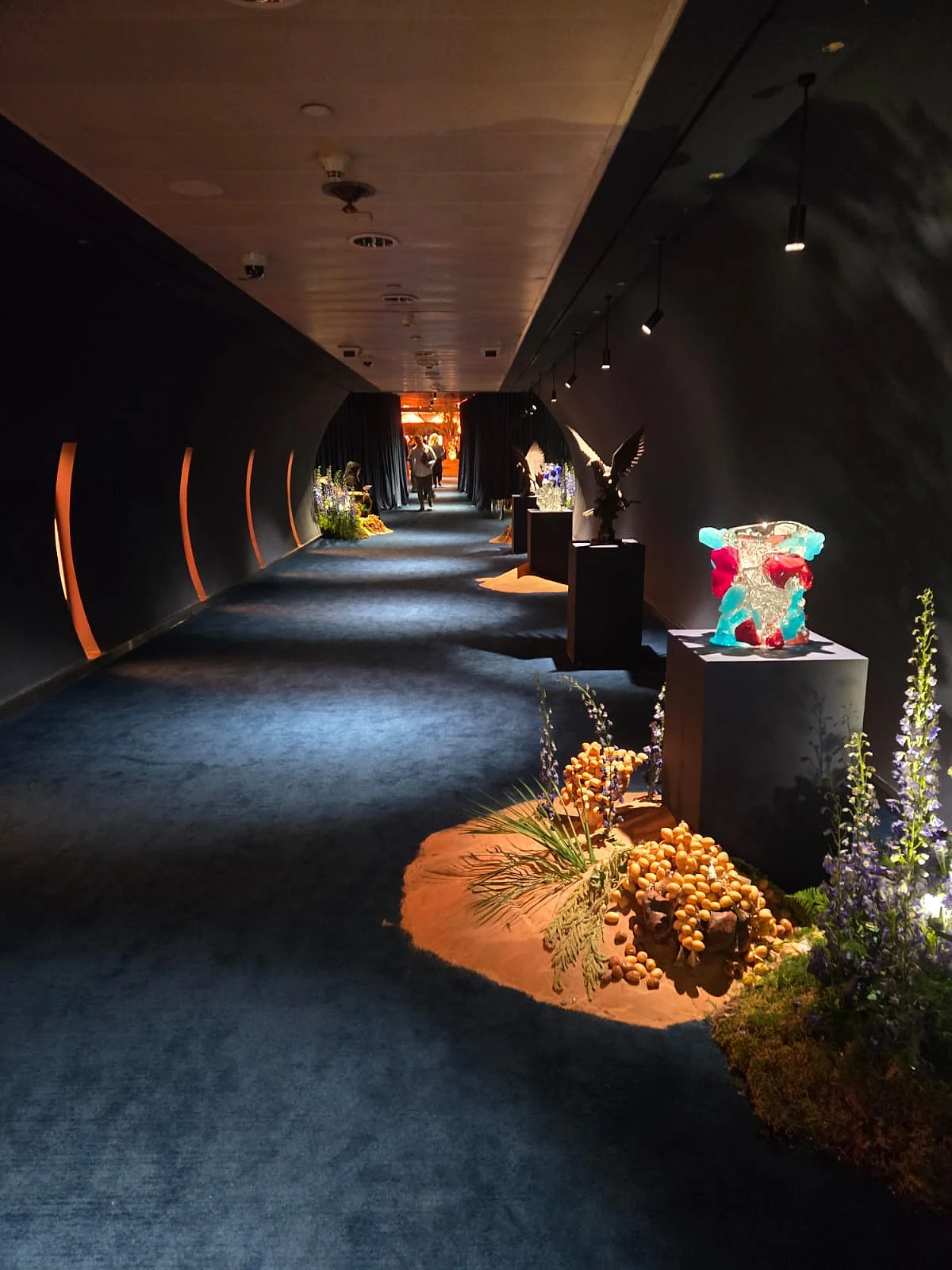
The work is among the pieces that make visitors stop and take a second look at the fair, which has returned for its second edition at Terminal 1 of the former Abu Dhabi International Airport. More than 50 exhibitors are taking part this year, presenting contemporary art, collectible design, jewellery and craft across the old terminal.
Recommended For YouStay up to date with the latest news. Follow KT on WhatsApp Channels.
Another installation that demands a closer look is at Tashkeel. It features a series of small mosque structures, some of which appear to be leaning at an angle that seems almost impossible. But walk away from the front and towards a particular viewing point, and the structures begin to straighten.
Shamin Sharum, the artist and designer behind the work, said the effect was created by starting with two-dimensional drawings and gradually shifting the forms into three dimensions.
“I wanted to create a way that you could see projection as an axonometric in real life,” he explained. An axonometric drawing is a way of representing a three-dimensional structure on a flat surface while retaining its proportions. The artist wanted to translate that drawing technique into a physical installation, creating an illusion that changes as visitors move around it.
The leaning effect also has a conceptual purpose.“A lot of the works in the show is about compression of space because musallas are small internally."
The structures represent different prayer spaces, from small musallas to larger areas used for Friday and Eid prayer. One is based on the Rashid and Fatima Mosque, which has since been demolished.
“I sort of rebuilt it through memories and through photography,” Sharum said, explaining that the work was a way of recreating a place that no longer exists. He said his wider practice has focused on the built environment, including social housing and the way people inhabit cities.
Nour Moukadem, a representative of Tashkeel, said the artist used architectural details such as minarets and domes as references for the models. Some of the smaller prayer spaces can accommodate only six to 10 people, she explained, while other structures represent larger congregational spaces.
Moukadem said the installation was the artist's first and was developed through Tashkeel's Critical Practice Programme, which brings in mentors to help artists develop their projects before presenting the outcomes in an exhibition. She also said another work by the artist is currently at Louvre Abu Dhabi and that he is among six nominees for the Richard Mille Art Prize.
When design crosses culturesAt Super Loop, consultant Hamza Lachhab walks visitors through Crossings, a collection of around six to seven pieces, each produced in a limited edition of six.
The collection brings together designers and artisans, combining materials including fibreglass, mirror glass, beads, steel, fabric and 3D-printed elements. Some pieces have the appearance of sculpture, but are designed to be used as furniture or functional objects.
Lachhab pointed to a table made using fibreglass to create a textured surface, explaining that the collection combines traditional handcraft with machinery and digital techniques.
“The idea is connecting different artists, artisans and different cultures and traditions,” he said.
The pieces draw on influences from Asia, the Mediterranean, the Red Sea and the Gulf. Customers can also request changes to dimensions, colours and shapes, he said, allowing the objects to be adapted for different spaces.
That combination of craft and contemporary design is also central to Irthi Contemporary Crafts Council's presentation. Its collaboration with Super Loop includes five pieces from the Al Taif collection, incorporating Emirati Talli, a traditional braiding technique used to decorate clothing, into contemporary furniture.
The collection includes a console table, side table, mirror, floor lamp and interior partition. Talli is combined with wood, including mahogany and beechwood, alongside materials such as beads and pearl inlay.
The work takes the intricate hand-braiding traditionally seen on garments and applies it to furniture and interior objects. The pieces were made through the collaboration of craftswomen and skilled artisans across the UAE, Lebanon and Egypt.
A cabinet inspired by the galaxyAt The A/P Room, one cabinet is inspired by the galaxy and the gravitational pull that keeps planets connected. Its designer sees a parallel with human relationships.
“Just like the planets are all connected with the gravity, the same for people. We are part of something bigger and we are all connected,” the designer Eva Szumilas said.“How much sometimes we try to disconnect. I think we need to connect together again.”
The cabinet is functional and opens, but its design also allows it to be placed in the centre of a room. The back has been finished to look just like the front, rather than being treated as a side that would normally face a wall.
The piece is handmade using cast aluminium and cast brass. Its first prototype took between two and four months to develop.
The gallery is also showing a Moreno sofa by the late architect Zaha Hadid, made in 2000, alongside a desk from the 1960s. The desk is made from Brazilian jacaranda wood and has a painted glass top. The gallery representative said the top was not original and that the gallery selected its current colour; the original would typically have been green, light or black.
Another collection at the gallery comes from American designer Rogan Gregory, who worked in fashion with brands including Levi's and Calvin Klein before turning his attention to sculpture.
The gallery representative, Lygie Duvivier, said Gregory grew tired of mass production and returned to his first interest. His father, an anthropology teacher, used to sculpt at weekends, and Gregory's childhood memories of spending time with him helped inspire the move.
His handmade pieces are biomorphic, with forms that can resemble creatures or appear to be in motion. Duvivier described his use of pareidolia, the tendency to see familiar shapes or faces in objects and patterns.
One sculpture has horsehair on its upper section and can suggest the shape of a woman or a creature. Gregory also incorporates playful elements into some works. At a workshop in Los Angeles, visitors could touch parts of a sculpture, including its sculpted bones, to dim the lights; however, that feature is not operating at the Abu Dhabi display.
A mirage, a flower an d a very old ring
At Galerie Gastou, the presentation is built around the idea of Fata Morgana, an optical illusion or mirage. Victor Gastou explained that the selection brings together works that sit somewhere between reality and fantasy, with unusual shapes, curves and visual effects.
One of the pieces that draws attention is a flower-like work made from glass and bronze. Gastou explained that the glass uses several layers and a special technique to create different effects as light passes through it.
The gallery also has a collection of antique rings tracing the history of jewellery. Gastou said some of the pieces date back centuries, with the oldest dating to around 200 BC.
The cement truck offers a different kind of surprise. Its gallery representative explained that the artist had taken an object from everyday life, something people would not normally consider particularly interesting, and transformed it into an elaborate piece.
The result initially looks like a palace. Only when visitors look more closely do the wheels and familiar features of a cement truck become apparent.
“Your eyes are very distracted because you're not expecting such a piece to be made,” the representative said.
The gallery itself has a family history: Gastou said it was founded by his father around 40 years ago. He joined in 2008 and took over in 2020.
Across the terminal, the works range from pieces rooted in local craft traditions to experimental furniture and objects that play with perspective. But the most memorable encounters often come from hearing the people behind them explain the thinking, materials and personal stories that visitors might otherwise miss.
ALSO READ- Look: 130-year-old kerosene fan, radio designed in Braille; rare items at Sharjah festival 'Our UAE' gallery opens, tracing the nation's story through art Look: Sikka 2026 converts Dubai's heritage houses into spaces of deliberate discomfort

Legal Disclaimer:
MENAFN provides the
information “as is” without warranty of any kind. We do not accept any
responsibility or liability for the accuracy, content, images, videos,
licenses, completeness, legality, or reliability of the information
contained in this article. If you have any complaints or copyright issues
related to this article, kindly contact the provider above.


Comments
No comment