


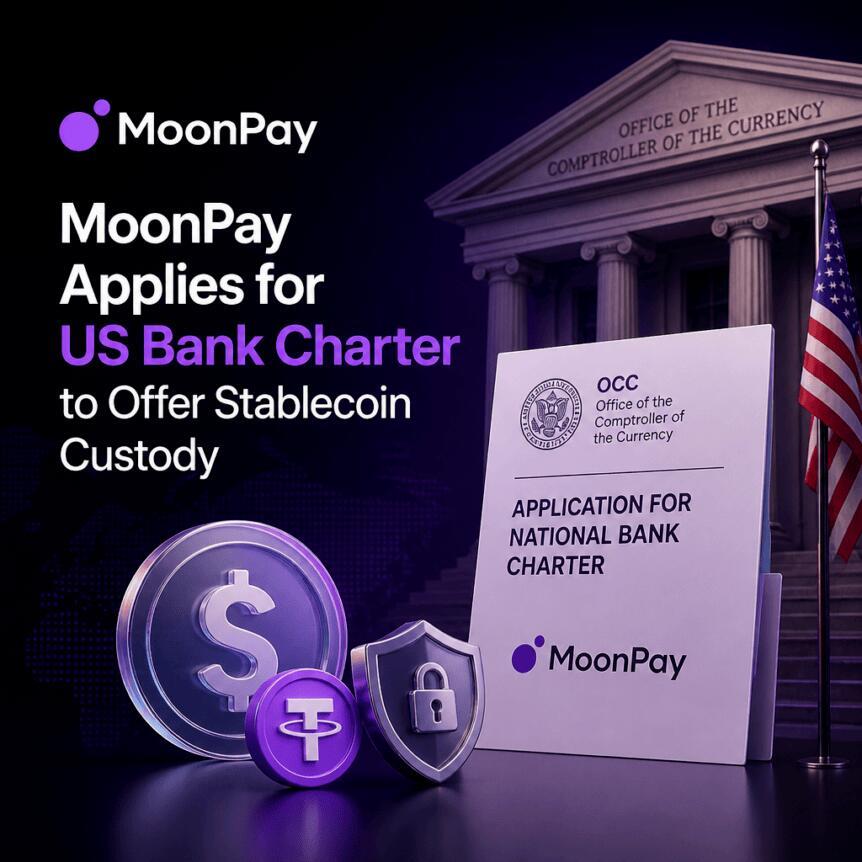
Moonpay Applies For US Bank Charter To Offer Stablecoin Custody


According to an Office of the Comptroller of the Currency (OCC) filing, MoonPay submitted its application on Tuesday for“MoonPay National Trust Bank.” The charter proposal is designed to expand what the company can do with stablecoins once it operates under federal supervision, including handling reserves and custody services that are increasingly central to stablecoin compliance.
Key takeaways- MoonPay has applied for a US national trust bank charter to support stablecoin issuance/redemption, reserve management, and custody. The proposed entity would be non-depository and would not issue loans, based on the OCC filing. The move aligns with upcoming US stablecoin regulatory rules under the GENIUS Act, which takes effect on Jan. 18, 2027. MoonPay joins other crypto and payments firms pursuing trust bank charters, reflecting a push toward federally supervised operations. Community banks have opposed the OCC's approach, arguing the regulator has expanded authority for non-depository trust banks.
In its application, MoonPay proposes establishing MoonPay National Trust Bank as a national trust bank located in Miami Beach, Florida. The filing describes an institution that would operate without accepting traditional deposits or extending loans-functions typically associated with commercial banks.
Instead, the proposed bank structure is geared toward activities that sit closer to stablecoin operations and asset holding. MoonPay already provides stablecoin issuance infrastructure for businesses, including support for branded digital dollars. Under a successful charter process, the company's banking subsidiary would gain a pathway to offer stablecoin-related services and digital asset custody with federal oversight.
The practical implication for customers and counterparties is straightforward: if the charter is approved, MoonPay could potentially streamline stablecoin workflows-especially areas involving reserves and custody-inside a regulated entity rather than relying solely on non-bank intermediaries.
Why the timing matters with GENIUS Act implementationMoonPay's application arrives as US regulators move toward implementing stablecoin standards under the GENIUS Act. The act is scheduled to take effect on Jan. 18, 2027, establishing federal requirements for stablecoin issuers, including reserve backing and redemption-related obligations.
MoonPay's request appears designed to prepare for that shift. When stablecoin rules become more uniform nationwide, firms that can demonstrate compliant reserve handling and redemption frameworks may be better positioned to scale issuance. A trust bank charter can also signal a more formalized approach to governance and custody practices-areas that regulators and users are likely to scrutinize more tightly once the new regime starts.
Still, approval is not guaranteed. Applicants must meet OCC requirements and address the broader policy questions raised by critics of trust bank expansion.
A wave of trust bank filings from crypto and payments firmsMoonPay is not the only company seeking a federally supervised banking structure. The filing places it within a broader trend: crypto and payments businesses have been applying for US trust bank charters in increasing numbers.
Earlier efforts highlighted in recent coverage include applications from Rain, Modern Treasury, and Block, each seeking trust bank charters focused on custody and stablecoin-related activities. Cointelegraph also notes that Coinbase 's national trust bank charter took effect earlier this month, and that Circle received final OCC approval in July-both developments pointing to regulatory momentum toward federally chartered entities for stablecoin and custody functions.
For investors and market participants, this pattern suggests that the industry is responding to regulatory pressure by moving beyond purely fintech-style compliance models. Rather than treating banking partnerships as an afterthought, more firms are trying to bring stablecoin and custody capabilities inside a structure that regulators already supervise directly.
Community bank opposition and the governance battle behind the chartersThe expansion of trust bank charters has not been universally welcomed. The rise in crypto-related filings has drawn resistance from community banks, which argue that the OCC has pushed the boundaries of what non-depository trust banks should be allowed to do.
According to earlier reporting, the Independent Community Bankers of America sued the OCC in October. The complaint argued that the regulator exceeded its authority by permitting non-depository trust banks to conduct activities traditionally associated with commercial banks.
That dispute matters because it could affect how quickly and how broadly future trust bank proposals are approved, and it may influence the compliance expectations that applicants must meet. Even if a given applicant receives approval, ongoing legal and policy challenges can add uncertainty around the long-term operating landscape for federally chartered crypto banking entities.
What to watch nextMoonPay's filing is a signal that stablecoin issuance and custody are moving closer to regulated banking frameworks in the US. The next key developments will be how the OCC evaluates the application and whether legal challenges to trust bank authority reshape the approval environment ahead of the GENIUS Act's Jan. 18, 2027 effective date.
Risk & affiliate notice: Crypto assets are volatile and capital is at risk. This article may contain affiliate links.
Legal Disclaimer:
MENAFN provides the
information “as is” without warranty of any kind. We do not accept any
responsibility or liability for the accuracy, content, images, videos,
licenses, completeness, legality, or reliability of the information
contained in this article. If you have any complaints or copyright issues
related to this article, kindly contact the provider above.


Comments
No comment