


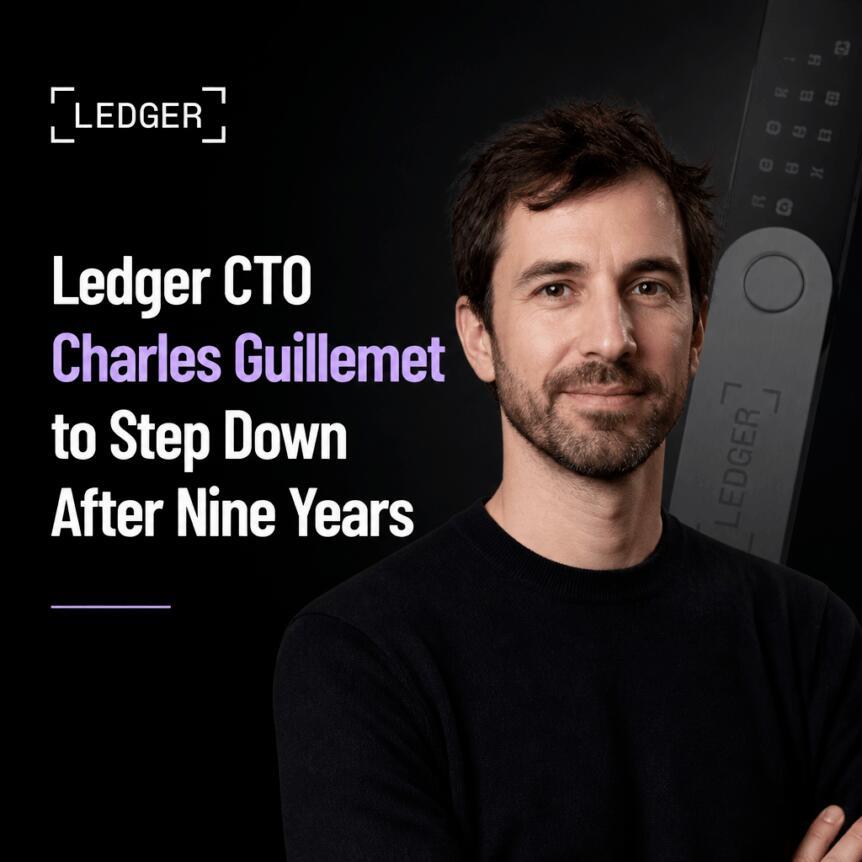
Ledger CTO Charles Guillemet To Step Down After Nine Years


In a LinkedIn post on Thursday, Guillemet said he joined Ledger as chief security officer in December 2017-about three years after the company was founded-and later helped create and launch Ledger Donjon, the firm's attack lab, a year after joining.
Key takeaways- Charles Guillemet will depart Ledger at the end of 2026 after nine years at the company. He was instrumental in establishing Ledger Donjon, an internal lab focused on testing hardware and software security. Guillemet said Ledger devices secure roughly 20% of the world's crypto assets. He cited AI-driven changes to the threat landscape, arguing security is now a problem for all sectors, not just crypto. The announcement comes shortly after Ledger disclosed cases involving tampered wallets designed to capture recovery phrases.
Guillemet framed his exit as part of an already planned transition. He said Ledger's teams, partners, and product roadmaps are prepared and that the company is ready to continue its work into the next phase.
While he did not provide a detailed timeline beyond the end of 2026, he emphasized that the transition had been in preparation for“many months,” suggesting internal continuity planning rather than a sudden leadership disruption.
From chief security officer to the technology helmAccording to Guillemet, his responsibilities evolved over time as Ledger grew. He moved from chief security officer to chief technology officer, with a central focus on defensive research and security operations.
He highlighted Ledger Donjon, which tests hardware and software vulnerabilities. The lab's purpose-identifying weaknesses in devices before adversaries can exploit them-has been a recurring theme in Ledger's broader security posture as hardware wallet usage has expanded.
In his post, Guillemet also stated that Ledger devices now secure roughly 20% of the world's crypto assets. The claim underscores how central the company's security work has become to a significant share of self-custody demand, though readers should note this figure was presented by Guillemet without further methodological detail in the announcement itself.
Why AI changes the security equationGuillemet argued that the threat landscape has materially shifted. He said AI is making attacks cheaper, faster, and easier to scale, changing the cost-benefit dynamics for attackers.
He suggested that crypto's long-standing question-how to protect what matters when any device could be compromised-has now become a wider societal and industrial problem. In his view, the same security challenge applies to“every company,”“every AI agent,” and“every government,” reflecting a broader trend: as AI systems spread, so do automated capabilities that can be directed at fraud, exploitation, and data theft.
Departure amid a fresh hardware wallet tampering caseGuillemet's announcement arrives just weeks after Ledger said attackers modified genuine hardware wallets with hidden components intended to capture users' recovery phrases, and then slipped the devices into authorized resellers.
The tampering incidents were reported first in Asia, with later cases identified in Europe and the United Arab Emirates, according to the information included alongside Guillemet's departure statement.
This timing matters for investors and users because it places leadership change directly alongside a high-scrutiny security chapter. Hardware wallet incidents that involve supply-chain or reseller channels tend to create prolonged questions about how quickly controls can detect changes in the field and how effectively customers can verify the legitimacy of devices before use.
Guillemet did not address those incidents in detail in the excerpt provided, but his comments about a shifting threat landscape-especially AI-enabled scaling-align with why hardware integrity and recovery-phrase protection remain urgent concerns.
What comes next for Ledger and for GuillemetGuillemet did not disclose where he will go next, but he said he would be“building something new” and plans to“dedicate [his] time to solving this security mess.” The lack of specifics leaves room for uncertainty about whether his next role will remain focused on hardware security research, broader cyber defense, or a venture tied to new security tooling.
For Ledger, the near-term focus is likely to remain on reinforcing customer protections and tightening processes that reduce the chance of tampered devices reaching legitimate distribution channels-especially in a period where attackers may be able to iterate more quickly, aided by AI.
As Guillemet's timeline runs through the end of 2026, the next question for Ledger customers and market watchers is how the company will maintain security momentum while leadership transitions unfold-and what further safeguards will be introduced in response to the tampered-wallet cases across multiple regions.
Risk & affiliate notice: Crypto assets are volatile and capital is at risk. This article may contain affiliate links.
Legal Disclaimer:
MENAFN provides the
information “as is” without warranty of any kind. We do not accept any
responsibility or liability for the accuracy, content, images, videos,
licenses, completeness, legality, or reliability of the information
contained in this article. If you have any complaints or copyright issues
related to this article, kindly contact the provider above.


Comments
No comment