


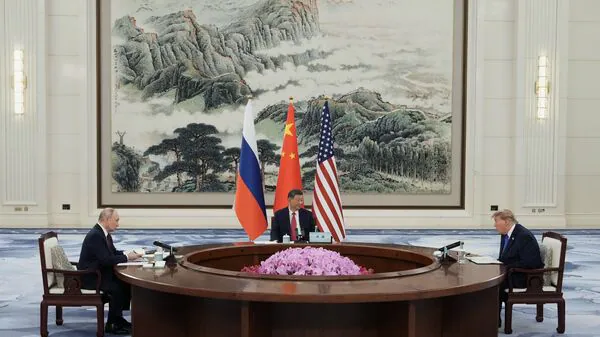
Trump, Xi And Putin Revive Reagan-Gorbachev Nuclear Pledge: Why The 40-Year-Old Principle Matters Today?


Despite the leaders reaffirming their stance on nuclear war, the first-of-its-kind meeting appears to have yielded little immediate diplomatic progress. According to Reuters, the three leaders did not specify a timeline for discussions on reducing nuclear risks. The joint statement also made no mention of a possible trilateral nuclear arms-reduction agreement. Trump has advocated such a deal since his first term, but China has repeatedly resisted the proposal, arguing that its nuclear arsenal is considerably smaller than those of the US and Russia.
Quick answers to key questions
.5 QUESTIONS1What is the Reagan-Gorbachev principle on nuclear war?⌵It is the shared understanding that a nuclear war cannot be won and must never be fought. Ronald Reagan and Mikhail Gorbachev formally included the declaration in a joint statement after their Geneva summit in 1985.
2Why did Trump, Xi and Putin reaffirm the nuclear-war pledge?⌵The leaders reaffirmed it as nuclear arms control faces new challenges and agreed to hold dialogue on reducing nuclear risks and preventing the spread of nuclear weapons. The pledge echoed the Reagan-Gorbachev principle.
3Did the Trump-Xi-Putin statement create a nuclear arms-reduction agreement?⌵No. The joint statement offered no concrete commitment to reduce the three countries' arsenals and set no timeline for talks on nuclear risks.
4Why is a three-way nuclear arms-control deal difficult to negotiate?⌵China has resisted joining such negotiations, arguing that its nuclear arsenal is considerably smaller than those of the US and Russia. Differences in the countries' nuclear capabilities and security priorities also complicate a common framework.
5How did the Reagan-Gorbachev pledge lead to arms-control efforts?⌵The 1985 declaration helped create diplomatic conditions for later arms-control efforts. These included the 1987 INF Treaty, which eliminated a category of US and Soviet missiles, and the 1991 START I agreement, which required significant strategic-arms cuts.
Also Read | Trump and Xi's show of friendship is good for marketsWhile the declaration may appear to be a fresh diplomatic commitment, its central message dates back nearly four decades. The phrase“a nuclear war cannot be won and must never be fought” is associated with the historic understanding reached between then US President Ronald Reagan and Soviet leader Mikhail Gorbachev during the Cold War, CNN reported.
Reagan had expressed a similar view in a 1982 address. However, it gained wider diplomatic significance in 1985, when Reagan and Gorbachev included the declaration in a joint statement following their summit in Geneva.
In the decades that followed, the commitment came to be known as the Reagan-Gorbachev principle.
What is the Reagan-Gorbachev principle?The nearly four-decade-old principle refers to a shared understanding between the United States and the Soviet Union that a nuclear war would have no winner and, therefore, must never be fought. The declaration was formally included in a joint statement issued by the two leaders after their Geneva summit on November 21, 1985.
The meeting marked a crucial moment in Cold War diplomacy, signalling a willingness by the two nuclear powers to move away from confrontation and work towards reducing the threat of nuclear conflict. The principle also helped create the diplomatic conditions for subsequent arms-control efforts, including the 1987 Intermediate-Range Nuclear Forces (INF ) Treaty, which led to the elimination of an entire category of US and Soviet missiles.
What happened after the Reagan-Gorbachev declaration?The two leaders carried the discussions forward at their October 1986 summit in Reykjavik, Iceland. There, Reagan and Gorbachev explored far-reaching proposals to reduce their nuclear arsenals, including the possibility of eliminating nuclear weapons. However, the talks broke down over disagreements about the US Strategic Defense Initiative (SDI), a proposed missile-defence programme, and whether its testing should be restricted to laboratories, according to the Arms Control Association.
In the years that followed, the two sides signed two landmark agreements. The 1987 INF Treaty eliminated all US and Soviet ground-launched ballistic and cruise missiles with ranges of 500 to 5,500 kilometres. The 1991 Strategic Arms Reduction Treaty (START I) required both countries to make significant cuts to their strategic nuclear arsenals and established verification measures to monitor compliance. These agreements did not eliminate all nuclear weapons, but they marked major steps towards reducing the two countries' nuclear capabilities.
Also Read | Trump Open to Putin, Xi Summit But Would Focus on Nuclear Arms Why does the Reagan-Gorbachev principle matter today?The renewed commitment by the three leaders comes at a time when nuclear arms control faces fresh challenges. While Washington and Moscow possess the world's largest nuclear arsenals, Beijing is rapidly expanding and modernising its capabilities. According to SIPRI's 2026 estimates, China's nuclear arsenal stood at an estimated 620 warheads in January 2026, compared with 5,420 for Russia and 5,042 for the US in total inventory estimates.
Trump has repeatedly pushed for a three-way nuclear arms-reduction arrangement involving the US, Russia and China. However, Beijing has been reluctant to participate in such negotiations, arguing that its arsenal remains considerably smaller than those of the other two powers. The differences in their nuclear capabilities and security priorities make a common arms-control framework difficult to negotiate.
The challenge has also been compounded by the weakening of existing arms-control arrangements. The New Strategic Arms Reduction Treaty (New START ) between the US and Russia expired on February 5, 2026, leaving the two countries without binding limits on their strategic nuclear arsenals. Trump has called for a new arms-control agreement that would also include China, rather than simply continuing with the previous bilateral framework.
Following the Shenzhen meeting, Trump acknowledged that reaching an agreement to limit nuclear weapons with China and Russia would be difficult, although he said he intended to continue pursuing the proposal. The joint declaration, meanwhile, offered no timeline for negotiations or concrete commitments to reduce the three countries' nuclear arsenals.
Also Read | Nuclear arms race on the horizon? US, Russia's New START expires todayWith New START now expired and the US seeking to bring China into a new arms-control framework, the latest declaration raises the question of whether the three powers can move beyond a shared commitment against nuclear war and agree on concrete steps to reduce their arsenals.

Legal Disclaimer:
MENAFN provides the
information “as is” without warranty of any kind. We do not accept any
responsibility or liability for the accuracy, content, images, videos,
licenses, completeness, legality, or reliability of the information
contained in this article. If you have any complaints or copyright issues
related to this article, kindly contact the provider above.


Comments
No comment