


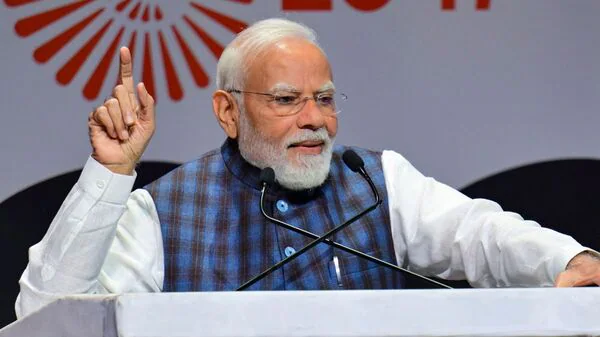
'Do Not Take 140 Crore Indians For Granted': PM Modi's Blunt Message To India Inc At FICCI AGM 10 Key Takeaways


Addressing the 100th Annual General Meeting and Annual Convention of the Federation of Indian Chambers of Commerce and Industry (FICCI) at Bharat Mandapam in New Delhi, PM Modi outlined opportunities across pharmaceuticals, agriculture, food processing, engineering, steel and aluminium.
He also challenged businesses to translate the benefits of tax reforms into higher salaries and more employment, while invoking Mahatma Gandhi's message of Swadeshi and self-reliance.
Here are the key takeaways from PM Modi's address:
1. Don't take Indian consumers for granted; improve product qualityPM Modi urged businesses to stop treating India's large domestic market as an assured destination for products, stressing that Indian consumers deserve the same quality of goods as overseas buyers.
He criticised the practice of selling products to Indian customers by describing them as "export quality".
"Do not take 140 crore Indians for granted as an assured market where anything will sell. Even today, sellers tell customers 'this is export quality' to convince them it is good. What do you take our countrymen for? Do they not deserve good quality? This mindset must change; my countrymen deserve top quality," he said.
He added that India's domestic market should serve as a launchpad for global competitiveness rather than become a comfort zone.
"Our domestic market must not become our comfort zone. It should give us the confidence to compete in global markets," PM Modi said.
2. Make 'India First' the foundation of investment decisionsThe Prime Minister asked industry leaders to look beyond short-term business gains and prepare for emerging requirements in India and international markets.
He called on businesses to prioritise national interests while making long-term investment decisions over the next two decades.
"In every long-term investment decision of yours for the next 20 years, make India First your foundation," he said.
PM Modi said this approach would strengthen India's self-reliance while creating new opportunities for businesses.
He also warned that companies needed to prepare for a world where resources were increasingly being used as strategic instruments.
"In this era of the weaponisation of resources, securing the nation's future becomes the responsibility of all of us," he said.
3. Increase salaries and hiring after tax cutsPM Modi highlighted the government's tax reforms, including the reduction in the basic corporate tax rate and the income-tax exemption for earnings up to ₹12 lakh under the applicable provisions.
However, he questioned whether companies had passed on the benefits of these measures through higher employee salaries and additional hiring.
"We brought the basic corporate tax rate down from 30% in 2014 to 22%, and today there is no income tax on earnings up to ₹12 lakh. Did you increase your employees' salaries or hire more staff?" he asked.
He also highlighted improvements in tax administration, claiming that income-tax refunds that previously took several months were now generally processed within a week.
GST reforms had also reduced taxes on several products, supporting consumer demand and benefiting businesses, he said.
4. Reduce dependence on imported pharmaceutical ingredientsPM Modi urged India's pharmaceutical industry to reduce its dependence on imported active pharmaceutical ingredients (APIs), bulk drugs and drug intermediates.
Despite being known as the "pharmacy of the world", India continues to import billions of dollars' worth of pharmaceutical ingredients every year, he said.
"India is called the 'pharmacy of the world,' yet it imports billions of dollars' worth of APIs, bulk drugs, and drug intermediates every year," he said.
He asked pharmaceutical companies to identify ingredients that could be manufactured domestically and invest in new technologies and large-scale production facilities.
"In finished medicines, we have strength. Now we will have to build our capabilities in ingredients as well," Modi said.
5. Export value-added products instead of raw materialsThe Prime Minister questioned why India continued to export raw materials while importing finished products, calling for greater domestic manufacturing and value addition.
"What kind of a country is this, and what kind of industrialists are we, if we export wheat and import bread?" he asked.
He cited opportunities in the steel and aluminium industries, noting that India exports iron ore but imports finished steel, while also importing specialised aluminium alloys despite having substantial bauxite reserves.
He urged companies to identify the grades of steel and aluminium products that India imports and develop the technology and manufacturing capabilities to produce them domestically.
6. Invest more in agriculture and food processingPM Modi called on the corporate sector to increase investments in agriculture, food processing and procurement infrastructure to expand India's agricultural exports.
He said India's share of global agricultural exports remained at around 2-2.5%, highlighting the considerable room for growth.
"I would urge you to increase your industry's investment in India's agricultural sector. Set up reliable procurement systems with specific overseas markets in mind, and develop products for which there is demand there, so that Indian products can become our calling card around the world," he said.
He also highlighted the rise in processed food's share of India's agri-food exports from 13% to more than 20% over the past 12 years.
Businesses, he said, should focus on value addition and develop products according to the requirements of specific international markets.
7. Focus on hand tools, machinery and engineering exportsThe Prime Minister identified hand tools, power tools and machinery manufacturing as sectors where Indian companies could build a stronger global presence.
He encouraged large companies to help smaller enterprises develop manufacturing capabilities that meet international quality and scale requirements.
PM Modi also pointed to opportunities in manufacturing machinery for developing economies, particularly countries in the Global South.
Packaging equipment, irrigation systems and factory-related machinery were among the areas where Indian businesses could explore export opportunities, he said.
8. Use free trade agreements to expand global marketsPM Modi asked Indian industry leaders to take advantage of the Free Trade Agreements (FTAs) signed with several major economies.
He said these agreements had opened new opportunities for Indian manufacturers and exporters, but questioned whether businesses had adequately prepared to exploit them.
"India has signed Free Trade Agreements (FTAs) with several major economies; doors have opened for you. Have you planned to seize this opportunity? If you do not take advantage of all my hard work, who will?" he said.
He urged companies to invest in overseas market research, understand consumer preferences and establish distribution networks to strengthen India's export presence.
9. Take forward Mahatma Gandhi's message of SwadeshiMarking FICCI's 100th anniversary, PM Modi invoked Mahatma Gandhi's 1930 message of Swadeshi and self-reliance, saying Indian businesses needed to carry forward the same vision.
He questioned why the country still needed to emphasise indigenous manufacturing and self-reliance nearly a century after Gandhi advocated the use of domestic products.
"Imagine, 100 years have passed, but in 1930, Gandhi left us with this message, and today, so many years later, I too have to say the same thing. Is this your success or your failure? Don't listen to me; at least you could have listened to Gandhi!" he said.
He urged industry leaders to spread the message of Swadeshi and Atmanirbhar Bharat across the country.
Also Read | PM Modi urges CAG to focus audits on small firms, urban services & local bodies 10. 'This is a government of friends': PM Modi invites industry suggestionsModi also urged businesses to move beyond any hesitation arising from their experiences with previous governments and openly communicate their concerns to the current administration.
"Your experience with previous governments has been so bitter that I am having to bear the consequences. This is not the old government; this is a government of friends. It knows how to honour friendship, and you are my true friends," he said.
He invited industry representatives to submit written suggestions on areas requiring further reforms, assuring them that the government was open to addressing their concerns.
India has moved beyond 'Fragile Five', says PMHighlighting India's economic performance, PM Modi said the country had moved from being counted among the world's "Fragile Five" economies to becoming the fastest-growing major economy.
He cited a recent World Bank report, saying around 500 million Indians had moved out of poverty over the past 12-13 years.
He also highlighted merchandise exports of nearly $50 billion in October, describing it as the highest-ever monthly goods export figure.
"Today, India stands as the world's fastest-growing major economy, with projected growth of around 7%. In October, India's goods exports reached nearly $50 billion, our highest-ever monthly goods export," he said.
PM Modi added that international institutions, including Moody's Ratings, S&P Global Ratings, Fitch Ratings, the World Bank and the Asian Development Bank, had revised their growth projections for India upwards.
Indian industry must focus on the next 20 yearsConcluding his message to industry leaders, Modi said FICCI's centenary was an opportunity to reflect on the contribution Indian businesses could make over the next two decades.
He urged companies to prepare for future domestic and global demand instead of concentrating only on sectors that already offered established business opportunities.
"Over its 100 years, FICCI has seen the country's industry achieve a great deal. Now is the time to decide what Indian industry can achieve in the next 20 years--how you can further increase your contribution to the journey of Viksit Bharat and Atmanirbhar Bharat," he said.
"Developed India is not a slogan; it is a commitment," PM Modi added.
Also Read | Watch: PM Modi Picks Up Indian Flag From Floor At Quad Leaders' Meeting
Legal Disclaimer:
MENAFN provides the
information “as is” without warranty of any kind. We do not accept any
responsibility or liability for the accuracy, content, images, videos,
licenses, completeness, legality, or reliability of the information
contained in this article. If you have any complaints or copyright issues
related to this article, kindly contact the provider above.


Comments
No comment