


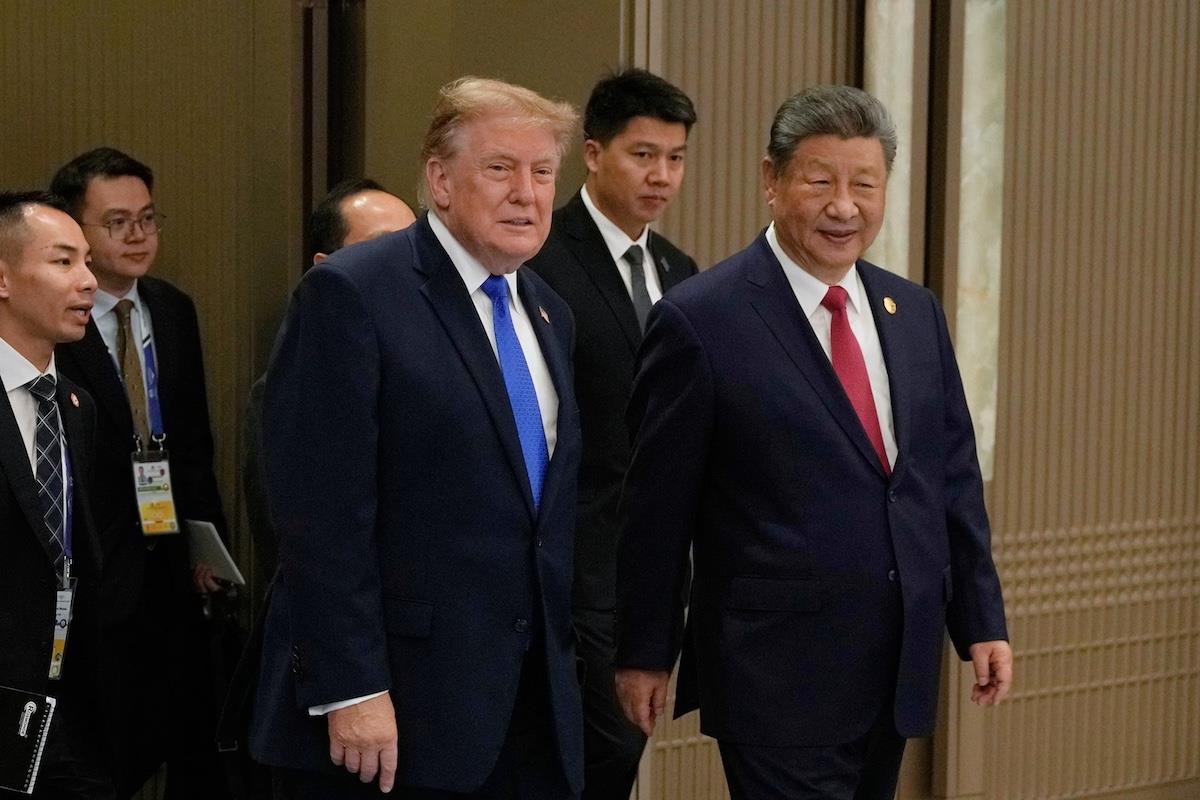
In Shenzhen, Great-Power Pageantry Masks A Hardening Tech Divide


“We oppose any form of globalist regulation or anything to control or stifle SI (superintelligence), and we won't allow that to happen, frankly,” Trump declared, insisting Washington just invented SI moments after acknowledging that Pacific Rim economies produce“more than 90% of all semiconductors.”
Tailored as much for Silicon Valley backers and a restless post-midterm base back home as for the Shenzhen hall, Trump's pitch offered Asia no shared compute frameworks or digital public goods.
Instead, he based Washington's regional offer on allied-funded fossil fuels, touting an Alaska liquefied natural gas pipeline that Seoul is still hedging on financing alongside expanding US oil operations in post-Maduro Venezuela, leaving Beijing to address Southeast Asia's more immediate need for low-carbon data center power.
Moments later, Xi countered with a four-pillar blueprint for an“Asia-Pacific community” built around open regionalism, harmonized rules and concrete institutional funding.
“We should uphold open regionalism, steadily advance economic integration and develop a cooperation pattern that is open and integrated rather than exclusive or fragmented,” the Chinese leader told delegates, in a pointed diplomatic rebuke to Washington's unilateral chip and cloud export curbs.
Calling on members to“strengthen the digital infrastructure development, improve data governance and collaboration in the region and achieve efficient, convenient and secure cross-border data flow,” Xi backed his institutional pitch with immediate deliverables: $20 million for practical APEC projects, a new Center for Asia-Pacific Community Studies in Shenzhen and dedicated regional mechanisms covering digital technology, cross-border data flows, clean energy and small business development.
Latest stories Awami League's violent comeback bid affirms its 'terrorist' label Trump's $23 billion battleship faces sinking odds Vietnam uses APEC sidelines as safety valve with ChinaFor Southeast Asian governments watching from the plenary floor, the immediate upshot is an unmistakable strategic asymmetry: Beijing is offering institutional architecture, cross-border data rules and development cash, while Washington is denouncing global AI governance even as its own unilateral remote-cloud export restrictions take effect across Singapore, Malaysia, Indonesia and Thailand.
The deregulation paradoxTrump's anti-regulation message in Shenzhen collided directly with the new reality facing regional telecom operators and cloud providers on Thursday.
At the exact moment the US president warned against rules that might“destroy the tremendous potential” of AI, newly published Commerce Department rules began imposing strict know-your-customer verification and licensing mandates on overseas data centers providing remote compute access to Chinese clients.
Across Southeast Asia, local operators that rely on hosting both Western hyperscalers and Chinese tech firms are being forced to police Washington's export perimeter while Trump simultaneously dismisses international rules as“globalist” overreach.
Xi seized on that opening by positioning Beijing as the guarantor of institutional predictability, promising regional institutions to govern cross-border data and smart customs without unilateral political interference.
Speaking on the same plenary stage, Putin reinforced that message of regional integration, declaring Russia an“integral part of the Asia-Pacific region,” urging members to utilize Russian logistics infrastructure and signaling Moscow's support for the draft final APEC communiqué.
Transactional truces and great-power opticsYet Thursday's speeches also suggested why neither Beijing nor Southeast Asian capitals see Washington's tech crackdown as immovable.
Having broken nearly five decades of protocol on Wednesday evening to greet Trump personally on the Shenzhen tarmac with the remark that“China is a nation of etiquette with a tradition of reciprocity,” Xi framed Beijing's hospitality not as unconditional flattery, but as an expectation of concrete policy restraint on tariffs and technology.
Opening his bilateral talks with Xi at Shenzhen's Kylin Villa on Thursday afternoon, Trump cast the relationship in starkly transactional terms. He pointed to a“30 for 30” tariff-reduction package brokered through the bilateral Board of Trade, covering $30 billion in bilateral commerce, while pressing Beijing for further agricultural purchases alongside claims of a 97% drop in seaborne fentanyl and shared interests in keeping energy moving through the Strait of Hormuz.
Asked earlier in a Fox News interview about last week's espionage scandal surrounding former Nvidia chief executive Jensen Huang, a controversy that had hardened support in Washington for tighter cloud controls, Trump waved the issue aside as“a tragedy”and added that“we have to take care of geniuses.”
“As long as you and I are in charge of things, we'll never have a problem,” Trump told Xi at the start of their talks, shortly after confirming he had held a brief sideline meeting with Putin“to set the stage” for their afternoon trilateral.
In the bilateral talks that followed, Xi told Trump that“I am very firm in my conviction to working with you,” framing their stabilization effort around what he called a“new definition of a constructive China-US relationship of strategic stability” based on“respect, fairness and reciprocity.”
Within an hour of the meeting ending, China's Ministry of Commerce announced it would convene an agricultural working group with Washington“in the near future,” and Beijing's readout said both leaders agreed to draw up an action plan to stabilize ties while calling for“greater cooperation on artificial intelligence”, even though neither side announced any rollback of Washington's new remote-cloud restrictions.
Over an hour behind schedule, the two leaders then joined Putin around a large round table at Kylin Villa for their unprecedented three-way summit, where Trump declared the trio were“making history” and should lead on nuclear disarmament, while Xi hailed the talks as carrying“groundbreaking significance” for managing global challenges.
What Shenzhen means for Asia's middle powersFor Southeast Asian and East Asian economies, the broader upshot of Shenzhen is twofold.
Sign up for one of our free newsletters-
The Daily Report
Start your day right with Asia Times' top stories
AT Weekly Report
A weekly roundup of Asia Times' most-read stories
First, the Kylin Villa trilateral reinforces a nagging regional fear that Trump prefers great-power sphere-of-influence dealmaking over multilateral Asian institutions.
While Xi used the APEC plenary to promise lower trade barriers and deeper integration toward a Free Trade Area of the Asia-Pacific, Washington's top diplomatic priority in Shenzhen was a closed-door trilateral with Beijing and Moscow that left smaller Pacific Rim nations on the outside looking in.
Second, the gap between Trump's personal appetite for $30 billion trade truces and his administration's hardline export-control bureaucracy gives ASEAN capitals room to maneuver.
By treating Jensen Huang's fallout as a passing political headache rather than a reason to derail bilateral tariff cuts, Trump signalled that commercial enforcement remains negotiable at the top, even if the US Commerce Department compliance officers say otherwise.
By the time the Kylin Villa talks stretched into Thursday evening, the summit's operational pattern was clear: Washington and Beijing are willing to compartmentalize bilateral trade and farm working groups while leaving unilateral tech controls intact, even as Big Three summitry over nuclear weapons and distant wars overshadowed APEC's economic agenda.
Ultimately, Shenzhen affirmed the central paradox of Washington's regional tech statecraft: the United States wants to deregulate AI at home while policing its compute perimeter abroad, leaving Southeast Asia to build its digital future out of whatever space remains between American export rules and Chinese infrastructure cash.
Albert Cleisthenes Wong is a geopolitical and policy analyst covering technology policy and digital infrastructure.
Sign up here to comment on Asia Times stories OrThank you for registering!
-
Share on X (Opens in new window)
Share on LinkedIn (Opens in new window)
LinkedI
Share on Facebook (Opens in new window)
Faceboo
Share on WhatsApp (Opens in new window)
WhatsAp
Share on Reddit (Opens in new window)
Reddi
Email a link to a friend (Opens in new window)
Emai
Print (Opens in new window)
Prin

Legal Disclaimer:
MENAFN provides the
information “as is” without warranty of any kind. We do not accept any
responsibility or liability for the accuracy, content, images, videos,
licenses, completeness, legality, or reliability of the information
contained in this article. If you have any complaints or copyright issues
related to this article, kindly contact the provider above.


Comments
No comment