


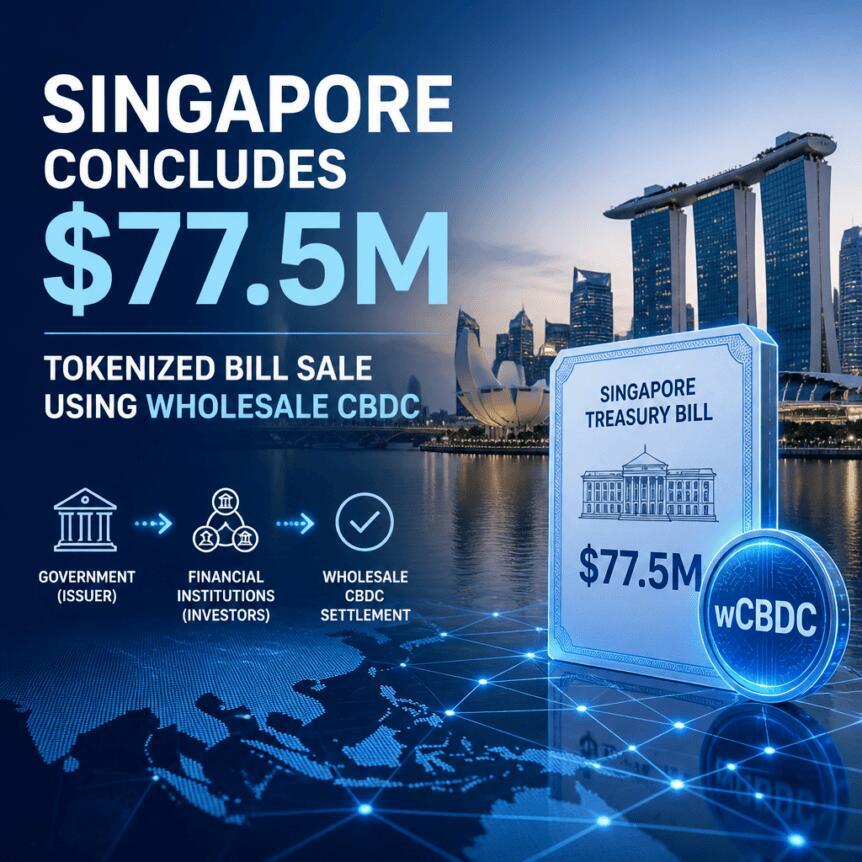
Singapore Concludes $77.5M Tokenized Bill Sale Using Wholesale CBDC


MAS reported that five banks placed bids totaling more than twice the amount offered. The newly issued tokenized bills have a four-week tenor and mature on Dec. 4.
Key takeaways- MAS issued S$100 million in tokenized bills using wholesale CBDC on the Singapore Dollar Test Network. Demand was strong: bids submitted by five banks exceeded 2x the issuance amount, according to MAS. The bills are designed to be useful collateral within MAS's network-based experiments. MAS plans to evolve the test network into a broader settlement platform for financial institutions, with additional issuances and expanding collateral use in 2027.
According to MAS, the central bank conducted the issuance directly on the Singapore Dollar Test Network, a blockchain-based environment intended to test how digital money and tokenized assets could function in real financial workflows.
The significance for market participants is practical: MAS said the tokenized bills provide borrowers with an asset they could pledge as collateral for loans executed on the same network. That collateral angle is important because it connects token issuance to downstream credit and liquidity use-rather than treating tokenization as a standalone experiment.
MAS also framed the CBDC settlement layer as a key requirement for moving high-value transactions with confidence. In remarks published by MAS ahead of and during the Singapore FinTech Festival, Managing Director Chia Der Jiun emphasized that trusted settlement on CBDC helps support settlement finality and confidence, particularly for large-value settlement.
From payment experiments to settlement infrastructureSingapore's work on blockchain-enabled finance is not new. MAS noted that the country began experimenting with blockchain-based bank payments in 2016. More recently, MAS said that in 2025 banks used the test network alongside MAS-issued digital currency to settle overnight loans.
The Nov. 6 tokenized bill issuance builds on those earlier payment and settlement trials by introducing tokenized government-related debt instruments into the same ecosystem. Instead of limiting testing to transfers, MAS is now pushing toward a fuller“money + collateral + settlement” structure-where the network can potentially handle both issuance and the financing use cases tied to that issuance.
MAS's next step is to broaden the network's role. Chia said the Singapore Dollar Test Network-where the bills were issued-will be developed into a settlement system for financial institutions, and that it will be renamed SG Digital Ledger.
What MAS expects to do nextLooking ahead, MAS indicated that additional tokenized bill issuance is planned for 2027. The central bank said it expects to bring more financial institutions into the trials and expand how the bills are used as collateral across network-based lending.
While MAS did not outline specific timelines beyond the 2027 expansion plan, the direction is clear: the central bank wants to move from isolated proofs of concept toward a repeatable settlement and collateral framework that could be tested at wider scale.
For traders, lenders, and compliance teams, the key“watch item” is how these experiments handle operational realities-such as onboarding more institutions, managing collateral workflows, and maintaining clear settlement finality when transactions involve larger values.
Why the collateral and settlement design matterTokenization efforts can fail to translate into real-world relevance when the tokens do not integrate with existing risk management, liquidity, and settlement requirements. MAS's approach appears designed to avoid that gap by linking token issuance to collateral usage and by using wholesale CBDC for settlement.
Chia's comments point to the core policy rationale: as tokenized assets and digital money grow, MAS believes trusted settlement on CBDC is needed to support settlement finality and confidence. That matters in lending markets because collateral frameworks depend on certainty of ownership and settlement completion.
At the same time, readers should treat this as an expansion of testing rather than a sign that tokenized bills are immediately replacing traditional issuance and settlement across the entire market. MAS is still building a network-based settlement system and planning incremental scaling through additional issuances and broader participation.
Next, the market will likely focus on whether MAS can onboard more institutions to SG Digital Ledger and expand collateral use beyond the initial setup. With tokenized bills already issued and structured for collateral, the remaining uncertainty is how smoothly the network can support larger participation and more complex lending flows as MAS moves toward its 2027 plans.
Risk & affiliate notice: Crypto assets are volatile and capital is at risk. This article may contain affiliate links.
Legal Disclaimer:
MENAFN provides the
information “as is” without warranty of any kind. We do not accept any
responsibility or liability for the accuracy, content, images, videos,
licenses, completeness, legality, or reliability of the information
contained in this article. If you have any complaints or copyright issues
related to this article, kindly contact the provider above.


Comments
No comment