


The Growth Gap: New Research from The Trade Desk Reveals Why Marketers May Be Sacrificing Long-Term Growth for Short-Term Efficiency


(MENAFN- In2 Consulting) November 19, 2026 - New neuroscience research from The Trade Desk, the world's largest independent advertising technology company, conducted in partnership with PA Consulting and Brainsights, reveals that balanced media strategies led to 47% uplift in persuasion, while outperforming social-heavy strategies by 1.6x. The findings come as part of a multipronged study, which explores the disconnect between how marketers measure media performance and what drives long-term business growth.
The research suggests marketers may be prioritising short-term efficiency metrics over long-term effectiveness. Many acknowledge a disconnect between measurement and growth, with channels that are easiest to measure often receiving disproportionate credit for business outcomes. The findings point to an increasing growth gap between media decisions and long-term brand performance.
Together, the findings suggest marketers achieve stronger outcomes when social forms part of a balanced media strategy spanning channels across the open internet. The research reinforces that growth is driven by balanced omnichannel strategies rather than over-reliance on any single channel or platform.
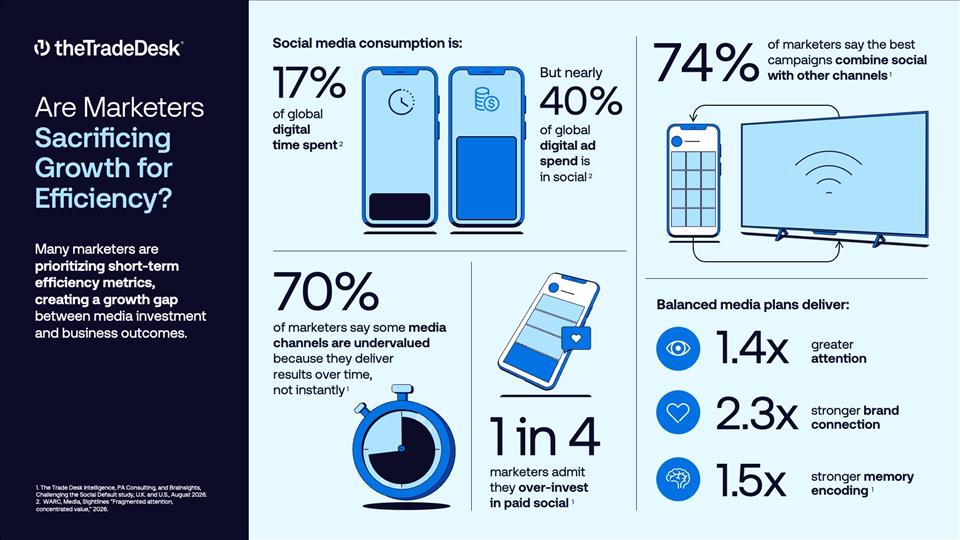
A survey of 400 marketers suggests many recognise the value of balanced media planning, yet face barriers to putting it into practice. Nearly three-quarters (74%) say they believe the most effective campaigns combine social media with other channels. Yet three-quarters (75%) also say they favour social channels because they are familiar, while 72% believe channels that are easier to measure receive disproportionate credit for business success. The findings suggest a disconnect between what marketers believe drives effectiveness and the factors shaping day-to-day investment decisions.
To understand the impact of media mix on advertising effectiveness, The Trade Desk partnered with PA Consulting and Brainsights to compare balanced media plans with social-heavy approaches. The research found that balanced media plans delivered:
•1.4x greater attention, helping brands capture more meaningful audience engagement
•2.3x stronger brand connection, demonstrating the potential for deeper consumer relationships
•1.5x stronger memory encoding, supporting stronger brand recall
•One in four marketers admit they over-invest in paid social despite recognising the value of a more balanced media mix
"Social media remains an important part of modern marketing, but no channel should exist in isolation." said Phil Duffield, VP of Northern Europe at The Trade Desk. "Our research suggests marketers achieve stronger outcomes when social forms part of a broader, balanced media strategy that reflects how consumers engage across streaming TV, audio, gaming and the wider open internet."
For marketers under increasing pressure to demonstrate return on investment, the research highlights the importance of looking at how media investment contributes to long-term brand effectiveness and empowers CMOs to argue about tangible impact.

Legal Disclaimer:
MENAFN provides the
information “as is” without warranty of any kind. We do not accept any
responsibility or liability for the accuracy, content, images, videos,
licenses, completeness, legality, or reliability of the information
contained in this article. If you have any complaints or copyright issues
related to this article, kindly contact the provider above.


Comments
No comment