


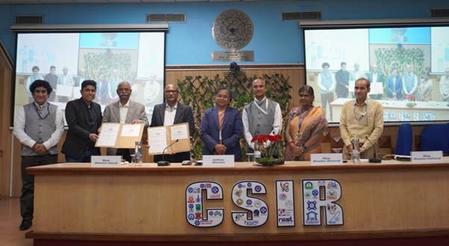
CSIR Transfers Indigenous Tech To Industry Partners To Promote Sustainable Road Construction


CSIR-Structural Engineering Research Centre (CSIR-SERC), Chennai showcased three important technologies addressing critical infrastructure requirements, sustainable construction and the circular economy.
The Emergency Retrieval System (ERS) for Power Lines, developed by CSIR-SERC, is an indigenous, lightweight and modular structural system designed for rapid restoration of electricity transmission lines following failures or disruptions. The technology was transferred to IFAB Global, further expanding its potential for industrial deployment.
CSIR-SERC also transferred its recycled aggregate-based eco-friendly bricks, hollow blocks and paver blocks technologies to the National Automotive Test Tracks (NATRAX).
These technologies utilise 100 per cent recycled aggregates and industrial waste to manufacture sustainable construction products, reducing dependence on natural aggregates and promoting large-scale utilisation of construction and demolition waste.
The event also featured technologies developed by CSIR-Central Road Research Institute (CSIR-CRRI), New Delhi; CSIR-Advanced Materials and Processes Research Institute (CSIR-AMPRI), Bhopal; and CSIR-Indian Institute of Petroleum (CSIR-IIP), Dehradun.
NATRAX received a technology for pilot-scale field implementation, namely, Ultra-High-Performance Concrete (UHPC) Pavement Technology. The technology offers high strength, durability, superior resistance to heavy axle loads and reduced maintenance requirements, making it suitable for developing longer-lasting road infrastructure.
Ravi Sekhar, Director, CSIR-CRRI, presented an overview of the technologies being transferred to industry, highlighting the collaborative research efforts of CSIR-CRRI with CSIR-AMPRI and CSIR-IIP in developing sustainable road construction materials and technologies.
The MicroReAct-RAP technology, a sustainable cold micro-surfacing solution incorporating up to 40 per cent reclaimed asphalt pavement (RAP), was transferred to three industry partners. The technology reduces the requirement for virgin aggregates and bitumen emulsion while promoting circular utilisation of road construction materials.
Another significant technology transferred was Bio-Bitumen, developed through collaborative research involving CSIR-CRRI and CSIR-IIP. The technology converts agricultural residues, including rice straw (parali), into a biomass-derived material capable of partially replacing conventional petroleum-based bitumen.
CSIR-CRRI also signed two Memoranda of Understanding to strengthen research, technical cooperation and industry engagement with the Global Automotive Research Centre (GARC), Tamil Nadu and Pārakhi Skill Systems Private Limited, Patna.
-IANS
aar/pk

Legal Disclaimer:
MENAFN provides the
information “as is” without warranty of any kind. We do not accept any
responsibility or liability for the accuracy, content, images, videos,
licenses, completeness, legality, or reliability of the information
contained in this article. If you have any complaints or copyright issues
related to this article, kindly contact the provider above.


Comments
No comment