


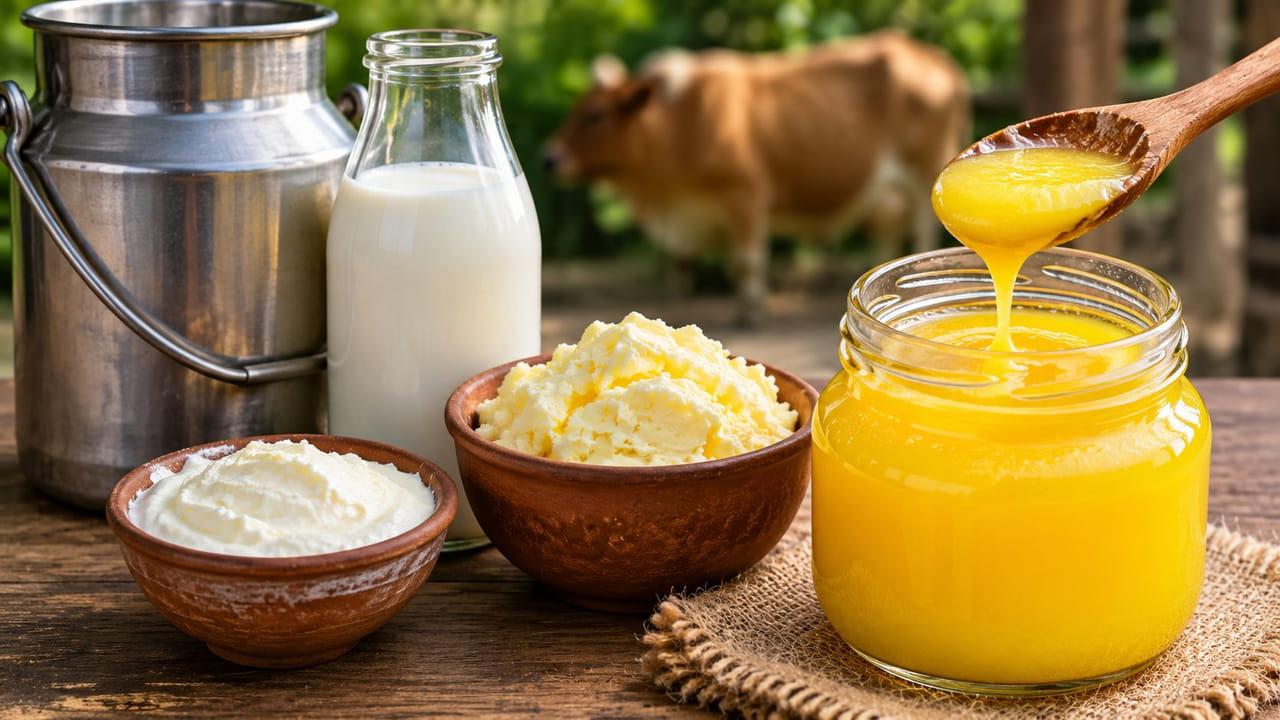
How Much Ghee Do You Get From One Litre Of Milk Cow Vs Buffalo Yield - Explained


Ever wondered how much pure ghee you can extract from 1 litre of cow or buffalo milk? We break down the exact math, fat percentages, the Bilona method, and exactly how many litres you need for 1 kg of ghee.
You never get one litre of ghee from one litre of milk. You usually get around 30 to 65 grams of pure ghee from a single litre of milk, which is just about 2 to 4.5 tablespoons. This yield fully depends on the type of milk, its fat percentage, and your ghee-making method.
. Cow milk: You get roughly 30 to 40 grams of ghee from one litre of cow milk containing 3.5% to 4.5% fat. Jersey or crossbred cow milk yields slightly more, around 40 to 45 grams.
. Buffalo milk: Buffalo milk packs more fat (5% to 8%). So, one litre of buffalo milk gives you a solid 45 to 65 grams of ghee.
. Packet milk: Full cream packet milk yields 50 to 60 grams of ghee, while toned milk gives you a mere 20 to 30 grams.
Milk mostly contains water, protein, lactose, and minerals. Only the milk fat turns into ghee. One litre of milk weighs about 1.03 kg. Assuming a 90 to 95 percent fat recovery rate, here is the estimated ghee yield per litre of milk:
. 3% fat: 27–29 grams
. 3.5% fat: 31–34 grams
. 4% fat: 35–38 grams
. 4.5% fat: 40–43 grams
. 5% fat: 44–48 grams
. 6% fat: 53–57 grams
. 7% fat: 62–66 grams
The total milk volume required to make one kilogram of pure ghee changes based on the milk's fat percentage.
. Cow milk (3.5–4% fat): Around 27 to 32 litres
. Cow milk (4.5% fat): Around 23 to 26 litres
. Buffalo milk (6% fat): Around 17 to 20 litres
. Buffalo milk (7% fat): Around 15 to 17 litres
. Toned milk (3% fat): Around 34 to 45 litres
People generally use two main methods to extract ghee.
. Cream or Malai method: You boil the milk, cool it down, refrigerate it, and collect the cream (malai) over a few days. You then heat this cream directly or turn it into butter before making ghee. This method gives a 90 to 95% fat recovery. You get 5 to 10% more ghee here compared to the Bilona method.
. Traditional Bilona method: You boil the milk, set it into curd, and churn the curd to extract butter. You then heat this butter to make ghee. Some fat stays back in the buttermilk, giving only an 80 to 85% recovery. However, Bilona ghee beats everything else in nutrition and aroma.
. Commercial dairy factories use centrifuge separation machines that extract almost 99% of the fat, ensuring a much higher ghee yield.
Cows and buffaloes eating green grass and oil cakes give milk with higher fat content. The cattle feed and weather conditions heavily influence the final ghee yield.
FSSAI standards state that pure ghee must have at least 99.5% milk fat and less than 0.5% moisture. To get more ghee at home, you should boil the milk on a low flame and refrigerate it for 6 to 8 hours to form a thick malai layer. Heat the butter on a low flame until it turns golden brown without burning it to get high-quality, maximum ghee.

Legal Disclaimer:
MENAFN provides the
information “as is” without warranty of any kind. We do not accept any
responsibility or liability for the accuracy, content, images, videos,
licenses, completeness, legality, or reliability of the information
contained in this article. If you have any complaints or copyright issues
related to this article, kindly contact the provider above.


Comments
No comment