


Trump's $23 Billion Battleship Faces Sinking Odds


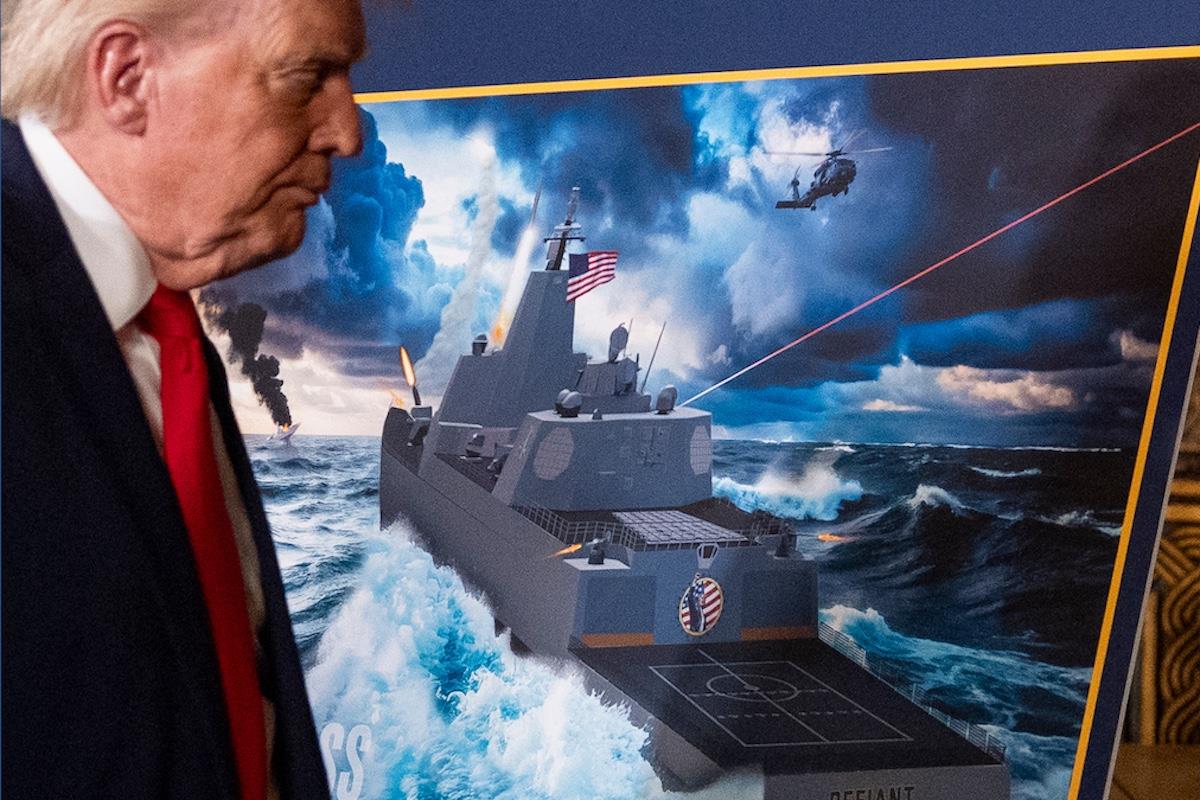
This month, multiple media outlets reported that the US Navy's proposed BBG(X) guided-missile battleship, a centerpiece of the Trump administration's Golden Fleet initiative, faces mounting Congressional opposition that threatens to derail the program.
US Senate appropriators unveiled a reconciliation-free US$1.1 trillion fiscal 2027 defense spending bill that strips nearly $1.84 billion from the roughly 34,000- to 35,000-ton warship, including its entire $1 billion advance procurement request - deemed“early to need” - and $836.9 million in research and development funding.
The move follows Democrats' sweeping midterm election victories earlier this month, which will hand control of both Congressional chambers and key defense committees to outspoken program critics next year. Announced in December 2025, the nuclear-powered BBG(X), beginning with the future USS Defiant, would be the largest US surface combatant built since World War II.
However, the program has drawn bipartisan scrutiny over industrial-base strain and US Congressional Budget Office (CBO) estimates projecting costs of up to $23 billion for the lead ship and $18 billion for subsequent vessels. Lawmakers seek to halt construction until key weapons-hypersonic missiles, railguns, and lasers-are proven mature, imperiling the multibillion-dollar effort.
The deteriorating condition of the US Navy's surface fleet helps explain the original push behind the BBG(X). A January 2026 US Congressional Research Service (CRS) report noted that aging Ticonderoga-class cruisers and Arleigh Burke-class destroyers face mounting obsolescence and severe design limits.
The report points out that the 22 remaining Ticonderoga-class cruisers, built between 1978 and 1988, are slated for complete retirement by fiscal 2027 after five earlier vessels proved too costly to modernize.
Latest stories Vietnam uses APEC sidelines as safety valve with China Thousands of Filipinos protest Trump Pax Silica mineral project A world so busy – overworked – can't run with nothing in reserveIt adds that after 40 years of production and three decades of upgrades, Arleigh Burke-class destroyers lack the space, weight, electrical power, cooling, and stability margins required for future directed-energy weapons, larger long-range missiles, and expanded sensors, prompting the US Navy to pursue replacements.
While the US surface fleet ages, China has rapidly modernized its naval forces. An April 2025 US CRS report mentions that China's People's Liberation Army Navy (PLAN) expanded its large surface combatant fleet from 19 cruisers and destroyers in 2000 to 60 by 2023, with US Navy projections reaching 80 by 2040.
The report says this expansion centers on 12,000- to 13,000-ton Type 055 Renhai-class cruisers, which feature vertical launch systems (VLS) for YJ-21 hypersonic anti-ship missiles, with the tenth hull launched in May 2024. It also cites 7,500-ton Type 052D Luyang III-class destroyers equipped with phased-array radars, noting that their 27th and 28th hulls were launched in 2023.
In view of that growing disparity, Mark Schneider mentions in a June 2026 National Institute for Public Policy (NIPP) report that the BBG(X) is designed to outmatch foreign adversaries, deter nuclear escalation, and serve as a central fleet command node.
According to Schneider, the nuclear-powered BBG(X) is three times the size of an Arleigh Burke-class destroyer, providing the hull volume, heavy armor, and deeper magazines required to survive mass drone and missile salvos while firing Conventional Prompt Strike (CPS) hypersonic weapons, railguns, and lasers.
Yet from the outset, naval strategists have questioned the operational logic of reviving a massive capital ship. In a February 2026 S. Rajaratnam School of International Studies (RSIS) report, Geoffrey Till says the BBG(X) design has severe tactical flaws that run counter to modern distributed maritime warfare.
Till argues that concentrating firepower on a massive, conspicuous hull creates an outdated single point of failure vulnerable to unmanned swarms and anti-ship missiles-a vulnerability underscored by World War II battleship sinkings and the sinking of Russia's cruiser Moskva.
He also points out that an equivalent tonnage of Flight III Arleigh Burke destroyers would deploy more than the BBG(X )'s 128 VLS cells, while its planned railgun and lasers demand extraordinary electrical power generation.
Beyond tactical doubts, industrial capacity remains a major hurdle for the US. In a September 2026 Asan Institute report, Peter Lee notes that severe US shipbuilding bottlenecks - marked by high labor costs, weak domestic supply chains, long-term industry consolidation, and chronic unprofitability - threaten to derail the project.
Lee points out that because US shipyards cannot meet required timelines alone, the US Navy has explored fabricating large, non-sensitive hull modules in allied overseas facilities.
However, he says that foreign shipbuilders remain reluctant to invest in US yards amid rising costs, order backlogs, and strict rules mandating all-American workforces and supply chains, while growing Congressional opposition to foreign outsourcing further clouds the lead ship's prospects.
On Capitol Hill, critics have also attacked the BBG(X) as political theater rather than sound naval strategy.
In August 2026, House Armed Services Committee Democrats Adam Smith and Joe Courtney called US President Donald Trump's proposed battleship program a“misguided, ego-driven mistake” and an“ill-conceived vanity project,” citing its lack of strategic justification or a buildable design. They said it began as a poster-board rendering at Mar-a-Lago in December 2025, then became virtually unbuildable as requirements ballooned.
If Congress ultimately cancels the BBG(X), the US Navy could redirect funding and shipyard capacity to a more achievable alternative.
Sign up for one of our free newsletters-
The Daily Report
Start your day right with Asia Times' top stories
AT Weekly Report
A weekly roundup of Asia Times' most-read stories
The January 2026 US CRS report says the US Navy's planned DDG(X) destroyer will displace about 14,500 tons - nearly 50% more than Arleigh Burke-class ships, but far less than the BBG(X). Its average estimated cost is $4.4 billion, versus the US Navy's $3.3 billion projection and $23 billion for the BBG(X)'s first unit.
It notes that the US Navy may intend to suspend work on the DDG(X) to prioritize the BBG(X); if the US cancels the latter, work on the destroyer could proceed earlier than planned.
Like the BBG(X), the report says the DDG(X) will begin replacing aging cruisers and destroyers in the early 2030s. It includes Flight III Aegis systems, integrated power, and capacity for directed-energy weapons. Its baseline armament is 96 VLS cells, adaptable for 12 large missile cells, plus two 21-cell Rolling Airframe Missile (RAM) launchers.
Regardless of which hull the US Navy prioritizes, it faces an accelerating numerical gap with China. The April 2025 US CRS report says the PLAN surpassed the US Navy in fleet size between 2015 and 2020, becoming the world's largest navy with over 370 battle force ships, alongside earlier projections of 395 vessels by 2025 and 435 by 2030.
In contrast, a separate January 2026 US CRS report mentions that the US Navy's fleet stood at 293 vessels as of October 2025 and is projected to remain near that level by 2030.
China's shipbuilding capacity is 232 times greater than the US's, enabling it to field modern multi-mission combatants, while construction delays and industrial-base constraints hamper US naval expansion. As a new Congress convenes in January 2027 and defense spending faces scrutiny, the Trump-class battleship will test whether the US favors political symbolism or industrial pragmatism in its naval race with China.
Sign up here to comment on Asia Times stories OrThank you for registering!
-
Share on X (Opens in new window)
Share on LinkedIn (Opens in new window)
LinkedI
Share on Facebook (Opens in new window)
Faceboo
Share on WhatsApp (Opens in new window)
WhatsAp
Share on Reddit (Opens in new window)
Reddi
Email a link to a friend (Opens in new window)
Emai
Print (Opens in new window)
Prin

Legal Disclaimer:
MENAFN provides the
information “as is” without warranty of any kind. We do not accept any
responsibility or liability for the accuracy, content, images, videos,
licenses, completeness, legality, or reliability of the information
contained in this article. If you have any complaints or copyright issues
related to this article, kindly contact the provider above.


Comments
No comment