


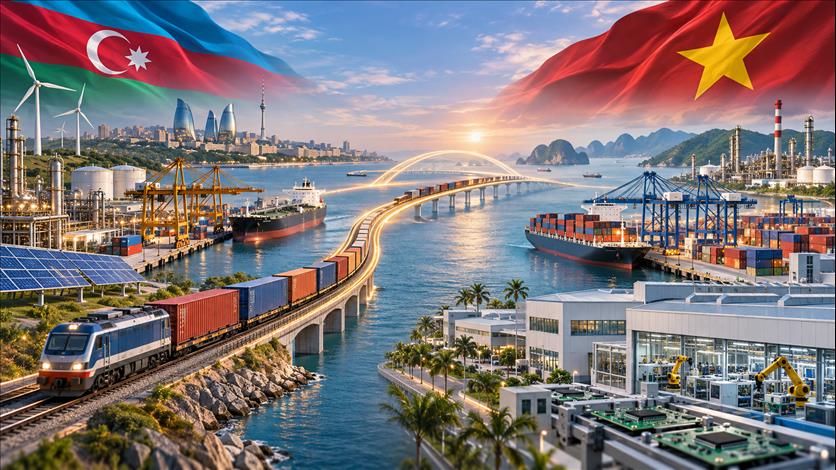
Azerbaijan, Vietnam Seek To Turn Strategic Ties Into $930 Billion Trade Opportunity


When Azerbaijan's President Ilham Aliyev last travelled to Vietnam, in May 2014, bilateral commerce was modest. Twelve years later, he is returning to a much larger economy. His November 19–21 visit will test whether an old friendship can become a commercial bridge between Southeast Asia and the Caspian. The time chosen for such a trip is quite symbolic, as the visit by the Vietnamese leader, Tô Lâm, back in May 2025 resulted in the strengthening of bilateral relations to the level of a strategic partnership.
Big ambitions, small numbers
Before undertaking the synthesis, it would be difficult to overlook this gap between potential and performance. Vietnam's economy grew by 8.02% in 2025 and merchandise trade by the country reached an impressive $930bn as reported by the national statistics service of Vietnam. Manufactured products constituted nearly 89% of exports. Vietnam is an active player in the world's supply chains.
By comparison, the volume of trade with Azerbaijan in 2025, as reported by the Vietnamese authorities, was only $150mn – less than 0.02% of total goods trade with Vietnam. The figure for the period January–September 2026 amounted to $60mn. The periods are different, but the scale of operations is modest. Status precedes economic might.
However, the energy link is much stronger than annual trade volumes. During the period from 2010 until January 2025, SOCAR Trading supplied 31.7mn barrels of Azerbaijani crude oil worth around $ 2.55 billion to the Dung Quat refinery in Vietnam, according to the company operating the refinery. Oil is not only the foundation of this relationship, but also a functioning business line. A memorandum signed in Baku in 2025 foresaw longer-term crude deliveries to Dung Quat. The challenge is to move from petroleum shipments to a broader relationship encompassing petrochemicals, technical services and investment. Selling oil is a transaction like the majority of Azerbaijan's relationship, but developing industrial capacity creates a more enduring partnership.
In that case, Azerbaijan has become a manufacturing and export hub by combining foreign investment, industrial policy and access to international markets. Baku, seeking to diversify beyond hydrocarbons, has reason to study both the results and the complications of that model, including Vietnam's heavy dependence on foreign-invested exporters.
There are early indications of collaboration in non-traditional energy resources. Azerbaijan officials have reported that Vietnam's ROX Group is exploring the possibility of solar energy projects in Nakhchivan and wind energy projects near Baku. There are seven Vietnamese investments operating in Azerbaijan, as per the energy ministry of Azerbaijan. This represents opportunities, not an investment wave; the proposed ventures would require financing, licenses and buyers.
Vietnamese businesses can export their processed foods and electronics products to Azerbaijan and other nearby markets. Businesses from Azerbaijan could leverage Vietnam as an access point to the much bigger market of Southeast Asia. However, good intentions cannot mitigate the challenges of distance, regulatory differences, and weak business relations.
The transport aspect also provides a larger opportunity - certainly for Baku. Azerbaijan seeks to make its ports and railways an integral part of the Middle Corridor, a logistical chain from Asia to Europe through Central Asia and the Caspian Sea. And Vietnam, with its access to the sea and manufacturing capabilities, would be another source of cargo for this supply chain.
There have been signs of that already. According to the country's ministry of energy, transshipments related to Vietnam via Azerbaijani territory increased more than twofold in 2025 and by almost sixfold in the first nine months of 2026. Certainly impressive numbers although officials provided no absolute tonnage data in that release. From a low base, growth is encouraging but does not necessarily mean that a well-established logistics chain is in place.
And the Middle Corridor is not a short-cut route per se. Its importance lies in its stable customs clearance procedures, regular cargo shipments across the Caspian and competitive cost of delivery. For experienced exporters who are used to established maritime channels, any other route should win their trust on logistics performance rather than purely geopolitical value.
A partnership that has to deliver
The issue of diplomacy goes beyond the immediate needs of either nation. Azerbaijan has been building its relations on a wider scale, and Vietnam has been cultivating partners consistently without relying exclusively on one partner for its economic prosperity. In both cases, the wider scope of business opportunities can help to maneuver in a fragmenting global economy.
Historical connections provide a pleasant base to start with; Hồ Chí Minh was in Azerbaijan in 1959, and Heydar Aliyev was in Vietnam in 1983. But historical fondness can never replace a good investment portfolio. Both nations need to establish a solid investment climate, business-to-business contacts, and transportation links.
So the real proof of the success of President Aliyev will not be the number of signed contracts in Hanoi, but whether, after a couple of years, businesses in Vietnam will consider Azerbaijan not only as an energy partner but also as a trading partner, and vice versa.
*the cover image has been generated by artificial intelligence

Legal Disclaimer:
MENAFN provides the
information “as is” without warranty of any kind. We do not accept any
responsibility or liability for the accuracy, content, images, videos,
licenses, completeness, legality, or reliability of the information
contained in this article. If you have any complaints or copyright issues
related to this article, kindly contact the provider above.


Comments
No comment