


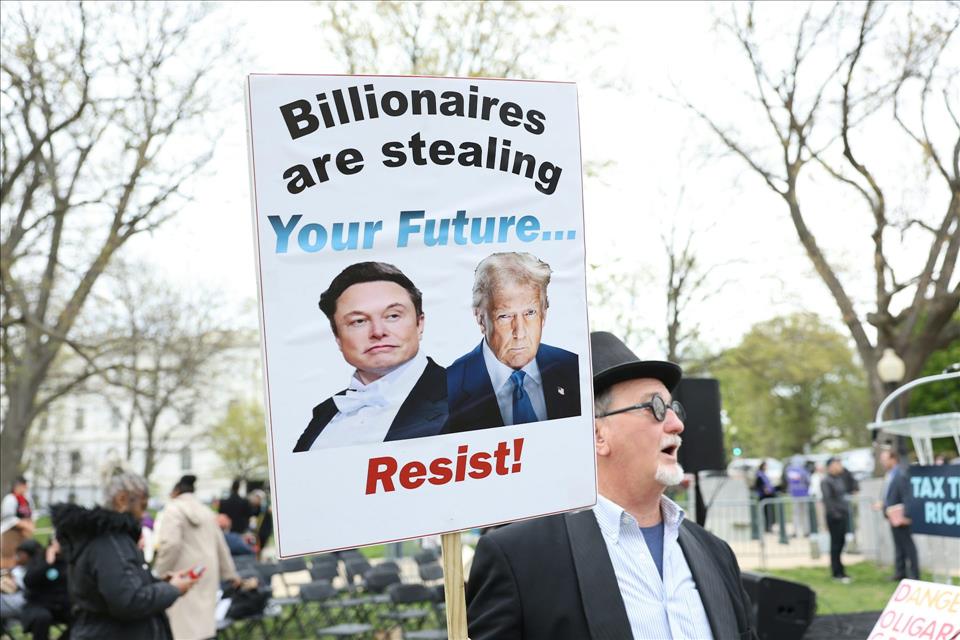
An Attempt To Tax US Billionaires Has Failed. It Says A Lot About Wealth And Power In America


Proposition 40, sponsored by a Californian trade union, would have levied a one-off 5% tax on the wealth of the state's billionaires.
Early opinion polling showed majority support for the proposition. However, the billionaires opposed to the tax waged a furious campaign to defeat it, spending a staggering US$378 million. In contrast, supporters of the measure raised only US$33.5 million.
The billionaires' spending was clearly effective. Not only was Proposition 40 defeated, but its opponents also successfully passed an additional ballot measure amending the state constitution to prohibit new taxes on wealth.
If the proposal was an attempt to rein in the extreme wealth of California's billionaires, it has ended up only proving their political power.
Money and political powerBeyond California, the midterms demonstrated the relationship between big money and political power is not always straightforward.
Elon Musk spent US$474 million supporting Republican candidates, to very little effect. In other states, measures increasing income taxes on the wealthy mostly succeeded. Money is always influential in elections, but it cannot simply buy votes.
The crucial difference in California though was that the ballot proposal targeted wealth, rather than income.
Billionaires have a myriad of options to shield their wealth from income taxes. A wealth tax is much harder to avoid.
So a wealth tax is a more radical challenge to the concentration of wealth and power in the United States. Unsurprisingly, it attracted a much more coordinated response.
Billionaires were able to effectively veto this measure, even in a“blue wave” election. That suggests the United States is in the grips of what political economists have described as a“Medici vicious circle” or“Medici cycle”.
The Medici cycleThe Medici family was a political dynasty that dominated politics in Renaissance Florence from the 15th to early 18th century.
Their power originally derived from the family's Medici bank, which at its height was the largest in Europe. However, their interests quickly grew beyond just banking. Using their economic wealth, they acquired political power in Florence, which in turn was used to protect and extend the family's economic power.
This cycle – using economic power to acquire political power, which in turn generates more economic power, and so on – has been called a“Medici cycle”.
In previous work, I have observed this cycle in the Australian mining sector. The largest mining corporations in Australia used their economic wealth to rewrite tax policies in the sector. The result was even further concentrations of corporate wealth and power.
The Medici cycle in the United StatesThe extreme concentration of wealth shaping the exercise of political power is clearly on display in the United States.
A 2010 Supreme Court decision, which found laws restricting political spending by corporations was unconstitutional, opened the door for the flood of corporate money reshaping US politics.
From banking and pharmaceutical regulation to tax policy and the regulation of big tech, corporate interests have systematically reshaped the rules of the game in their favour.
In spending so much money to back only one party, Elon Musk is something of an exception. Typically, corporate donations flow freely to both major parties. This ensures that whichever party is in charge, the wealthiest always have a seat at the table.
For instance, in the aftermath of the midterms, key figures in big tech are already scrambling to ingratiate themselves with Democratic politicians and voters.
Alexander Karp, the billionaire co-founder and CEO of Palantir, donated US$1 million to a pro-Trump political fundraising committee in December 2024. Palantir later donated another US$10 million to Trump's ballroom project. Palantir has profited significantly under Trump, securing contracts from the Pentagon and Department of Homeland Security potentially worth billions.
Days after the midterms, however, Karp claimed,“I've been a Democrat my whole life”. He added:“I know more about being a progressive than almost anybody on the planet.”
With some Democrats now signalling plans to restrict and regulate big tech, especially around artificial intelligence and data centres, the political and financial outreach from big tech to Democrats is likely to intensify.
The future of billionaire powerThe ability of billionaires to play both sides of politics was also important in the defeat of the billionaires' tax.
California's Democratic Governor Gavin Newsom opposed the tax, along with other moderate Democrat politicians.
Newsom claimed the tax would drive billionaires from the state, thus reducing overall revenue. His opponents claimed he was also worried passage of the tax might crimp future corporate donations to his party.
Taxing the wealthy has become a key division between so-called“moderate” and“progressive” Democrats. If the leverage of billionaire funding can continue to convince ambitious politicians like Newsom that taxing wealth is too risky, the Medici cycle will remain in full force.
Though Musk's erratic behaviour might generate headlines, a Medici cycle runs much deeper than a single billionaire. It shapes the priorities of both major parties and decides which topics – like the billionaires' tax – are too politically toxic to risk touching.
To recover from the democratic decline widely observed in the last decade, the United States will need to find a way to break out of the dangerous Medici cycle which is currently suffocating its politics.


Legal Disclaimer:
MENAFN provides the
information “as is” without warranty of any kind. We do not accept any
responsibility or liability for the accuracy, content, images, videos,
licenses, completeness, legality, or reliability of the information
contained in this article. If you have any complaints or copyright issues
related to this article, kindly contact the provider above.


Comments
No comment