


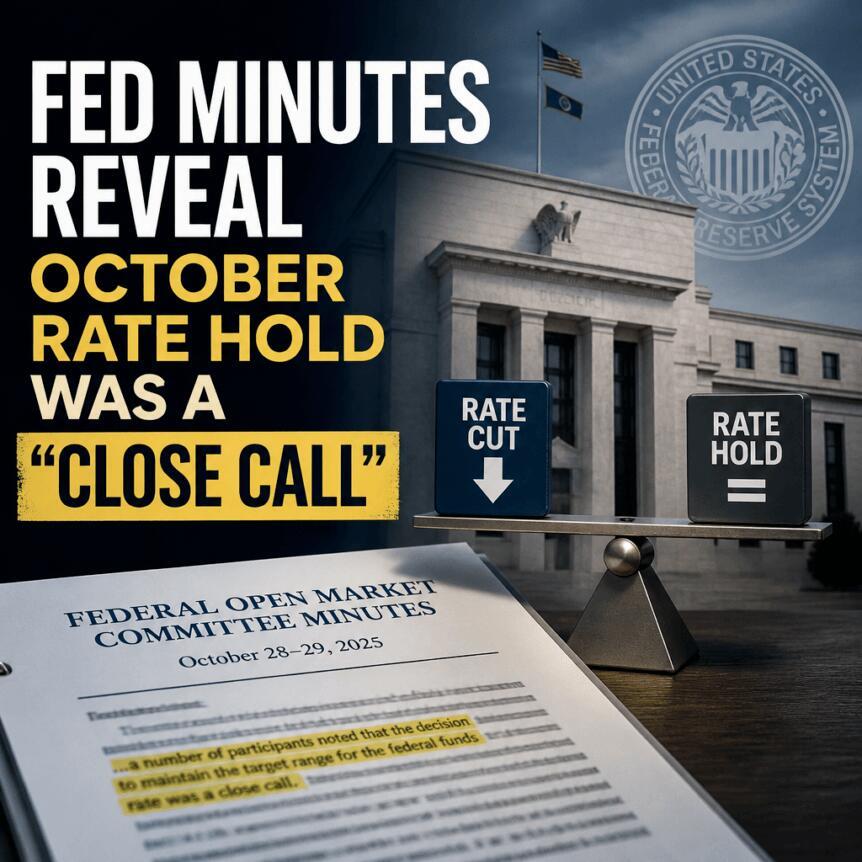
Fed Minutes Reveal October Rate Hold Was A“Close Call”


At the time, the Federal Open Market Committee voted 10–2 to hold the federal funds rate at 3.75% to 4%. The minutes indicate that sentiment was not uniform: Fed Governor Lisa Cook and Cleveland Fed President Beth Hammack favored a quarter-point increase, and the internal discussion behind the final vote suggests a broader willingness among some participants to consider tightening-especially after economic data strengthened.
Key takeaways- Fed minutes characterize the October hold decision as a“close call,” implying a stronger tilt toward hiking than the 10–2 vote alone suggested. Markets are focused on whether the next move in December is a quarter-point or half-point rate increase; CME FedWatch shows roughly 90% odds for a quarter-point hike. Fed officials discussed inflation pressures tied to AI-related investment, including strained equipment supply that can lift consumer tech prices. Participants also raised concerns that AI-related financing may be growing quickly through opaque structures and concentrating risk among fewer firms.
The October meeting kept the benchmark rate in the 3.75% to 4% range, but the minutes released Wednesday suggest the debate was more balanced than the final vote might indicate.
According to the minutes, a subset of participants who favored maintaining the status quo still considered the decision finely poised. Analyst Lewis Huang of crypto exchange Bitget told Cointelegraph that the record implies“broader support for an October hike than the 10–2 vote alone implied,” adding that the assessment came before later inflation and labor data arrived-specifically noting that“payrolls and CPI both came in hot.”
This matters for markets because it reframes how investors should interpret the Fed's reaction function: even when the committee ultimately chooses to pause, internal confidence may be limited if incoming data suggests inflation persistence.
December hike now the central focusWith investors largely expecting the Fed to act again in December, attention is shifting from whether rates will rise to how much the next increase will be and what that implies for the path beyond it.
CoinShares data on expectations was not cited in the provided excerpt; however, CME FedWatch was referenced to describe market probabilities at the time of writing. The odds were reported at about 90% for a December quarter-point hike and about 10% for a half-point increase.
Huang said that because a December hike was“already fully priced in,” traders should look primarily at the magnitude of the move and the broader policy guidance afterward. In practical terms, that distinction can affect duration-sensitive assets-including cryptocurrencies-because it influences how quickly markets expect real yields to adjust and how long liquidity conditions may tighten.
After the minutes were released, Bitcoin was reported trading around $62,300. Huang noted that if Treasury yields and the U.S. dollar continue to rise, it could add pressure on Bitcoin, which was already below its 200-week moving average near $68,000.
He added that a break below the weekend low near $62,000 could potentially extend selling pressure, highlighting how crypto positioning often reacts not only to rate direction but to the expected strength of the next macro move.
AI-linked inflation and hidden financial risk on the Fed's radarBeyond rates, the minutes also documented a set of concerns tied to artificial intelligence investment-an issue that may sound niche, but became a mainstream macro talking point as AI spending has expanded across the economy.
Fed officials discussed the inflationary effect of AI-related capital expenditure. The minutes state that many participants pointed to demand for equipment associated with AI buildouts that is straining supply and pushing up consumer technology prices. Importantly, some warned the pressures were not confined to data centers or directly related industries.
Officials also considered what could happen if AI-driven investment disappoints. The minutes say most participants observed that AI-related debt had grown rapidly, and that much of this growth occurred through complex and opaque financing structures. A few participants remarked that exposures were becoming increasingly concentrated among a small number of firms.
This combination-rising costs feeding inflation, alongside financial structures that may be difficult to price transparently-could influence how the Fed weighs the trade-offs between tightening to curb inflation and avoiding financial instability.
Fabian Dori, chief investment officer at Sygnum Bank, said markets were already pricing in a series of hikes into next year. In his view, that could keep long-term yields and the dollar firm, while the key question for Bitcoin becomes whether concerns about currency debasement and continuing institutional adoption can offset macro-driven headwinds.
What to watch next for crypto traders and long-term investorsAs December approaches, the most market-relevant uncertainty is likely to be the Fed's tone on the size of the hike and the forward path implied by the minutes' discussion-especially around inflation sources and financial stability risks. For crypto participants, closely monitoring shifts in Treasury yields and the dollar may be as important as any headline rate probability.
Risk & affiliate notice: Crypto assets are volatile and capital is at risk. This article may contain affiliate links.
Legal Disclaimer:
MENAFN provides the
information “as is” without warranty of any kind. We do not accept any
responsibility or liability for the accuracy, content, images, videos,
licenses, completeness, legality, or reliability of the information
contained in this article. If you have any complaints or copyright issues
related to this article, kindly contact the provider above.


Comments
No comment