


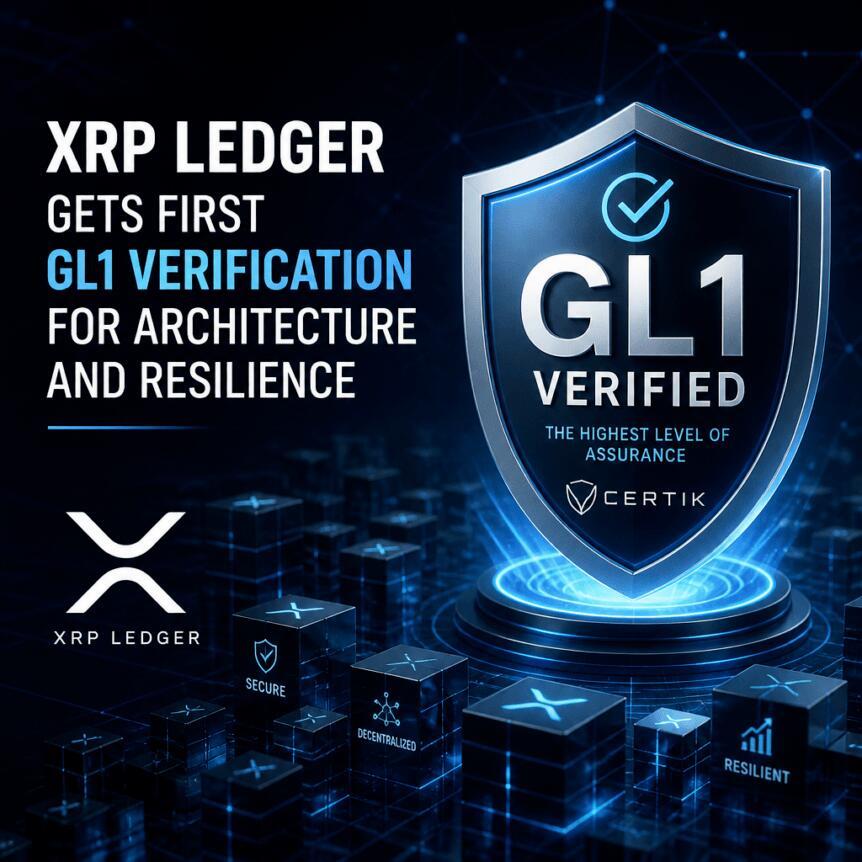
Xrp Ledger Gets First Gl1 Verification For Architecture And Resilience


The XRP Ledger Foundation assessed the network against ten GL1 principles and documented the controls behind its findings. CertiK reviewed the foundation's evidence for architecture and resiliency, including safeguards that support the network's operation. The foundation also identified equivalent safeguards on the public ledger for controls that GL1 designed with private networks in mind.
The Market Infrastructure Toolkit lists XRP Ledger alongside Solana, Base, Kinexys and other networks across public and institutional finance. Its criteria cover governance, settlement finality and links between financial systems, as well as operational resilience and network architecture. The toolkit draws on existing financial market infrastructure principles and risk management frameworks familiar to financial institutions.
Assessors mark each control as observed, partly observed, not observed, or not applicable, using the evidence. Network operators can submit their own findings, and independent auditors can examine selected controls within the same assessment framework. GL1 states that completion of the assessment does not establish compliance with its standards for financial market infrastructure.
XRPL Developers Patch Transaction And Payment FlawsXRPL developers disclosed two security vulnerabilities in October, and the issues involved transaction validity and payment calculations. Version 3.4.1 addressed the transaction validity issue, and version 3.4.2 included a fix for the payment calculation flaw. The release notes provide a public record of the software updates for network operators.
Separately, developers proposed a security amendment to limit unauthorized token activity involving delegated permissions on the XRP Ledger. Validators backed the amendment ahead of activation, and independent tracking recorded its rollout on November 4. XRPL documentation also lists software reviews, bug bounties, and signed software releases among the network's security practices.
XRPSCAN reported 2.91 million confirmed transactions and 47,483 active accounts on the XRP Ledger at the time of reporting. The explorer also recorded 1,021,376 successful payments in its activity figures for the ledger. The explorer reported an average interval between payments of 3.91 seconds.
Gl1 Banks Develop Standards For Tokenized FinanceFive financial institutions established the Global Layer One Organisation as a nonprofit in Singapore earlier in November. HSBC, JPMorgan's Kinexys, MUFG, Societe Generale-FORGE and Standard Chartered founded the group to develop common standards for tokenized markets. The Monetary Authority of Singapore coordinated the initiative, and the nonprofit carries forward work on shared infrastructure frameworks.
BNY Mellon offers custody for XRP and Ripple 's RLUSD stablecoin as part of the expanded partnership. The two companies are also exploring tokenized trade finance, a use case for the ledger.
On November 16, Metrika released a prototype dashboard for GL1 risk indicators covering four aspects of network operations. The dashboard tracks network availability and settlement finality, and it also shows validator concentration. It also displays transaction costs alongside other measures of network performance and operating risk.
Risk & affiliate notice: Crypto assets are volatile and capital is at risk. This article may contain affiliate links.
Legal Disclaimer:
MENAFN provides the
information “as is” without warranty of any kind. We do not accept any
responsibility or liability for the accuracy, content, images, videos,
licenses, completeness, legality, or reliability of the information
contained in this article. If you have any complaints or copyright issues
related to this article, kindly contact the provider above.


Comments
No comment