


US, India, Japan, Australia To Hold First Joint Maritime Exercise In 2027


The Quadrilateral Security Dialogue, or Quad, is an informal strategic forum involving the US, Japan, Australia and India, mainly aimed at countering China's influence in the Asia-Pacific region.
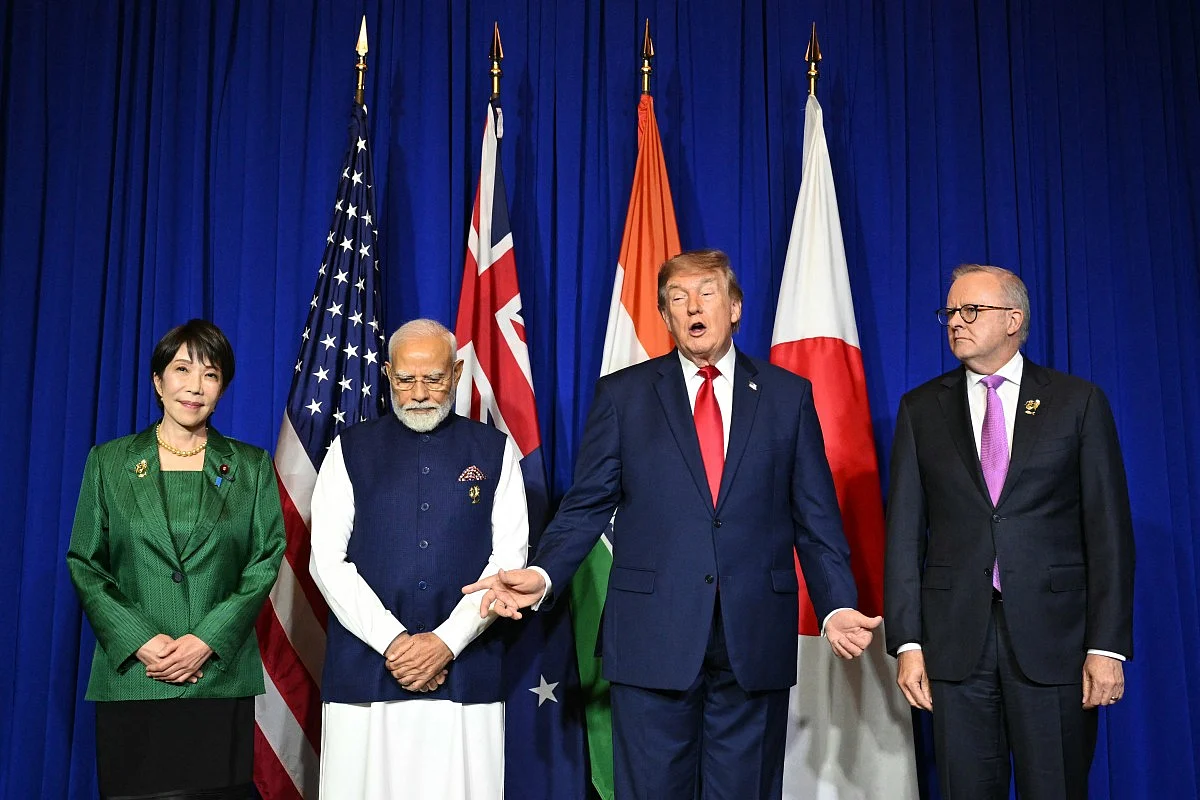
Recommended For YouUS President Donald Trump, Indian Prime Minister Narendra Modi, Japanese Prime Minister Sanae Takaichi and Australian Prime Minister Anthony Albanese attended the Quad Summit in Manila, the Philippines, on Tuesday, on the sidelines of the 49th ASEAN Summit.
Stay up to date with the latest news. Follow KT on WhatsApp Channels.
In a joint statement, the leaders announced the Indo-Pacific Maritime Surveillance Collaboration, an initiative to make seas safer.
“Indo-Pacific Maritime Surveillance Collaboration, a new initiative to enhance information sharing and maritime domain awareness,” the press statement read.
“In 2027, our respective P-8 and P-3C patrol aircraft are scheduled to fly in a maritime exercise for the first time in a Quad context, making our seas safer.” The aircraft are used for maritime reconnaissance, surveillance and anti-submarine warfare.
The planned exercise is expected to strengthen the ability of the four countries to share information and monitor maritime activity across the region, the leaders said.
Safeguarding global maritime tradeThe four-nation grouping does not constitute a specific security arrangement for the Arabian Gulf. However, the disruption of shipping routes in West Asia has underlined the importance of international cooperation, information sharing and freedom of navigation in safeguarding global maritime trade.
The war involving the US, Israel and Iran has heightened concerns over the safety of commercial shipping, seafarers and critical maritime corridors, particularly in the Arabian Gulf and the Strait of Hormuz - a key route for global energy supplies, with around a fifth of the world's oil consumption passing through it.
According to the International Maritime Organization, more than 130 attacks had been reported on internationally trading commercial vessels in and around the Strait of Hormuz, with at least 25 seafarers killed as of November 11.
The UK Maritime Trade Operations (UKMTO) has separately recorded 163 conflict-related maritime incidents, including 141 reports of damage to vessels, across the Strait of Hormuz, Arabian Gulf and Gulf of Oman.
India has also borne a significant human cost, with 78 vessels carrying Indian seafarers reported to have come under attack, including four Indian-flagged ships, according to the government **in October**.
India is the world's second-largest supplier of seafarers, with more than 310,000 sailors working in global shipping fleets. **However,** nearly a dozen sailors have been killed in such attacks, and at least 139 Indian sailors were still stranded in the Strait of Hormuz as of October 8, according to Shipping Secretary Vijay Kumar.
One Indian sailor went missing while 21 others were evacuated after their Panama-flagged LPG tanker, MT TARA GAS, was attacked in the Strait of Hormuz on Tuesday. Two injured sailors, also Indians, were admitted to hospital.
The Quad leaders reaffirmed their commitment to ensuring open, safe and resilient maritime transit corridors across the Indo-Pacific.
This year marks nearly a decade since the Quad was revived and the 10th anniversary of the vision of a Free and Open Indo-Pacific, first articulated by former Japanese Prime Minister Shinzo Abe in 2016.
ALSO READ- India's Modi launches seafarers' safety initiative amid attacks on ships in Hormuz Six Arab countries step up diplomatic contacts as Gulf tensions rise Why is Iran targeting Bahrain and Kuwait, what is happening in the Strait of Hormuz?

Legal Disclaimer:
MENAFN provides the
information “as is” without warranty of any kind. We do not accept any
responsibility or liability for the accuracy, content, images, videos,
licenses, completeness, legality, or reliability of the information
contained in this article. If you have any complaints or copyright issues
related to this article, kindly contact the provider above.


Comments
No comment