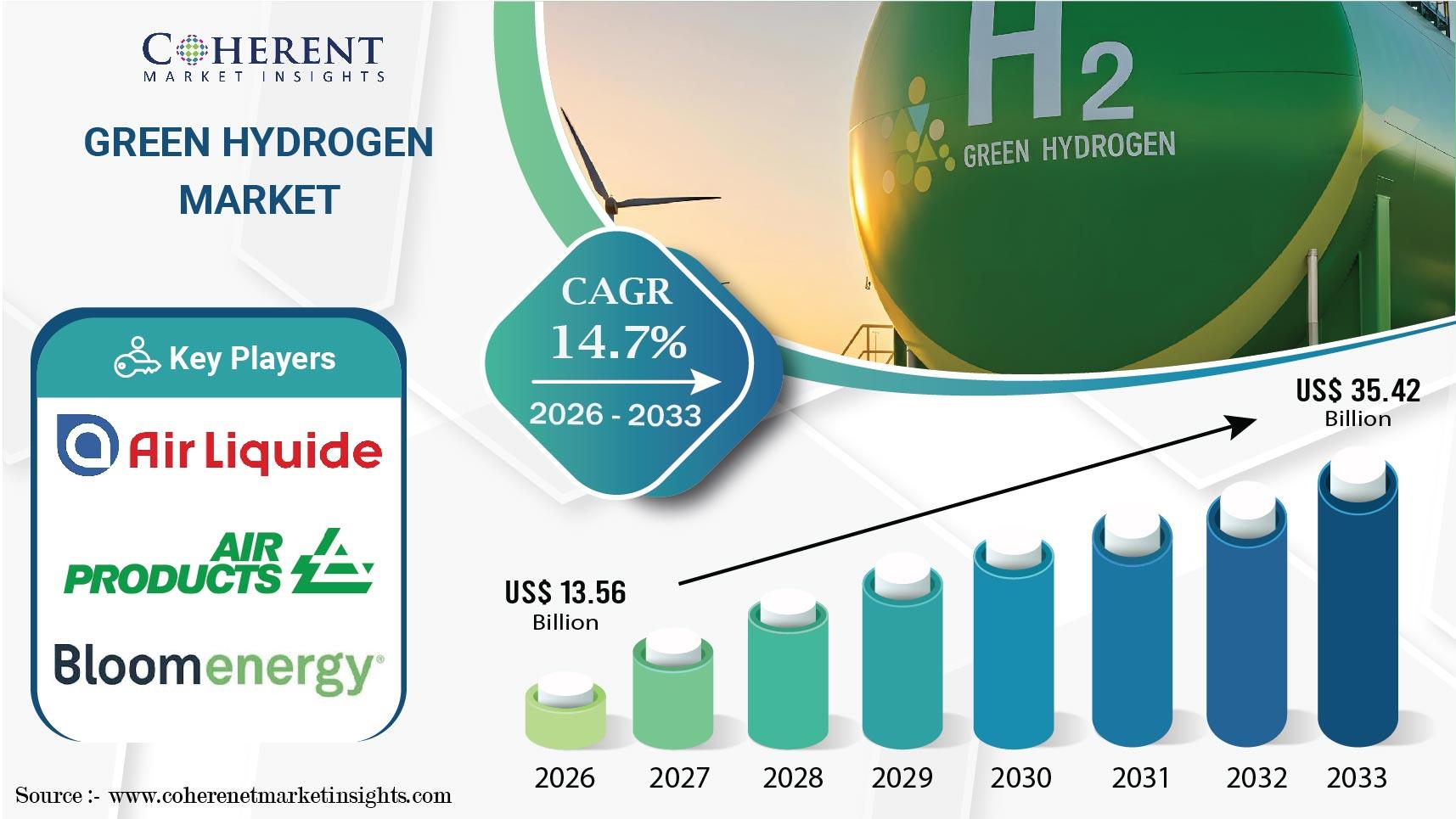
(MENAFN- GlobeNewsWire - Nasdaq) Burlingame, CA, Nov. 18, 2026 (GLOBE NEWSWIRE) -- According to Coherent Market Insights, the Global Green Hydrogen Market is estimated to be valued at USD 13.56 billion in 2026 and is projected to reach USD 35.42 billion by 2033, registering a compound annual growth rate (CAGR) of 14.7% during 2026–2033. Market growth is primarily driven by increasing investments in renewable energy infrastructure, rising demand for clean and sustainable fuel alternatives, and growing government initiatives aimed at reducing carbon emissions and achieving net-zero targets. Additionally, advancements in electrolyzer technologies, declining renewable electricity costs, expanding hydrogen production capacities, and increasing adoption of green hydrogen across industries such as transportation, chemicals, steel manufacturing, and power generation are supporting the expansion of the global green hydrogen market. Request Sample Report:
Global Green Hydrogen Market Key Takeaways
Based on type, proton exchange membrane (PEM) electrolyzers are expected to account for the largest revenue share of 38.1% in 2026, thanks to their increasing use in green hydrogen production due to their ability to respond to changes in renewable power supply.
By distribution channel, solar energy segment is expected to hold 31.8% of the global green hydrogen market share in 2026, supported by rising solar power capacity and its use in electrolyzer operations.
Asia Pacific is expected to dominate the global market with a 41.3% share in 2026, owing to increasing investments in renewable energy, growing government support as well as rising industrial demand for green hydrogen.
Europe, with a 15.3% share in 2026, is anticipated to be emerge as fastest-growing regional market during the forecast period, supported by investments in hydrogen production and infrastructure.
Increasing Demand for Clean and Sustainable Energy Driving Market Growth
Coherent Market Insights' latest green hydrogen market analysis outlines major factors spurring industry growth. These include growing demand for sustainable energy and efforts to reduce carbon emissions. Government initiatives and investments in hydrogen technologies are also encouraging companies to develop green hydrogen production facilities and related infrastructure.
There is a gradual transition towards green and sustainable energy sources throughout the world amid growing environmental concerns and enforcement of stringent environmental regulations. This, in turn, is putting green hydrogen into the limelight and fueling its demand across various industries.
Green hydrogen is produced by splitting water through electrolysis using renewable electricity, mainly from solar and wind power. It can help reduce emissions in industries that are difficult to electrify directly, including refining, chemicals as well as steel production. These industries already use hydrogen in several processes, creating an opportunity to replace conventional hydrogen produced from fossil fuels.
Government support is also helping projects move forward. Under India's National Green Hydrogen Mission, the government has awarded 862,000 metric tonnes per annum of green hydrogen production capacity to 18 companies. It has also awarded 3,000 MW per annum of electrolyzer manufacturing capacity to 15 companies. These allocations are expected to support domestic green hydrogen production and equipment manufacturing during the forthcoming period.
As more industries look for ways to reduce the carbon footprint of their operations, demand for renewable hydrogen is expected to increase during the forecast period.
High Production Costs and Limited Hydrogen Infrastructure Hampering Market Growth
The global green hydrogen market outlook remains positive due to rising demand for clean hydrogen in industrial applications and growing efforts to reduce carbon emissions. However, high production costs and limited hydrogen infrastructure may slow down market growth to some extent.
Green hydrogen production through electrolysis is still more expensive than conventional hydrogen production using natural gas, mostly due to high cost of renewable electricity as well as electrolyzer systems. This makes green hydrogen less competitive for industries seeking affordable fuel and feedstock alternatives.
Infrastructure gaps add to the challenge. Green hydrogen requires dedicated facilities for storage, transportation, and distribution, including pipelines and refueling stations. However, many countries still lack the necessary infrastructure to support large-scale production and delivery. This can hamper market growth to some extent during the forecast period.
Immediate Delivery Available | Buy This Premium Research Report:
Technological Advancements in Electrolyzers Creating Lucrative Growth Opportunities
Improvements in electrolyzer technology are creating opportunities for green hydrogen producers and equipment manufacturers. Companies are working on systems that can produce hydrogen more efficiently, operate with renewable power, and support larger production capacities. PEM, alkaline as well as solid oxide electrolyzers remain important technologies in this area.
For instance, in July 2026, thyssenkrupp nucera and Bharat Heavy Electricals Limited (BHEL) signed a strategic collaboration agreement to localize alkaline water electrolyzer module fabrication in India. The companies plan to combine their technology, manufacturing, and project execution capabilities to participate in green hydrogen projects. Such partnerships can help develop local supply chains as well as support expansion of electrolyzer manufacturing.
In addition, further improvements in electrolyzer performance, manufacturing capacity, and renewable power integration could help lower production costs over time. This is expected to create opportunities for companies involved in hydrogen equipment and project development.
Emerging Green Hydrogen Market Trends
Growing use of PEM electrolyzers is a key growth-shaping market trend. PEM technology is gaining attention because it can adjust to changes in electricity supply and work with intermittent solar and wind power. This makes it useful for projects that depend on renewable energy. An example of such a project is the 30 MW Barrow Green Hydrogen project developed by Plug Power in the UK. The final investment decision on this project was made in May 2026. Plug Power will provide six 5 MW PEM electrolyzers for the project. The project is expected to produce around 100 GWh of green hydrogen per year for the manufacturing plant of Kimberly-Clark. This development highlights the use of PEM systems in industrial hydrogen production.
Rising demand for clean hydrogen in industrial applications is fostering market growth. Industries such as steel, chemicals, fertilizers, and oil refining are increasingly exploring green hydrogen to reduce their dependence on fossil fuels. These sectors traditionally rely on hydrogen produced from natural gas or coal, making the shift toward renewable hydrogen an important part of industrial decarbonization. Green hydrogen can replace conventional hydrogen in ammonia production and refining and can also support lower-emission steelmaking. Growing efforts to reduce industrial carbon emissions are therefore creating new opportunities for green hydrogen producers. For example, in July 2026, Orica reached a final investment decision on its 50 MW Hunter Valley Hydrogen Hub in Australia. The facility is expected to produce around 4,700 tonnes of renewable hydrogen annually, gradually replacing natural gas in ammonia production
Increasing use of solar energy is supporting expansion of green hydrogen market. Solar energy is now emerging as one of the key sources of power that will help generate green hydrogen, especially in locations where there is abundant solar potential. In September 2026, Maruti Suzuki commissioned a 300 kW green hydrogen electrolyzer pilot plant for green hydrogen electrolysis at its Manesar unit in India. The plant produces hydrogen using excess solar energy generated at the facility and uses the same as fuel after blending it with natural gas.
Rising demand from industrial users is boosting growth of green hydrogen market. Refineries and other industrial facilities are exploring green hydrogen to reduce emissions from their operations. The refining industry is an important potential user because hydrogen is required for processes such as hydrocracking and desulfurization. The Spanish oil and gas company Repsol announced in January 2026 that it will install another 100 MW electrolyzer plant at its Petronor refinery in Spain. The plant would have the capacity to produce around 15,000 tons of renewable hydrogen annually, which will primarily be used in the refinery.
Expansion of local electrolyzer manufacturing is likely to fuel green hydrogen market value during the forecast period. Countries are also focusing on domestic manufacturing to reduce dependence on imported equipment and support new hydrogen projects. In July 2026, thyssenkrupp nucera and BHEL agreed to work together on the phased localization of alkaline electrolyzer module fabrication in India. The partnership is aimed at developing local manufacturing capabilities and supporting participation in upcoming projects. Such collaborations could strengthen the supply chain as green hydrogen production capacity expands.
Analyst's View
“The global green hydrogen market is gaining attention as industries look for cleaner sources of hydrogen and governments increase support for renewable energy. Projects in refining, chemicals, and manufacturing are creating demand for electrolyzers and related infrastructure. However, production costs and the availability of storage and transportation facilities will remain important factors influencing market development,” said a senior analyst at CMI.
Current Events and Their Impact on the Green Hydrogen Market
Air Products Inc.
Cummins Inc.
Linde plc.
CONTACT: Mr. Shah
Coherent Market Insights
533 Airport Boulevard,
Suite 400, Burlingame,
CA 94010, United States
US: + 12524771362
UK: +442039578553
AUS: +61-8-7924-7805
India: +91-848-285-0837
Email:...






Comments
No comment