


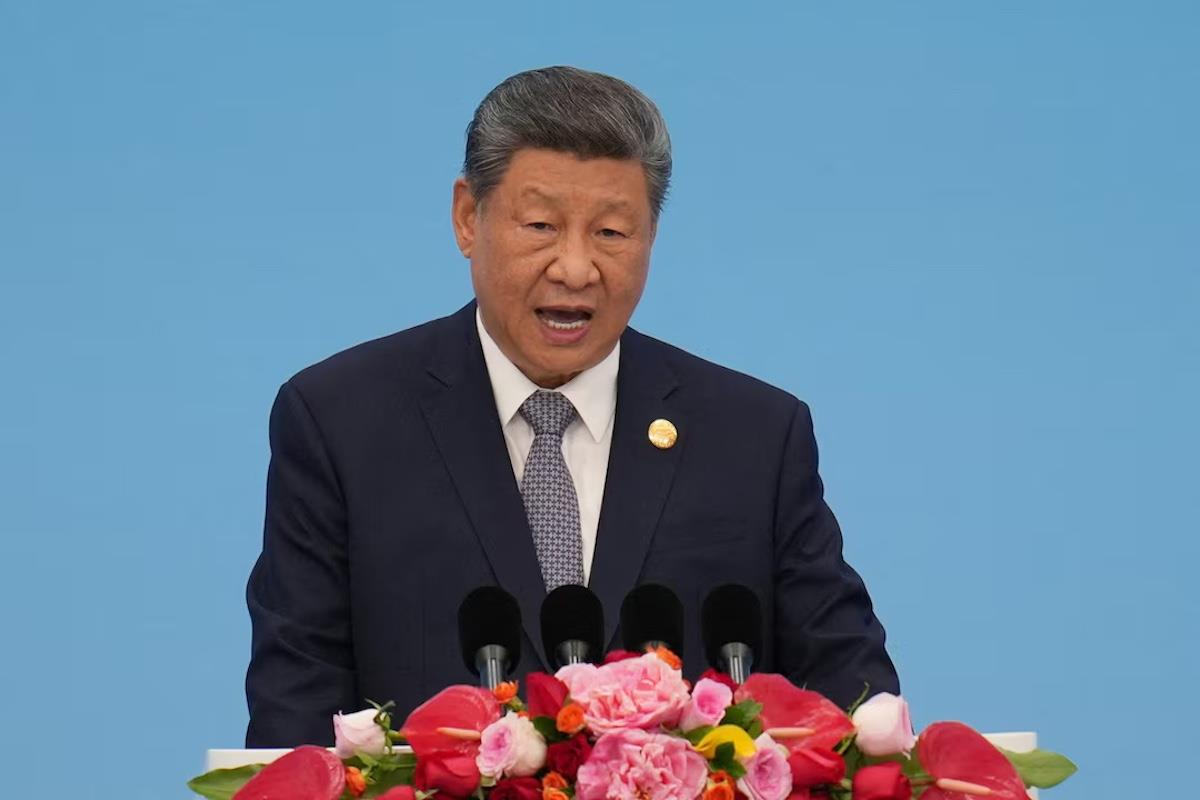
Xi's APEC Speech Casts China As Asia's Open Door As US Closes


Without naming the United States, Xi warned delegates that“unilateralism and protectionism are rampant” and invoked a classic Beijing formulation of historical inevitability:“To open doors or close doors, work together or against each other... History tells us that opening doors brings progress, while closing doors leaves one behind.”
Xi's lexicon, which frames globalization as an irreversible historical tide, serves a dual purpose, casting US export controls as structurally doomed without requiring Beijing to issue direct, escalatory threats ahead of Thursday's talks.
Behind the classical phrasing lay a highly specific strategic posture designed for the 24-hour window preceding Thursday's diplomatic and regulatory collision.
On Thursday, the US Commerce Department's Bureau of Industry and Security (BIS) interim final rule restricting remote cloud access to advanced American AI chips is scheduled for formal publication in the Federal Register. It will trigger a 90-day licensing window for existing arrangements, just hours before Xi is slated to meet Trump and join an unprecedented trilateral session alongside Russian President Vladimir Putin.
Rather than offering concessions to head off US chip curbs, Xi used his address and pre-summit meetings with regional leaders to pitch an alternative path.
Upstream chokepoints vs downstream scaleThe most revealing passages of Xi's speech centered on artificial intelligence and industrial upgrading.
Latest stories Trump needs a win in Shenzhen, and Xi knows it Mired in wars, US and Russia test new global power tactics Deutsche Bank leak reveals nearly $600M in Epstein paymentsWhereas Washington used Manila to pair its new BIS remote-compute restrictions and semiconductor licensing mandates with an exclusive Quad artificial intelligence accelerator, Xi sought to shift the entire technological contest from upstream silicon bottlenecks to downstream commercial scale.
Noting that“unicorn companies and large AI models have emerged in large numbers” across the region, Xi argued that technology's real value lies in empowering“hundreds of trades and industries.”
Pointing specifically to“factory and farm robots” alongside“autonomous driving and drone delivery,” Xi pitched China as a“supersized innovation testing ground where frontier technologies are tested, improved, and upgraded in real-world scenarios.”
The message to visiting executives and Southeast Asian delegations was unmistakable. While Washington's Pax Silica initiative and Thursday's BIS cloud rules aim to ring-fence upstream American compute clusters, Beijing is betting that applied industrial AI, running on mature nodes, open-weight models and Shenzhen's integrated hardware supply chains,will determine real-world productivity gains across the developing world.
Answering Trump's asymmetric trade haulXi's macroeconomic pitch was equally tailored to exploit the friction left in the wake of Trump's Manila layover. Just 24 hours earlier, Thai Prime Minister Anutin Charnvirakul had been pressed into signing a joint statement outlining a non-reciprocal framework to eliminate tariffs on US exports and purchase US$2.6 billion of American goods, a move still pending domestic legal sign-off in Bangkok.
Addressing those pressures indirectly in Shenzhen, Xi argued that because Asia-Pacific economies differ in their development stages,“taking a uniform approach will not advance cooperation.”
Tapping into Beijing's broader Global South narrative, he urged members to keep global industrial and supply chains 'stable and unimpeded' and pledged technological cooperation specifically“geared for developing economies”, a notable contrast to Washington's bilateral tariff leverage and extraterritorial compliance audits.
Xi promised that as China kicks off its 15th Five-Year Plan, backed by 4.6 percent GDP growth across the first three quarters of the year, Beijing will“not only cut tariffs and expand market access, but also go a step further.”
Using Beijing's signature formulation for“institutional opening-up,” he pledged deeper alignment in“challenging areas such as rules, regulations and standards in order to allow full manufacturing access,” alongside“digital transformation of trade, cross-border e-commerce, and smart customs.” Rather than merely offering tariff relief, Xi is signaling a long-term bid to embed Chinese technical standards into the region's regulatory DNA.
By emphasizing the harmonization of technical standards and smart customs just days before the upgraded China–ASEAN Free Trade Area (CAFTA) 3.0 protocol takes effect on December 1, Beijing is moving to lock in regional supply-chain plumbing before Washington's transshipment rules and 90-day cloud licensing clock can wall it off.
The Greater Bay Area bufferTo ground this vision geographically, Xi used the Shenzhen stage to elevate the Guangdong–Hong Kong–Macao Greater Bay Area (GBA) as a direct counterweight to Silicon Valley as a template of open regional integration.
Sign up for one of our free newsletters-
The Daily Report
Start your day right with Asia Times' top stories
AT Weekly Report
A weekly roundup of Asia Times' most-read stories
Highlighting the bay areas as“open and interconnected economies with positive spillover effects,” Xi announced that China supports establishing a new“World Association for Bay Areas Economic Cooperation” to link bay-area economies globally.
Coming just days after Washington locked in signatures for its San Francisco Declaration under Pax Silica, the initiative avoids confronting the US tech alliance head-on, instead offering an inclusive state-backed convening platform which contrasts subtly with Washington's security-vetted supply chain club.
Setting the floor before Thursday's talksPerhaps most telling for Thursday's bilateral showdown with Trump, alongside Treasury Secretary Scott Bessent and Commerce Secretary Howard Lutnick, was what Xi chose not to say.
By omitting any defensive reference to US chip restrictions and instead reminding delegates that China has anchored global 'stability and predictability' in the 25 years since its 2001 World Trade Organization accession, Xi projected classic Beijing“strategic composure.”
When Air Force One touches down in Shenzhen late Wednesday, the American delegation will encounter a host deliberately avoiding transactional urgency, signaling that Beijing views time, market scale, and institutional patience as its primary leverage.
Albert Cleisthenes Wong is an independent writer and analyst covering geopolitics, technology policy, and digital infrastructure.
Sign up here to comment on Asia Times stories OrThank you for registering!
-
Share on X (Opens in new window)
Share on LinkedIn (Opens in new window)
LinkedI
Share on Facebook (Opens in new window)
Faceboo
Share on WhatsApp (Opens in new window)
WhatsAp
Share on Reddit (Opens in new window)
Reddi
Email a link to a friend (Opens in new window)
Emai
Print (Opens in new window)
Prin

Legal Disclaimer:
MENAFN provides the
information “as is” without warranty of any kind. We do not accept any
responsibility or liability for the accuracy, content, images, videos,
licenses, completeness, legality, or reliability of the information
contained in this article. If you have any complaints or copyright issues
related to this article, kindly contact the provider above.


Comments
No comment