


Construction Robotics: An Industry On The Verge Of Revolution?


| Company and technology | Construction application |
|---|---|
| Monumental – robotic bricklayer | Mobile robotic systems for laying bricks in building walls |
| FBR – Hadrian X | Truck-mounted robotic system for automated block wall construction |
| Construction Robotics – SAM100 | Semi-automated bricklaying system designed to work alongside masons |
| Brokk – demolition robots | Remote-controlled machines for demolition, breaking and concrete removal |
| Husqvarna – DXR series | Compact remotely operated demolition robots |
| Hilti – Jaibot | Robotic drilling for overhead mechanical and electrical installations |
| Dusty Robotics – FieldPrinter | Autonomous floor layout and marking from digital construction plans |
| Canvas – drywall finishing robot | Robotic drywall finishing, including sanding and application processes |
| Advanced Construction Robotics – TyBOT | Automated tying of reinforcing steel on bridge decks |
| Advanced Construction Robotics – IronBOT | Robotic lifting and placement of reinforcing steel |
| Kewazo – LIFTBOT | Robotic material transport on scaffolding and construction sites |
| Built Robotics – autonomous equipment | Automation technology for heavy construction machinery and specialized site work |
| COBOD – BOD2 | Large-scale robotic 3D printing of concrete building structures |
| Boston Dynamics – Spot | Mobile inspection, surveying and progress monitoring |
| Flo Mobility – autonomous transport vehicles | Self-driving vehicles for moving construction materials around sites |
These examples cover a mixture of autonomous, semi-autonomous and remotely operated machines. Not all are capable of performing their assigned tasks without human supervision.
Nevertheless, they demonstrate that construction robotics is no longer confined to laboratory research.
Many of the technologies have already been tested on real projects, and some are being used commercially.
The question is why they have not yet become commonplace.
Why has construction automation taken so long?Most readers of Robotics & Automation News will already be familiar with at least some of these machines.
Robotic bricklayers, autonomous excavators and construction material transporters have been under development for years.
Some have demonstrated impressive capabilities.
Australia's FBR, for example, has developed the Hadrian X robotic blocklaying system, designed to construct building walls at speeds that would be difficult to achieve using conventional manual methods.
But building walls is not the same as completing a house.
Foundations, roofing, electrical systems, plumbing, insulation, windows, doors and finishing work still require other trades and processes.
Even so, the technology suggests that some of the most labor-intensive elements of construction could eventually be automated.
Why, then, are robots not already working on thousands of construction sites?
One explanation might be the cost of acquiring and operating the equipment.
Another is that construction sites are inherently unpredictable.
Unlike a factory, where machinery operates in a relatively controlled environment, building sites change constantly.
Materials arrive at different times, workers move equipment around, weather conditions vary, and unexpected problems require immediate decisions.
A robot that works perfectly in a demonstration may struggle when confronted with uneven ground, restricted access, changing site layouts or incomplete information.
There are also questions about responsibility.
If a robot damages a partially completed building, delays a project or creates a safety hazard, who is accountable?
The equipment manufacturer? The contractor? The project manager?
And who trains the workers who will be expected to operate alongside the machines?
These are not necessarily insurmountable problems, but they help explain why construction companies have been cautious.
There is also the matter of established habits.
Project managers are generally judged on whether projects are completed safely, on time and within budget.
Few will want to be responsible for introducing an unfamiliar machine that might cause more problems than it solves.
The familiar approach can therefore appear less risky, even when new technology promises substantial long-term benefits.
One might suspect that organised labour has resisted construction robotics because of concerns about job losses.
But there was little indication at Groundworks of any coordinated attempt to prevent automation.
On the contrary, the discussions suggested that labor shortages are becoming one of the strongest arguments in favor of adopting robots.
The more immediate obstacle appears to be finding practical, commercially viable ways to integrate them into everyday construction operations.
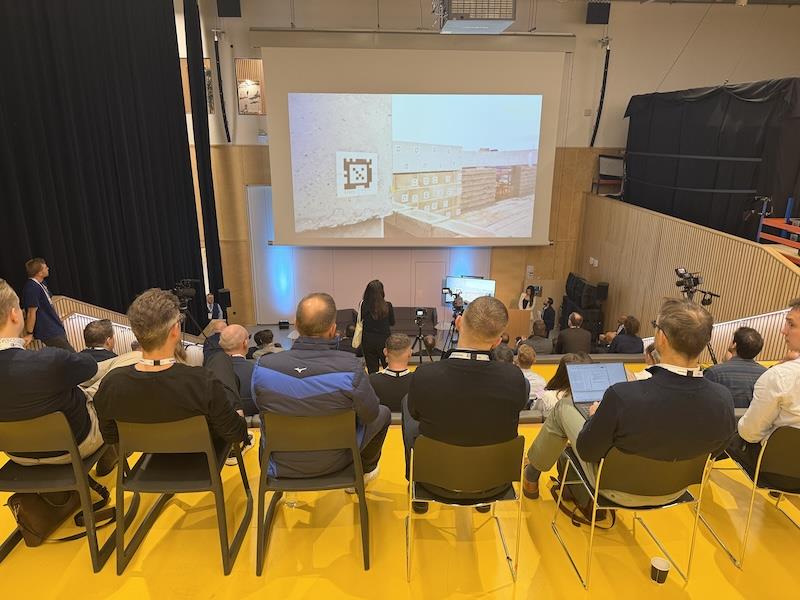
A robot that can lay 800 bricks a dayAmong the speakers at Groundworks was Salar Al Khafaji, founder and CEO of Dutch construction robotics company Monumental.
The company has developed a mobile robotic bricklaying system designed to work on construction sites rather than in a controlled factory environment.
Its machines combine robotic manipulation, mobility and software to position bricks according to digital building plans.
“The Monumental bricklayer robot can place 800 bricks a day,” said Al Khafaji during a panel discussion.
“The average human bricklayer can place around half of that number per day.”
The comparison is significant, although actual output will depend on the building design, site conditions, materials and supporting workforce.
Monumental's approach is also interesting because it does not depend on developing a humanoid robot. Al Khafaji said he considered humanoid robots“overhyped, especially for this sector – construction”.
It is an understandable position. A humanoid robot might eventually be capable of walking around a building site, picking up bricks and placing them much as a human bricklayer would. But reproducing the human body is not necessarily the most efficient way to automate a particular task.
A purpose-built robotic system can be designed around the materials, movements and working conditions involved.
For construction companies, the shape of the robot may matter considerably less than whether it can complete the work reliably and economically.
Who pays for the robot?The commercial challenge was a recurring theme throughout Groundworks.
One panel, titled“Who Pays for the Robot? The Commercial Case for Automation in UK Construction”, brought together Al Khafaji, Mark Reynolds, executive chairman of Mace Group and co-chair of the Construction Leadership Council, and Fergus Harradence from the UK Department for Business and Trade.
The question goes to the heart of construction robotics adoption.
A technology company may be able to demonstrate that its robot works.
But that does not automatically mean a contractor will buy it.
Construction projects involve multiple businesses, including developers, main contractors, subcontractors, specialist trades and equipment suppliers.
Each operates under different commercial pressures and contractual obligations.
A robot might generate savings across an entire project while requiring one subcontractor to bear most of the initial investment.
That imbalance can discourage adoption.
The Groundworks discussions identified several ways to address the problem.
One is to consider automation during the design and planning stages rather than introducing it after construction has already begun.
Another is to give equipment manufacturers and specialist contractors greater confidence that there will be continuing demand for robotic services.
A third is to develop evidence from completed projects, allowing contractors to evaluate actual productivity improvements rather than relying on demonstrations or manufacturers' projections.
Repeat use is particularly important.
A robot that requires extensive preparation and training for a single project may be difficult to justify financially.
The same machine, used across multiple projects by an experienced team, could offer a much stronger business case.
These considerations suggest that the transition to robotic construction may depend as much on contracts, procurement and project management as on technological breakthroughs.
A question of timingThere is an irony in the current situation.
The construction industry urgently needs productivity improvements, yet some of the companies that could benefit most from automation are operating under considerable financial pressure.
Investment in unfamiliar technology can be difficult to justify when projects are being postponed and margins are already tight.
But waiting until construction activity recovers may not be the best strategy either.
By then, contractors may face renewed pressure to recruit workers, accelerate projects and meet demanding schedules.
There may be little time to experiment with new equipment.
This makes the present period potentially important for construction robotics developers.
They have an opportunity to demonstrate that their machines can work under real site conditions, establish partnerships with contractors and develop operating models that make commercial sense.
For construction companies, the opportunity is to learn how these technologies can fit into existing operations before labor shortages and project pressures become even more acute.
The wider economic implications are considerable.
Construction is fundamental to housing, transport, energy, manufacturing and almost every other part of the built environment.
Improvements in productivity could help reduce costs, shorten project schedules and make developments financially viable that might otherwise be postponed.
Automation alone will not solve housing shortages, planning delays, financing difficulties or the many other problems affecting construction.
But it could become an increasingly important part of the solution.
An inevitable transition?There is no guarantee that construction will follow the same path as automotive manufacturing, where robots have become an essential part of production.
Building sites are more varied, less predictable and often more difficult to automate.
But the direction of technological development is becoming clearer.
Robots are already capable of laying bricks, drilling holes, transporting materials, inspecting structures, printing concrete components and performing demolition work.
The remaining challenge is to make these technologies sufficiently reliable, affordable and straightforward to use that contractors regard them as ordinary construction equipment rather than experimental machines.
Groundworks founder Owen Drury said the response to the inaugural event had exceeded expectations.
“Groundworks has given people a platform to come together, have conversations about the challenges, share ideas and work out how we can get more robotics technology onto construction sites.”
The event's emphasis on practical adoption, rather than distant technological possibilities, reflected an industry increasingly interested in what robots can accomplish today.
Construction may never be as automated as a modern automotive factory.
But given its persistent labor shortages, limited productivity growth and enormous importance to the wider economy, the pressure to modernise is unlikely to disappear.
Perhaps the greatest obstacle is not whether the robots can do the work.
It is whether construction companies are prepared to change the way they work to accommodate them.
And if the industry is waiting for the perfect moment to begin, the current slowdown might be as good an opportunity as any.
Perhaps construction's long-awaited robotics revolution is closer than we think.

Legal Disclaimer:
MENAFN provides the
information “as is” without warranty of any kind. We do not accept any
responsibility or liability for the accuracy, content, images, videos,
licenses, completeness, legality, or reliability of the information
contained in this article. If you have any complaints or copyright issues
related to this article, kindly contact the provider above.


Comments
No comment