


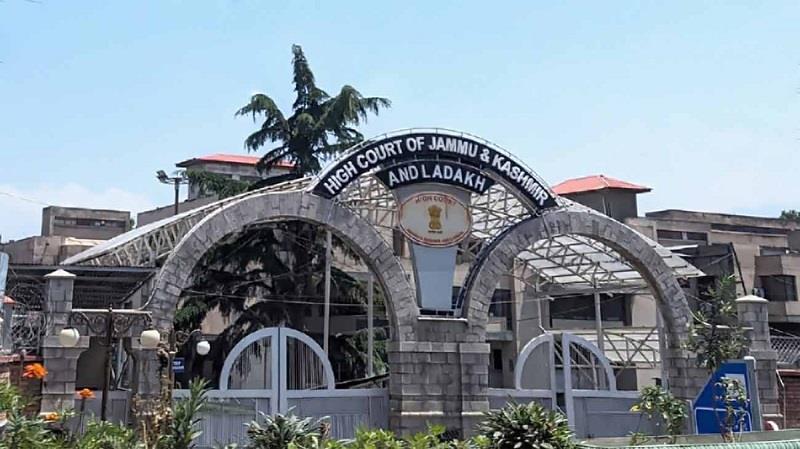
Crime Branch Can Probe Graft Cases: J&K HC - Kashmir Observer


A bench of Justice Sanjay Parihar observed that Section 3 of the Act expressly recognises the competence of police officers of the prescribed rank, including those belonging to the regular Police and Crime Branch, to investigate corruption offences, subject to compliance with statutory requirements.
The Court passed the judgment while partly allowing a petition filed by two doctors, Dr. Gulzar Ahmad and Dr. Abdul Lateef Salik, who had challenged the jurisdiction of Crime Branch Kashmir to investigate allegations that they had facilitated the issuance of a false age certificate to help a man secure regularisation and permanent employment in the Public Health Engineering Department.
Rejecting their contention that corruption cases could be investigated exclusively by the Vigilance Organization, now known as the ACB, the Court held that Section 3 of the Prevention of Corruption Act does not impose such a restriction.
It clarified that a police officer not below the rank of Deputy Superintendent of Police (DySP) is competent to investigate offences under the Act without prior permission of a Magistrate. An officer below that rank may investigate only after obtaining the requisite order from a Magistrate of the First Class, while officers of the Vigilance Organization can exercise such powers subject to the specific authorisation prescribed under the Act.
The Court further observed that SRO 202 dated June 3, 1999, empowered the Crime Branch to investigate specified categories of offences and matters, including those concerning the conduct of public servants.
ADVERTISEMENTIt held that an administrative circular regulating the distribution of investigative work between different agencies cannot override statutory powers or curtail jurisdiction conferred under law.
The case originated from allegations that the principal accused, G H Bhat, had procured and used a false age certificate to secure regularisation and permanent employment in the PHE Department.
According to the prosecution, the Medical Board, comprising the two petitioners and the then Chief Medical Officer, Dr. Abdul Samad Sheikh, had assessed Bhat's age as 32 years on December 16, 1999, placing his approximate year of birth in 1967.
Read Also J&K HC Rejects Govt Appeal Over Post-Article 370 Detentions HC Bars J&K Bank From Attaching Retirement BenefitsHowever, verification of the service and school records of his son, M S Bhat, revealed his date of birth as February 25, 1966. The investigating agency alleged that the assessment would make the father younger than his biological son, raising serious questions about the genuineness of the certificate.
The prosecution alleged that the doctors had abused their official position and acted in concert with the beneficiary to facilitate his regularisation and enable him to draw salary and other service benefits from the State exchequer.
Examining the forgery allegations, the Court observed that the certificate had admittedly been issued by the authorised members of the Medical Board and there was no allegation that the signatures or seals were forged, that the doctors had impersonated another authority, or that the document had been altered without lawful authority.
Relying upon the Supreme Court judgment, the Court held that merely making a document containing an incorrect statement does not necessarily amount to making a false document within the meaning of Section 464 RPC.
“The falsity of a statement contained in a document is not, by itself, sufficient to constitute forgery,” the Court observed.
It held that the offences under Sections 467, 468 and 471 RPC were not prima facie attracted against the doctors duo as the foundational requirement of making a false document was not established.
However, the Court distinguished the forgery allegations from those relating to cheating, criminal conspiracy and corruption, observing that the alleged deliberate manipulation of the age assessment to secure pecuniary benefits could attract other penal provisions.
It held that the allegations of deliberate misrepresentation, alleged concert between the doctors and the beneficiary, and the consequent conferment of financial benefits from the State exchequer provided sufficient prima facie grounds for proceedings under Sections 420 and 120-B RPC, read with Section 5(2) of the Prevention of Corruption Act.
On the scope of its inherent powers under Section 482 CrPC, the Court observed that such jurisdiction cannot be used as a substitute for trial or to undertake a meticulous appreciation of disputed evidence at the stage of quashing criminal proceedings.
Accordingly, the Court rejected the challenge to the Crime Branch's jurisdiction, quashed the FIR and consequential proceedings against the doctors under Sections 467, 468 and 471 RPC, but allowed proceedings under Sections 420 and 120-B RPC, read with Section 5(2) of the Prevention of Corruption Act, to continue.
The investigating agency has been permitted to complete any remaining investigation and present the final report before the competent court, subject to compliance with statutory requirements, including sanction for prosecution wherever applicable.

Legal Disclaimer:
MENAFN provides the
information “as is” without warranty of any kind. We do not accept any
responsibility or liability for the accuracy, content, images, videos,
licenses, completeness, legality, or reliability of the information
contained in this article. If you have any complaints or copyright issues
related to this article, kindly contact the provider above.


Comments
No comment