


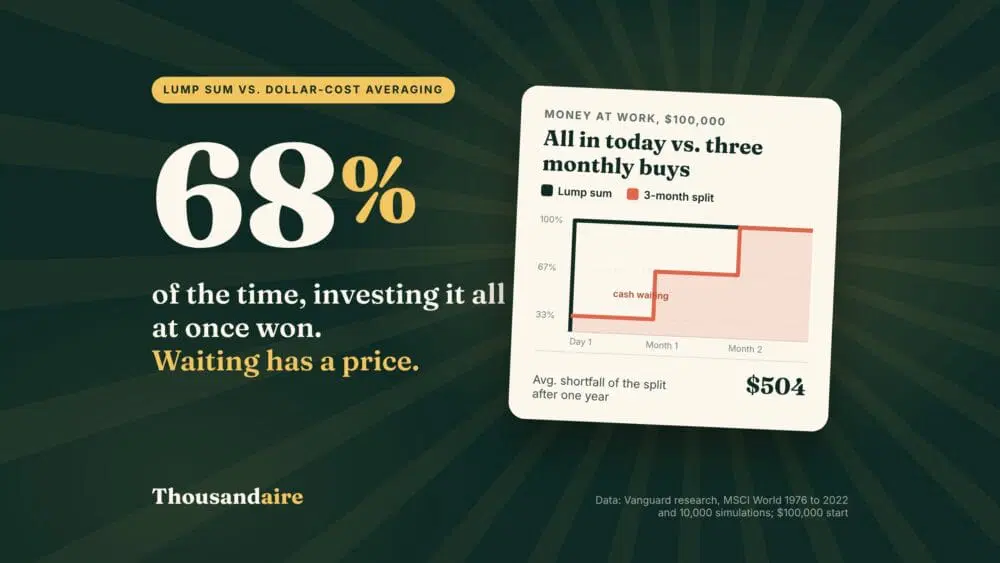
Lump Sum Vs. Dollar-Cost Averaging: What Waiting Costs


| Schedule | Average months in cash | Expected cost on $60,000 |
|---|---|---|
| All at once | 0 | $0 |
| 3 monthly installments | 1 | $150 |
| 6 monthly installments | 2.5 | $375 |
| 12 monthly installments | 5.5 | $825 |
The math for the 12-month row: $60,000 × 3% × 5.5 ÷ 12 = $825.
Two things stand out. First, a short schedule is cheap. Three months of averaging costs about the price of a nice dinner out on a $60,000 deposit. Second, the cost grows with the length of the schedule, so a year-long drip costs more than five times as much as a three-month one. (Vanguard's simulations point the same way: on a $100,000 start, the three-month version trailed the lump sum by $504 on average and the six-month version by $1,491.)
What averaging buys youIf averaging has an expected cost, the fair question is what you get for it. The answer is protection against one specific outcome: investing everything right before a sharp drop.
Take the same $60,000 and a 20% fall in the month after you invest.
-
All at once: your $60,000 is now worth $48,000. You're down $12,000 on paper.
12 monthly installments: only $5,000 was invested when the drop hit, so you're down $1,000. The next $55,000 goes in at lower prices.
FINRA puts it this way: averaging“can help you limit your losses in the event of significant market declines.”
That protection is real, but think about what it's worth to you. In the 32% of periods where averaging won in Vanguard's study, the benefit was usually modest. The case where it matters most is the one where a big early loss would push you to sell. If an early $12,000 drop would make you pull out of stocks entirely, that's a far worse result than either schedule, and $150 to $825 is a cheap way to avoid it.
Vanguard's paper makes the same point:“investors with significant loss aversion may be better suited for a CA strategy,” and having a plan for the cash“is the most important part.”
How to chooseWork through these four questions in order.
Is the money already in your hands? If it arrives with each paycheck, you're averaging by default. Keep contributing and skip the rest of this list. Is it truly long-term money? If you might need it within a few years (a down payment, tuition, a cushion while you job-hunt), the question isn't when to invest it in stocks. It's whether stocks are the right place for it at all. Could you watch a 20% drop the month after investing and hold on? If yes, invest the lump sum. You're accepting more risk of regret in exchange for the better expected result. If not, pick a short schedule and automate it. Three to six months keeps the expected cost low. Set up the automatic transfers on day one, keep the waiting money in a money market fund or Treasury bills rather than checking, and don't pause the schedule because of headlines. A schedule you abandon halfway through is worse than either option.Whichever you choose, write it down before you act: the amount, the schedule, the account, and the target allocation. The decision you make on paper, ahead of time, is the one you're most likely to follow.
The bottom lineInvesting a lump sum all at once wins about two out of three times, and averaging over three to six months costs relatively little in expectation. Both beat the most common outcome, which is leaving the money in cash until you feel ready, because that moment often doesn't come. Choose the schedule you'll stick with, and start it this week.
Sources FINRA, The Benefits and Limitations of Dollar-Cost Averaging (May 19, 2026) U.S. Securities and Exchange Commission, Investor, Dollar Cost Averaging (glossary) Megan Finlay and Josef Zorn, Vanguard Investment Strategy Group, Cost averaging: Invest now or temporarily hold your cash? (February 2023) Thousandaire Editorial TeamThe Thousandaire Editorial Team creates practical, evidence-based personal finance content for people building real wealth. We break down investing, retirement, taxes, real estate, and other wealth-building decisions with clear explanations, real numbers, and no hype

Legal Disclaimer:
MENAFN provides the
information “as is” without warranty of any kind. We do not accept any
responsibility or liability for the accuracy, content, images, videos,
licenses, completeness, legality, or reliability of the information
contained in this article. If you have any complaints or copyright issues
related to this article, kindly contact the provider above.


Comments
No comment