


Russia Outlines How Mobile Hospitals Can Keep Healthcare Running During War


Russia is using mobile hospitals, deployable specialist teams and a nationwide emergency medical coordination system to help civilian healthcare services cope with such scenarios, according to Professor Aleksei V. Osipov, director of the country's Federal Centre for Disaster Medicine.
Recommended For You UAE National Day: 3-day Eid Al Etihad break announced for public sectorSpeaking at the International Congress of Military Medicine in Abu Dhabi last week, Osipov described how the system connects regional hospitals and ambulance services with federal resources, allowing medical teams, evacuation support and mobile operating facilities to be deployed when local healthcare capacity is overwhelmed.
Stay up to date with the latest news. Follow KT on WhatsApp Channels.
"Not only the number of patients is the problem; the problem is with energy, with the water, with the supply chains," he said, highlighting the multiple pressures hospitals face during armed conflict.
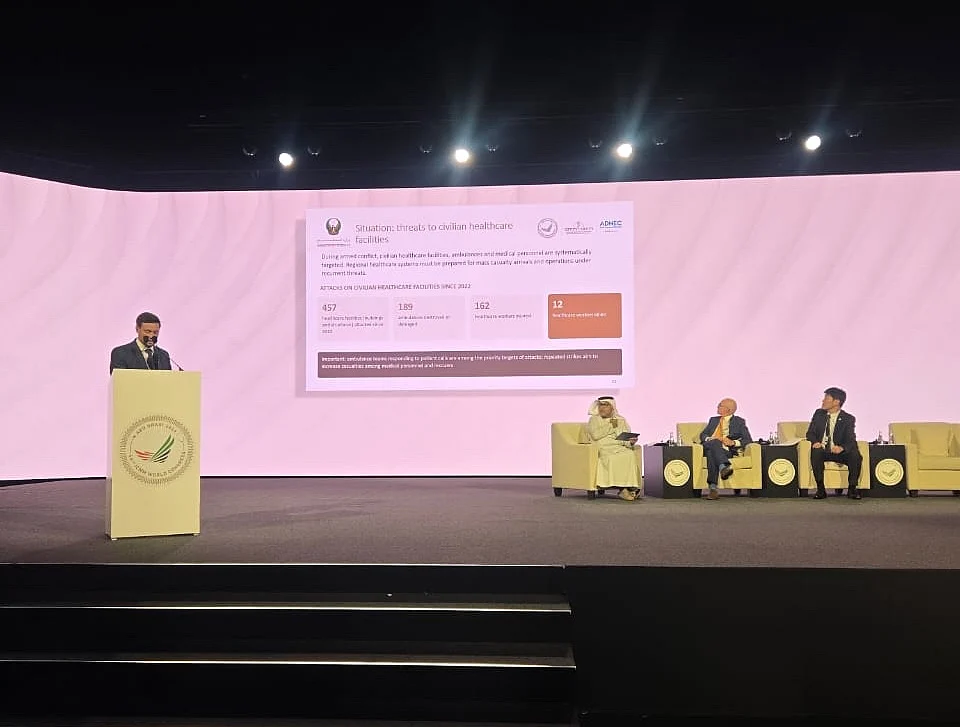
A slide in his presentation listed 457 healthcare facilities damaged or destroyed since 2022, alongside 189 ambulances damaged or destroyed, 162 healthcare workers injured and 12 killed. The geographical scope of these figures was not specified.
Osipov stressed that damage to a hospital affects more than its ability to treat casualties.
"Each damaged facility represents more than also building and equipment," he said, explaining that it also reduces access to everyday healthcare for the surrounding population.
The scale of the operation is reflected in figures presented by Osipov: more than 1,200 specialists have served in deployable medical teams, providing care to over 297,000 patients and performing more than 12,500 surgical procedures.
Operating theatres that can be movedOne of the key capabilities Osipov highlighted was a network of mobile medical complexes, including hospitals, operating theatres and laboratory facilities.
He described how these facilities can be moved between regions and deployed when local hospitals lack the capacity to manage large numbers of seriously injured patients.
He cited a scenario involving 150 patients with severe injuries arriving within half an hour, illustrating the pressure such an influx could place on a regional healthcare system.
The mobile operating facilities are designed to extend the surgical capabilities available outside conventional hospitals, with one of the units measuring 48 square metres.
Russia is also expanding its emergency department infrastructure. Nine new-generation emergency centres are already operating in Moscow, with a federal reconstruction programme planned to extend the model across the country by 2030.
AI to anticipate where casualties will goArtificial intelligence is another tool being explored to help authorities prepare for emergencies before hospitals become overwhelmed.
Osipov said AI could analyse incident patterns to estimate potential casualty numbers, assess available hospital capacity and compare different options for transferring patients.
The systems could help identify where additional beds, medical staff, blood supplies and transport would be needed, while directing patients towards facilities equipped to treat their injuries.
However, the technology is intended to support decisions by medical professionals and emergency coordinators, rather than replace clinical judgement. Osipov also stressed the need to validate its outputs and account for uncertainty.
Emergency planning must also consider patients who may be particularly vulnerable during a crisis, including pregnant women, young children and people dependent on home oxygen or regular dialysis.
He said regional emergency plans need to account for the continuity of essential medical services alongside the treatment of newly injured patients.
When asked how civilian and military patients should be prioritised when medical resources are limited, Osipov said decisions should be based on the severity of their medical conditions and injuries.
"Actually, we prioritise only clinical cases, not by the colour of uniform,” he concluded.
ALSO READ- Ukraine war exposes risks of military medical evacuations, Abu Dhabi congress hears UAE medical evacuations surge as conflict raises demand for emergency response How UAE hospitals prepare for disease outbreaks, emergencies, cyberattacks

Legal Disclaimer:
MENAFN provides the
information “as is” without warranty of any kind. We do not accept any
responsibility or liability for the accuracy, content, images, videos,
licenses, completeness, legality, or reliability of the information
contained in this article. If you have any complaints or copyright issues
related to this article, kindly contact the provider above.


Comments
No comment