


Axoltis Pharma presents further Phase 2 data on NX210c in amyotrophic lateral sclerosis (ALS) at Neuroscience 2026


(MENAFN- ALA Group) •Additional biological and clinical insights from SEALS trial support continued clinical development of drug-candidate NX210c
•Four-month patient follow-up demonstrates favorable safety profile, target engagement and encouraging signals of slower ALSFRS-R slope of decline
•Predictive digital twin simulations corroborated observed effect on functional decline and provided evidence to support decision-making
•Simulations will help guide optimization of repeated-dose regimen and selection of patient population most likely to respond in a future confirmatory clinical study
Lyon and Clermont-Ferrand, France, November 16, 2026 – Axoltis Pharma, a biotech company dedicated to developing novel therapeutic solutions for neurodegenerative diseases, today announces additional data and analyses from SEALS, its Phase 2 clinical trial evaluating NX210c in patients with amyotrophic lateral sclerosis (ALS), building on the initial results announced on September 15, 2026. These new findings were presented on November 15 at Neuroscience 2026, the Society for Neuroscience’s annual meeting, held in Washington, DC (USA), which brings together more than 20,000 neuroscience researchers and healthcare professionals.
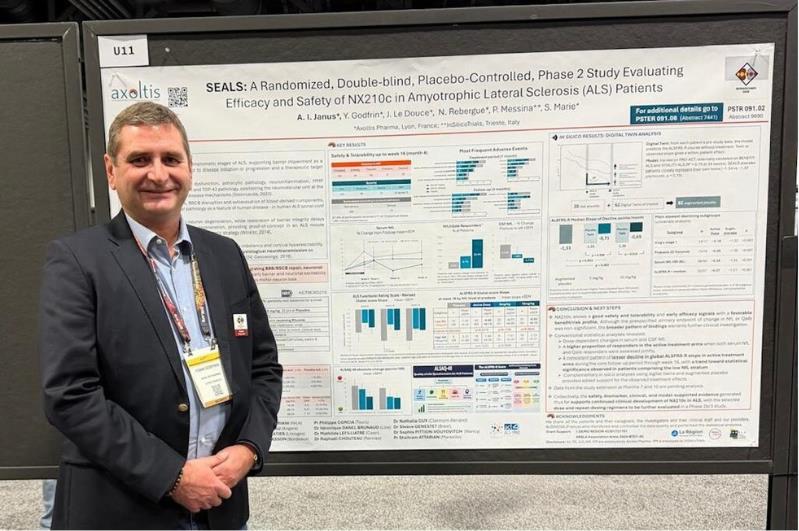
Two complementary presentations entitled 'SEALS: A Randomized, Double-Blind, Placebo-Controlled Phase 2 Study Evaluating Efficacy and Safety of NX210c in ALS Patients' and ‘NX210c, an Innovative Peptide with Neurovascular and Peripheral Effects in ALS’ were delivered during the event, highlighting the following key findings:
Effect on neurovascular unit, NX210c target engagement
Biomarker analyses revealed encouraging signals consistent with target engagement and neurovascular stabilization. As previously reported, after four weeks of treatment, the 10 mg/kg group showed a statistically significant reduction in plasma claudin-5 (p=0.0005 vs. placebo), suggesting stabilization of endothelial tight junctions. This was accompanied by effects on blood brain barrier related biomarkers such as reduced plasma MMP-9 activity, decreased plasma homocysteine and cerebrospinal fluid (CSF) S100β, whereas those increased in the placebo arm. These effects could be mediated by β1-integrin, a reported receptor for NX210c, which plays a crucial role in maintaining the integrity and stability of the neurovascular unit.
Alongside these biomarker effects, although changes in serum neurofilament light chain (NfL) levels from predose did not reach statistical significance at Week 6, a trend toward a dose-dependent effect became more apparent at Weeks 10 and 16 (Month 4). Consistent with this observation, cerebrospinal fluid (CSF) NfL levels also showed a trend toward a dose-effect relationship in the change from predose to Week 6 (timepoints for lumbar puncture to collect CSF).
Safety, tolerability profile and complementary analyses of secondary clinical endpoints
At 4-month follow-up, NX210c continued to demonstrate a good safety and tolerability profile. Functional decline, assessed by the slope of the mean global score of Amyotrophic Lateral Sclerosis Functional Rating Scale–Revised (ALSFRS-R), was reduced on average by 0.51-0.58 points/month (32-36% reduction) in both NX210c treatment arms compared with placebo. At the same time point, patients’ quality of life, assessed using the ALSAQ-40 questionnaire, showed less deterioration from baseline in both active treatment arms.
Muscle strength, assessed by hand-held dynamometry, also showed a generally lower reduction in elbow flexion, wrist extension, knee extension and ankle dorsiflexion.
Patients in the SEALS study were stratified at randomization according to their NfL levels at baseline. Subgroup analyses revealed that patients with lower baseline NfL levels (≤95 pg/mL), representing 69.5% of the 82 enrolled patients, showed a more pronounced reduction in the slope of decline at Month 4 versus placebo and an apparent dose–response relationship (placebo: -1.32 point/month; 5mg/kg: -0.77; 10mg/kg: -0.53, p = 0.062; corresponding to a 42% and 60% reduction of decline versus placebo arm). In contrast, patients with higher baseline NfL levels (>95 pg/mL) showed a smaller or no apparent treatment effect on the ALSFRS-R slope of decline.
In silico modelling using digital twins corroborates observed effects of NX210c on functional clinical outcomes and helps identify patient profiles most likely to benefit from treatment
To further substantiate the observed reduction in functional decline, a predictive model trained on PRO-ACT, a large database of ALS patients, was used to generate a patient-specific digital twin for each NX210c-treated patient, using their individual pre-treatment clinical data. The model predicted each patient's expected ALSFRS-R trajectory in the absence of treatment, providing a personalized counterfactual reference against which the observed disease progression could be compared.
At the 4-month follow-up, paired comparisons between the patients and their own placebo twins showed a 47% reduction in the median rate of ALSFRS-R slope of decline in the 5 mg/kg group (−0.71 vs. −1.33 points/month; p = 0.098) and a 49% reduction in the 10 mg/kg group (−0.69 vs. −1.36 points/month; p = 0.016) with the latter showing greater statistical significance.
An augmented placebo group comprising 82 patients was also constructed, combining the 20 randomized placebo patients with the 62 digital placebo twins of the treated patients. Comparisons against this group at four months showed a trend towards reduced functional decline of 47% in the 5 mg/kg arm (p = 0.053) and 48% in the 10 mg/kg arm (p = 0.002). In the subgroup of patients with low baseline NfL level (≤95 pg/mL), the median ALSFRS-R slope of decline was −0.29 points/month in NX210c-treated patients, compared with −1.24 points/month in the augmented placebo group (p < 0.001), corresponding to an approximately 77% reduction in the rate of functional decline. No significant effect was observed in patients with an NfL level above 95 pg/mL. Thus, patients with low baseline NfL level appeared more likely to respond to NX210c treatment with respect to clinical function.
“These additional findings suggest that baseline NfL levels may help identify patients more likely to benefit from NX210c treatment,” said Dr. Annette Janus, chief medical officer at Axoltis Pharma. “Collectively, the safety, biomarker, clinical and model-supported evidence generated thus far supports the continued clinical development of NX210c in ALS, with the selected dose and repeat-dosing regimens to be further evaluated in a Phase 2b/3 study.”
“This project demonstrates the value of digital twin technology in generating evidence to support real decisions in drug development, especially for rare diseases. It has been a privilege to work alongside the talented and forward-thinking team at Axoltis, and we look forward to continuing this journey together,” said Mario Torchia, CEO of InSilicoTrials (Trieste, Italy).
“I would like to extend our sincere gratitude to the patients and their caregivers for their participation in this clinical study, to the investigators and their clinical staff for their dedication and commitment, and to our laboratory partners for performing the bioanalytical assessments, as well as to our service providers for their invaluable contributions to study monitoring, data quality control, statistical analyses, and pharmacovigilance,” said Yann Godfrin, CEO of Axoltis Pharma. “We are also delighted with the constructive discussions and the meetings held so far at Neuroscience, which further support our plans to advance NX210c in clinical development.”
About the SEALS Study
The SEALS Phase 2 clinical trial enrolled 82 ALS patients in 16 investigator sites in France (ACT4ALS-MND -FILSAN network) between November 2024 and November 2025. The patients were randomized in a 3:3:2 ratio to receive NX210c at either 5 mg/kg or 10 mg/kg, or a placebo, via a 10-minute intravenous infusion three times weekly for four weeks. Nearly all patients continued receiving riluzole as background standard-of-care therapy. When all the patients reached the end of the treatment course, NX210c demonstrated a favorable safety and tolerability profile.
About NX210c
Axoltis is developing NX210c, a cyclic peptide of 12 amino acids designed from the most conserved and repeated sequence of SCO-spondin, a glycoprotein that plays a crucial role in the development of the central nervous system during embryogenesis. NX210c is a novel drug candidate for neurodegenerative or trauma-related disorders, with blood-brain barrier repair, neuroprotective and neurotransmission improvement properties. NX210c is protected by eight patents fully owned by Axoltis Pharma, including the composition of matter, which is covered in several countries. The FDA and the EMA have granted Orphan Drug Designation for NX210c in ALS. In 2023, the safety data collected in a Phase 1b multiple ascending dose study showed NX210c to be well-tolerated. The full results of SEALS, a Phase 2 clinical trial in ALS patients, are expected by the end of 2026.

Legal Disclaimer:
MENAFN provides the
information “as is” without warranty of any kind. We do not accept any
responsibility or liability for the accuracy, content, images, videos,
licenses, completeness, legality, or reliability of the information
contained in this article. If you have any complaints or copyright issues
related to this article, kindly contact the provider above.


Comments
No comment