


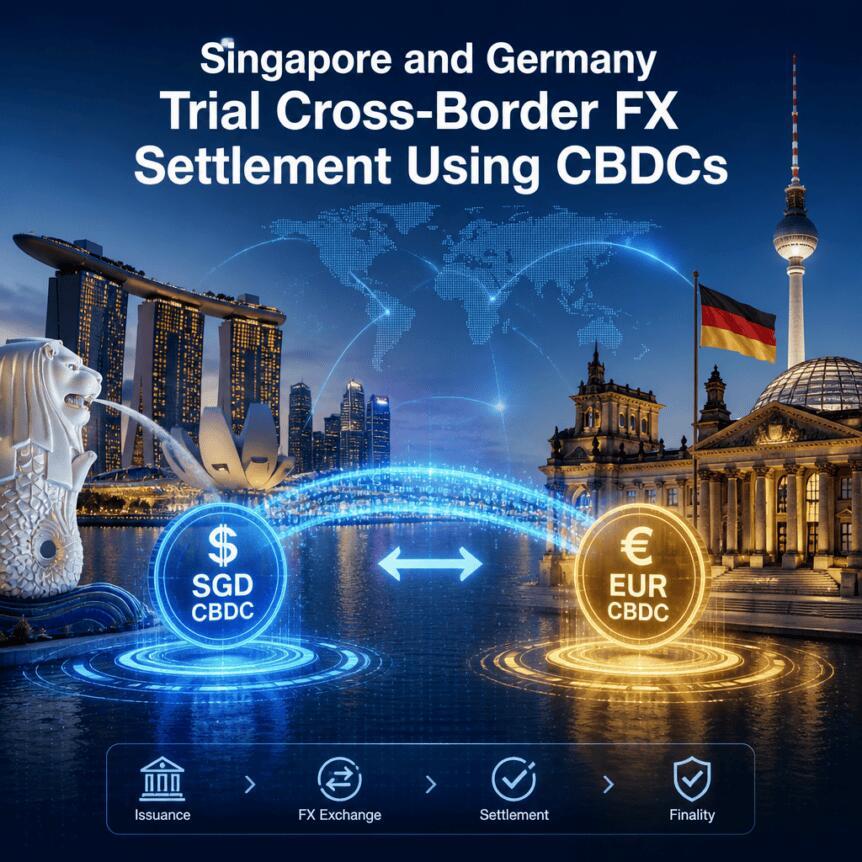
Singapore And Germany Trial Cross-Border FX Settlement Using Cbdcs


According to a Monday press release from MAS, the test-part of Project Simbolon-linked the two systems using payment-versus-payment (PvP) settlement, so each currency's final transfer depended on the final transfer of the other.
Key takeaways- MAS and the Bundesbank used wholesale CBDCs to test euro–SGD settlement across separate central bank digital asset test environments. Payment-versus-payment design reduced settlement risk by making final settlement of one currency conditional on the other. Zero-knowledge proofs enabled each system to verify settlement conditions without direct integration of central bank ledgers. Project Simbolon builds on a November 2025 memorandum on tokenization and cross-border settlement and aligns with MAS's Project Guardian. The work complements broader wholesale tokenized finance infrastructure efforts, including the Eurosystem's Pontes launch.
Project Simbolon's latest trial focused on connectivity between Singapore and Germany for cross-border digital asset settlement. MAS said the central banks used their respective wholesale CBDC systems to settle euro–Singapore dollar trades in a controlled test setting.
Crucially, the settlement approach was designed to be conditional rather than sequential. Under payment-versus-payment, the final transfer of one currency is dependent on the final transfer of the other, which is intended to mitigate settlement risk-the classic problem where one side may complete its leg while the counterparty fails to do so.
MAS also highlighted the privacy and integration mechanics of the test. The two systems used zero-knowledge proofs so each environment could check whether settlement conditions were met without requiring direct access to, or direct integration with, the other central bank's ledger infrastructure. That matters because it points to a pathway where interoperability can be achieved without exposing underlying ledger details.
Why zero-knowledge verification and PvP both matterThe combination of PvP settlement logic and zero-knowledge proofs addresses two practical frictions that often arise when connecting financial rails across jurisdictions: conditional settlement and information boundaries.
From a settlement-risk perspective, PvP is a familiar concept in traditional foreign exchange settlement, but implementing it across digital environments is more complex when different institutions run different infrastructures. MAS's description suggests the test was built to preserve the dependency of final transfers even while relying on separate digital asset test environments.
From an interoperability perspective, direct ledger-to-ledger integration can be difficult-especially for regulators and central banks that want to keep control over their own systems. By allowing verification of settlement conditions through cryptographic proofs, the test implies a design where connectivity can be established while limiting the need for full operational integration. For market participants, that could translate into smoother cross-border workflows without requiring a single shared ledger across all actors.
How this milestone fits into MAS and Bundesbank tokenization plansMAS framed the trial as a milestone in the broader collaboration between the two central banks. The project is linked to a November 2025 memorandum of understanding focused on tokenization and cross-border settlement.
MAS also placed the test in the context of its longer-running tokenization program, Project Guardian, which the central bank launched in May 2022. While Project Guardian is a wider initiative, this cross-border work demonstrates how MAS appears to be steering from experimentation toward settlement connectivity-an area that directly affects financial institutions involved in FX and other cross-border markets.
In remarks cited by MAS, Sabine Mauderer, first deputy governor of the Bundesbank, said:“Project Simbolon paves the way for eliminating settlement risk in global foreign exchange transactions.” While the statement is forward-looking, it aligns with the mechanics MAS described: conditional finality and verification designed to reduce the chance of partial settlement.
Broader momentum: Pontes and the move to tokenized wholesale financeThe central bank settlement test comes as wholesale tokenized finance infrastructure continues to take shape. MAS noted that, in September, the Eurosystem launched Pontes-an arrangement intended to let financial institutions settle wholesale tokenized asset transactions in central bank money.
For investors and market participants, these efforts collectively signal that the“tokenization stack” for regulated markets is gradually moving from isolated pilots toward connected settlement capabilities. Pontes focuses on enabling settlement in central bank money for tokenized transactions within the Eurosystem's framework, while Project Simbolon is aimed at cross-border connectivity between specific jurisdictions. Both themes are important because cross-border liquidity and settlement efficiency depend not only on tokenization itself but on interoperability between money rails.
Still, much remains to be clarified beyond these test environments. The MAS release describes the trial mechanics and intended benefits, but it does not outline timeline details for scaling the approach into live, production settlement. Readers should watch for further milestones that specify operational readiness-such as how expanded asset classes would be supported, what participant onboarding would look like, and how governance across jurisdictions would be handled.
With MAS and the Bundesbank now demonstrating cross-border settlement using PvP and zero-knowledge verification, the next question for the market is whether these concepts will be carried from testing into interoperable, production-grade workflows-and how quickly they can be adapted to real-world foreign exchange and tokenized securities activity.
Risk & affiliate notice: Crypto assets are volatile and capital is at risk. This article may contain affiliate links.
Legal Disclaimer:
MENAFN provides the
information “as is” without warranty of any kind. We do not accept any
responsibility or liability for the accuracy, content, images, videos,
licenses, completeness, legality, or reliability of the information
contained in this article. If you have any complaints or copyright issues
related to this article, kindly contact the provider above.


Comments
No comment