


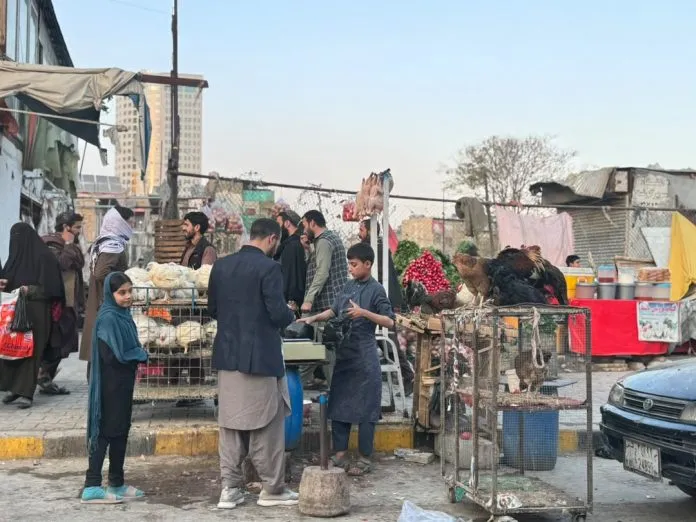
Open-Air Chicken Slaughter Raises Health Concerns In Kabul


In several markets across Kabul, poultry vendors slaughter and clean chickens in open spaces beside roads. Residents say the practice is sometimes carried out without proper hygiene standards, leaving surrounding areas contaminated with animal waste.
Shuja, a poultry vendor in Kabul's Third Makrorayan market, says the lack of designated slaughterhouses and customers' preference for buying freshly slaughtered chickens in front of them have made it difficult for vendors to move the practice elsewhere.
“We do not have a designated slaughterhouse. Even if one were available, people would not buy chicken from there because most customers choose their own chicken and then ask us to slaughter it,” he said.“For this reason, we cannot slaughter chickens away from customers' sight. We have placed a bucket here to collect the remains so that blood and feathers do not spread around the area.”
Meanwhile, some pedestrians have complained about the unpleasant smell and unhygienic conditions at places where chickens are slaughtered and cleaned.
Fariha, a resident who regularly passes through the area, says she has to hold her breath for several seconds while walking past the sites.
“When I pass through this area, I have to cover my nose because the smell is extremely foul. Even breathing in such an environment makes me feel nauseated,” she said.“When I see blood and chicken remains scattered around, I lose any desire to buy chicken. I even feel uncomfortable eating cooked chicken at home. We urge the authorities to address this situation and provide designated locations for poultry vendors and butchers who slaughter animals along roadsides.”
Fariha added that witnessing slaughter and scenes involving blood could also be distressing for children and negatively affect their emotional well-being.
Sayed Shah Gaharpour, an environmental expert, warned that the absence of an organised waste management system and improper disposal of poultry slaughter waste could have serious consequences for the environment and public health.
He said dumping blood, fat, feathers, skin and other chicken remains into drainage channels and surrounding areas could contaminate water and soil. The decomposition of such waste also produces unpleasant odours and creates conditions that attract insects, stray animals and disease-causing organisms.
Gaharpour further warned that the discharge of poultry waste and slaughterhouse wastewater into waterways could reduce dissolved oxygen levels, threatening aquatic life.
He explained that an increase in pollutants in water raises biochemical oxygen demand (BOD) and chemical oxygen demand (COD), two indicators used to measure water pollution and assess the impact of contaminants on water quality.
The environmental expert said poorly managed poultry waste could create a chain of environmental and public health problems through the contamination of water, soil and air.
To address the problem, he recommended assessing poultry shops and slaughtering sites and providing designated facilities that meet hygiene and environmental standards.
He said chicken slaughtering and cleaning areas should be covered, protected from dust, equipped with durable and washable flooring, and connected to an organised wastewater collection system. Blood and other poultry remains should never be discharged directly into public drains and channels.
Gaharpour also stressed the importance of separating waste, regularly disinfecting slaughtering areas, providing clean water for washing, and ensuring the proper disposal and transportation of wastewater and animal remains.
Meanwhile, Nematullah Barakzai, spokesman for Kabul Municipality, said street vending had existed in the city for years and required greater regulation and supervision.
He said the municipality monitors poultry vendors who violate regulations, while sanitation workers are responsible for cleaning roads and pavements.
Barakzai added that maintaining cleanliness after an area has been cleaned also depends on the cooperation of vendors and residents. He said cases of disorder and violations are followed up through Kabul police.
He stressed that maintaining public order and cleanliness across the city would not be possible without the cooperation of residents and vendors, urging the public to work with municipal authorities.
Despite the municipality's monitoring efforts and the work of sanitation staff, residents continue to express concerns about chicken slaughtering and cleaning in open public spaces.
Environmental experts say proper management of slaughterhouse waste, the provision of standardised facilities and compliance with hygiene regulations are essential to preventing further pollution in urban areas.

Legal Disclaimer:
MENAFN provides the
information “as is” without warranty of any kind. We do not accept any
responsibility or liability for the accuracy, content, images, videos,
licenses, completeness, legality, or reliability of the information
contained in this article. If you have any complaints or copyright issues
related to this article, kindly contact the provider above.


Comments
No comment