


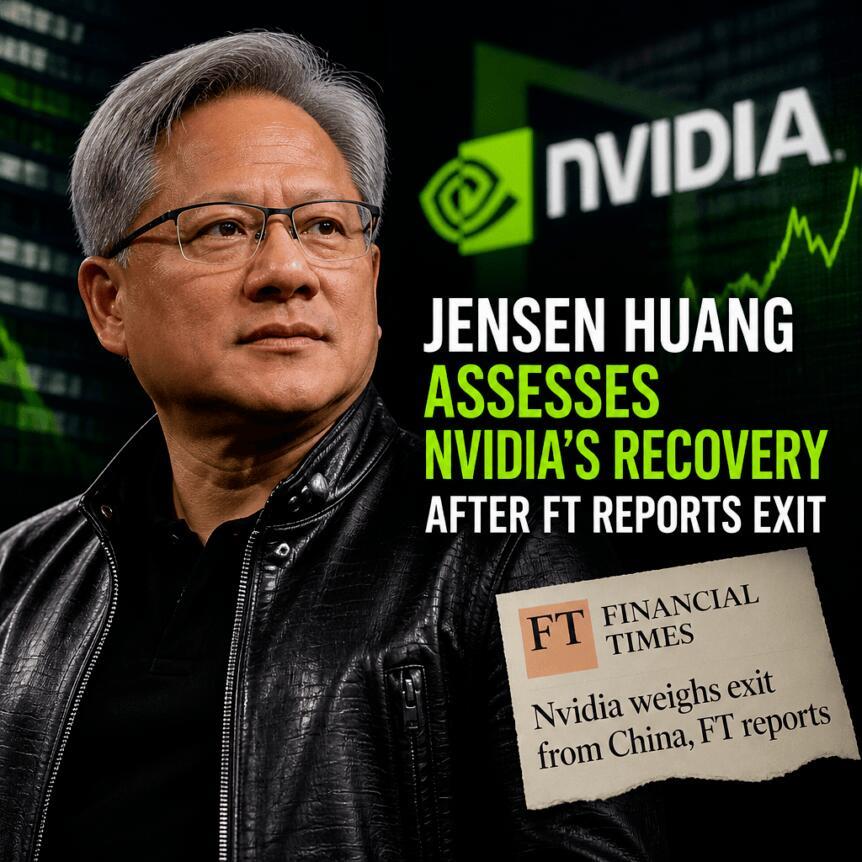
Jensen Huang Assesses Nvidia's Recovery After FT Reports Exit


The reported comeback effort is drawing both executive-level lobbying and public momentum. The Financial Times says some Silicon Valley insiders are preparing to assemble a“war room” to argue for Huang's return and to seek influence from the White House, while a campaign titled“Bring Jensen Back” has collected more than 161,000 signatures, according to its organizers.
Key takeaways- Huang's potential return is being discussed by confidants, per the Financial Times, shortly after his resignation. A lobbying effort described as a“war room” is reportedly forming to advocate for his reinstatement and to seek White House support. A public“Bring Jensen Back” campaign claims more than 161,000 signatures and thousands from current and former Nvidia employees. The push faces headwinds from calls for leadership change tied to an investigation and compliance questions around Nvidia's chip sales to China. Market reaction has reflected uncertainty: Nvidia shares dropped sharply on the resignation news before partially rebounding.
Jensen Huang resigned as Nvidia CEO following reports of alleged extramarital relationships, including an allegation involving a woman US intelligence officials reportedly suspected of links to Chinese intelligence. The company's decision also placed the leadership question in the spotlight at a time when Nvidia is under heightened scrutiny over how its AI chips are sold and distributed internationally.
Per the Financial Times, Huang has discussed with confidants the possibility of returning to Nvidia. One source cited by the outlet said supporters were assembling a group of Silicon Valley executives intended to lobby for his reinstatement, including the idea of gaining backing from the White House.
The Financial Times also included a remark from one person involved in the effort:“Everyone that matters in tech outside the frontier labs loves Jensen.” While the quote is not evidence of any formal company action, it underscores the narrative driving the campaign-Huang is widely viewed as more than a corporate executive, positioned as a central figure to Nvidia's AI strategy.
Public campaign adds pressure to an already volatile storylineAlongside the reported private lobbying, a public campaign called“Bring Jensen Back” is actively collecting support. Organizers claim it has gathered more than 161,000 signatures. The campaign website also lists prominent names, including Elon Musk and Tim Sweeney, as supporters. It further claims more than 9,000 signatures from current and former Nvidia employees.
Whether such momentum translates into a board-level decision remains unclear. However, for investors and market observers, the key point is that the“who leads Nvidia” debate is not confined to corporate governance-it has turned into a broader public contest about continuity versus change at the center of the AI chip industry.
Calls for new leadership and the China chip compliance questionThe push for Huang's return runs counter to demands for leadership shake-ups coming from US political figures. In comments reported by Fox Business, US Treasury Secretary Scott Bessent urged a“dramatic shake-up,” arguing Nvidia should hire a CEO from outside the company. The remarks reflect a theme that has circulated around Nvidia's position in the AI supply chain: beyond leadership style, regulators and policymakers appear focused on compliance and risk management.
US President Donald Trump suggested earlier that Tim Cook, former Apple CEO, could take the job, according to a post shared on Truth Social. While presidential comments do not create corporate obligations, they signal that leadership decisions are being watched at the highest level of US politics.
Underlying these debates is scrutiny of Nvidia's compliance with US restrictions on AI chip sales, especially involving customers in Asia with potential ties to China. Reports have also referred to an independent board investigation tied to the events surrounding Huang's resignation.
That matters because it reframes the leadership question: investors are not only evaluating business continuity, but also how Nvidia can reassure regulators about sales practices, distribution channels, and export controls. In situations like this, perceived governance stability can be as important as operational performance-particularly when US national security concerns are already part of the storyline.
Why the stock reaction is still a warning signalNvidia's share performance following Huang's resignation highlighted how quickly leadership uncertainty can ripple into the market. According to the article content, Nvidia shares fell as much as 14% on Thursday before recovering to close 4.3% lower. The rebound suggests investors were not universally panicked-but the initial drop indicates that many market participants were forced to price in a new risk: what happens to Nvidia's strategy if the company must navigate both governance changes and regulatory scrutiny at the same time.
In practice,“leadership continuity” and“compliance credibility” are linked in the current AI chip environment. If Huang returns, supporters may argue Nvidia benefits from continuity at a time of intense competition and fast-moving demand. Critics, however, may point to the need for a clean break-especially if the company is dealing with investigations and questions about adherence to US restrictions.
Either way, the market is likely to keep watching for concrete outcomes rather than campaign momentum. For now, it is the combination of board-level decisions, investigative findings, and any updates related to chip sales scrutiny that will determine whether investor uncertainty fades or intensifies.
What to watch nextReaders should focus on whether Nvidia's board makes any formal moves regarding leadership, and whether developments in the ongoing investigation and China-related compliance scrutiny provide clarity. Until those pieces line up, Huang's reported return talks-and the public push behind them-will remain a high-stakes storyline rather than a settled corporate plan.
Risk & affiliate notice: Crypto assets are volatile and capital is at risk. This article may contain affiliate links.
Legal Disclaimer:
MENAFN provides the
information “as is” without warranty of any kind. We do not accept any
responsibility or liability for the accuracy, content, images, videos,
licenses, completeness, legality, or reliability of the information
contained in this article. If you have any complaints or copyright issues
related to this article, kindly contact the provider above.


Comments
No comment