


Gemini Robotics 2.5 Improves Robot Dexterity And Industrial AI


The company says the new model expands the range of tasks robots can perform while improving dexterity, reliability and safety.
Gemini Robotics 2.5 was evaluated across more than 200 tasks, including handling delicate objects, using tools, manipulating flexible materials and performing precision assembly operations.
According to Google DeepMind, the model achieved success rates 30 to 100 percent higher than previous versions, depending on the task, while completing operations 20 to 30 percent faster.
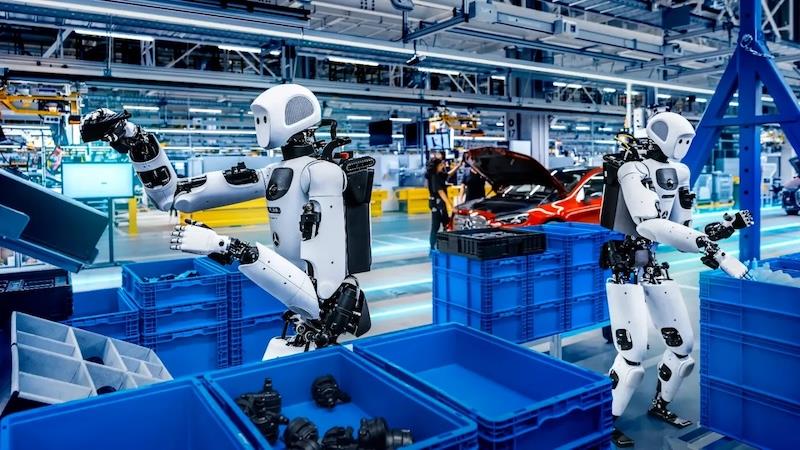
Testing humanoid robots at Mercedes-BenzOne of the most significant demonstrations involved Apptronik's Apollo 2 humanoid robot operating on Mercedes-Benz production lines in Kecskemét, Hungary, and Sindelfingen, Germany.
The robots performed automotive kitting, which involves selecting individual components from bulk containers and arranging them into trays for vehicle assembly.
Using Gemini Robotics 2.5 to control its arms and hands, alongside Gemini Robotics ER for task planning, Apollo 2 achieved a reported 96 percent success rate during the proof-of-concept program.
Jeff Cardenas, co-founder and CEO of Apptronik, says:“This is what we built Apollo for: useful work alongside people in real industrial settings.
“Pairing Apollo 2 with Gemini Robotics, we saw the models improve dramatically in just a few weeks of post-training and carry over to Mercedes-Benz production with very little drop-off. This is the foundation for bringing humanoid robots to industrial and commercial environments at scale.”
Improving safety and simulationGoogle DeepMind has also introduced improvements intended to help robots operate safely around obstacles and people.
The company reports that new reasoning-based safety controls increased safe task completion by 33 percent around obstacles and 43 percent when people were nearby.
Separately, it introduced ASIMOV-Jailbreak, an open-source benchmark designed to evaluate whether robotics AI systems resist instructions that could lead to unsafe actions.
Google DeepMind says its Gemini 4 Argon model achieved 99.5 percent resistance in these evaluations, compared with 82 percent for its previous baseline.
Gemini 4 Argon also supports robotics research by generating simulated training scenarios, creating digital twins and helping researchers investigate task failures.
The company says these capabilities have accelerated development of Gemini Robotics 2.5 by reducing the amount of physical training data required.
The new model is being made available to Google DeepMind's robotics partners as the company continues developing AI systems intended to operate across different robot platforms and real-world applications.

Legal Disclaimer:
MENAFN provides the
information “as is” without warranty of any kind. We do not accept any
responsibility or liability for the accuracy, content, images, videos,
licenses, completeness, legality, or reliability of the information
contained in this article. If you have any complaints or copyright issues
related to this article, kindly contact the provider above.


Comments
No comment