


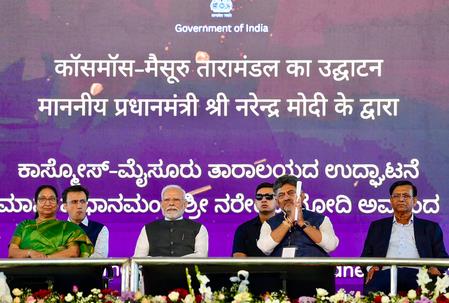
No Nation Can Slow Down Amid Rapid Technological Changes: PM Modi


Speaking after inaugurating COSMOS-Mysuru Planetarium, India's first LED Dome planetarium, he said the country had made significant progress in astronomy, astrophysics and the space sector over the last decade, with several achievements placing India among a select group of countries capable of undertaking complex space missions.
"Today, technology is changing rapidly. No country can take the risk of undermining or slowing down its progress. A strong ecosystem for science and research is being created in the country," he said.
PM Modi said the inauguration of COSMOS-Mysuru marked another important milestone in India's efforts to promote scientific temper and research, particularly among the younger generation.
Recalling his earlier visit to Mysuru for the inauguration of Viveka Smaraka, he said the two occasions carried a deeper message about India's cultural traditions and values. While Viveka Smaraka inspired people to look within themselves and seek spiritual knowledge, COSMOS-Mysuru encouraged them to look towards the sky and explore the mysteries of the universe.
"To understand this vast universe and unravel the secrets of the world is an inspiration in itself. In Bharat, the traditions of science and spirituality have always travelled together," he said.
Highlighting India's ancient contributions to astronomy, the Prime Minister said ancestors had studied celestial bodies in detail, calculated the movements of stars and planets, developed calendars and understood solar and lunar eclipses.
He recalled the contributions of renowned astronomers such as Aryabhata, Bhaskaracharya and Nilakantha Somayaji, noting that they made complex scientific calculations and discoveries despite not having access to modern technology and sophisticated instruments.
PM Modi said Mysuru had a long tradition of promoting knowledge and scientific inquiry. During the reign of Maharaja Nalvadi Krishnaraja Wadiyar, the University of Mysore was established, while the Wadiyar family also played a significant role in the establishment of the Indian Institute of Science (IISc) in Bengaluru.
He said the royal family had consistently supported researchers and institutions that encouraged scientific advancement.
"At a time when Bharat is achieving one milestone after another in science, Mysuru is adding a new chapter with the establishment of COSMOS Planetarium," he said, describing the facility as a state-of-the-art institution dedicated to the youth and people of the country.
Sharing his experience of watching a show at the planetarium, PM Modi described it as wonderful and congratulated the Indian Institute of Astrophysics, the University of Mysore, government departments and everyone involved in executing the project.
Recalling the slogan 'Jai Jawan, Jai Kisan', he said former Prime Minister Atal Bihari Vajpayee had added 'Jai Vigyan' to it, while he had further incorporated 'Jai Anusandhan' (hail research).
"The 21st-century Bharat will move forward with this vision," he said.
The Prime Minister praised Indian students for their achievements in international scientific competitions, particularly in astronomy and astrophysics. He recalled that India had hosted the International Olympiad on Astronomy and Astrophysics in Mumbai last year and said Indian students had participated enthusiastically.
This year, five Indian students participated in the competition held in Vietnam, winning four gold medals and one silver medal, he said, describing their performance as a matter of pride for the country.
He added that students had also performed well in mathematics, physics and chemistry, winning gold and silver medals in various competitions. Such achievements demonstrated the potential of young Indians, who could make further contributions when provided with the necessary tools, technology and financial support.
PM Modi said India had witnessed remarkable progress in astronomy, astrophysics and space exploration over the last decade. The country had established new telescopes and made breakthroughs in complex areas of space research.
Referring to Chandrayaan-3, he said India had become the first country to successfully land a spacecraft near the Moon's south polar region. Through the Aditya-L1 mission, India had also established a dedicated space-based solar observatory.
He said India had demonstrated its capability in space docking and undocking last year, becoming the fourth country in the world to achieve the feat. Experiments conducted by Indian astronauts during their space missions had also contributed to the country's human spaceflight programme.
PM Modi said the government had opened up the space sector, providing opportunities for startups and young entrepreneurs to demonstrate their capabilities. Indian startups were now developing and launching rockets and undertaking projects that had not been attempted earlier.
He stressed that India's space programme had always followed a 'humanity first' approach, with technology being developed to improve people's lives.
Explaining the practical applications of space technology, he said the Indian Space Research Organisation (ISRO) had developed systems to assist fishermen by providing warnings to fishing vessels and helping them return safely.
Similarly, the Real-Time Train Tracking System, developed with the involvement of Indian Railways and ISRO, enabled the tracking of trains and provided information about their exact locations. Space technology was also being used under the Pradhan Mantri Fasal Bima Yojana to support crop insurance for farmers, he said.
"Our satellites are reaching their designated orbits, and their applications are being used for the welfare of people. Science for society is our approach," he said.
PM Modi said the government was promoting science and research across the country and had launched a Rs 1 lakh crore research and innovation scheme last year to strengthen the ecosystem.
Emphasising the need to nurture scientific curiosity among children, he urged the management of COSMOS-Mysuru Planetarium, schools and colleges to encourage more students to visit the facility and make use of its infrastructure.
"Science can progress only when young people get opportunities to develop their curiosity. I urge the planetarium management, schools and colleges to ensure that more students visit this facility. One among them may return one day with an innovation or discovery about the universe," he said.
Governor Sudha Yadav, Union Minister Nirmala Sitharaman, Chief Minister D.K. Shivakumar, Minister for Higher Education Basavaraj Rayareddy, BJP MP Yaduveer Wadiyar and other dignitaries were present.

Legal Disclaimer:
MENAFN provides the
information “as is” without warranty of any kind. We do not accept any
responsibility or liability for the accuracy, content, images, videos,
licenses, completeness, legality, or reliability of the information
contained in this article. If you have any complaints or copyright issues
related to this article, kindly contact the provider above.


Comments
No comment