


Anchored In The Kingdom: Saudi Healthcare Leaders Meet In Riyadh To Plan For Resilience


(MENAFN- Mid-East Info) Global Health Stratalogues honoured its inaugural Laureates and convened two closed roundtables in Riyadh, the first in a GCC-wide series feeding intelligence reports for companies in the Kingdom.
Borderless Finance. AI-Native.
Your digital companion for smarter everyday choices. Built for how you live, earn, and grow. Move money at your pace with AI-powered finance, all in one tap.
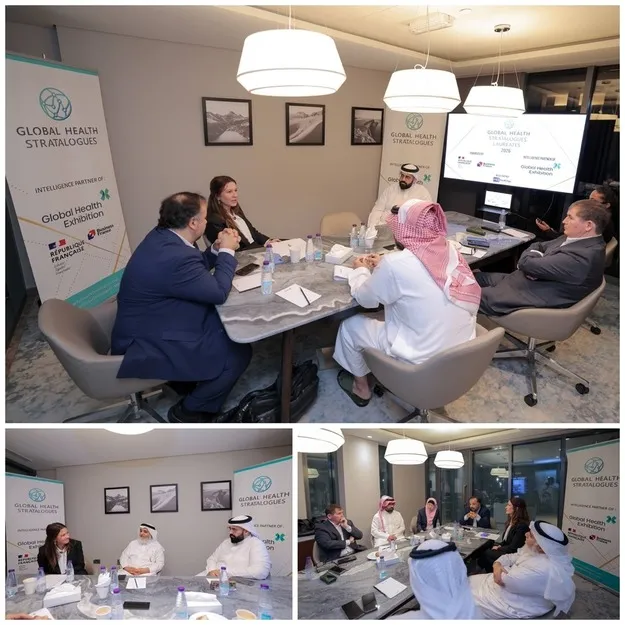
Join the waiting list. Earn As Intelligence Partner of Global Health Exhibition (GHE), Global Health Stratalogues (GHS) the official market entry report was presented, The Saudi Healthcare Market: A Guide to Entry and Growth, with a programme in Riyadh on 28 and 29 October. Produced by GHS and published by GHE, the guide is now available on the GHE website. To complement the guide, GHS brought together senior government, clinical and industry leaders for Anchored in the Kingdom: Resilience Meets Opportunity, an independent series of small roundtables organised in response to the current situation. The discussions will form the basis of upcoming reports giving companies insight into operating in the Kingdom. Resilience planned together Opening the discussions, Oscar Wendel, Founder and Chairman of Global Stratalogues, described the roundtable as the first in a series that will continue across the GCC member states, bringing government and private stakeholders together in each. The next discussions will take place in the lead-up to, and alongside, WHX Dubai in January 2027. Each round feeds into intelligence reports that help harmonise planning across the region: in policy, in standards and in emergency response frameworks. The series is built around two questions: how to make the most of healthcare capacity, and how to plan and coordinate healthcare resilience together. In Riyadh, that meant looking at where care capacity is needed, how financing is changing on the path to national insurance, the local production of medicines and medtech, and life sciences investment. Resilience in the Gulf, Wendel said, is strongest when it is planned together. GHS, the health arm of Global Stratalogues, began as an initiative coordinated between Global Health Exhibition and Business France, announced at the French Ministry of the Economy in Paris. Global Stratalogues has convened roundtables and published reports at the United Nations in New York and Geneva, in the UK Parliament's House of Lords and House of Commons, with DMCC in Davos, and with the Qatar Financial Centre at the Qatar Economic Forum. Participants at the Global Health Stratalogues“Anchored in the Kingdom” Majlis Discussions in Riyadh on 29 October 2026, where the 2026 Global Health Stratalogues Laureates were recognised. The closed-door roundtable on resilience and opportunity in Saudi healthcare was convened by Global Health Stratalogues, Intelligence Partner of the Global Health Exhibition, and endorsed by Business France. Fifteen inaugural Laureates The programme opened on the evening of 28 October with a reception on the terrace of the Radisson Blu Hotel at the Riyadh International Convention and Exhibition Centre (RICEC), where GHS recognised its first fifteen Laureates of Achievement and Leadership - figures in government, clinical care, research, industry and investment who are shaping the Kingdom's health transformation, and most of whom also joined the following day's roundtables. Selected by the GHS editorial board, the 2026 Laureates reach across the institutions driving the Vision 2030 health agenda. From government and policy, they include Dr. Abdulwahab Alkhamis, Secretary General of the National Committee for Needs Assessment and Solutions and Senior Advisor to the Health Sector Transformation Program (HSTP); Dr. Abdullah Alarifi, Director-General of Global Health at the Ministry of Health and founder of the Saudi Longevity Society; Waleed Alshemimary, the Ministry's Director of Innovation; and Dr. Dalia Khalil, who leads quality and performance at the Jeddah Second Health Cluster. From clinical care and research, the honourees are Prof. Jackie Ying, Chief Research and Innovation Officer at King Faisal Specialist Hospital & Research Centre; Dr. Adel Tash, Chief Executive of King Abdullah Medical City; Dr. Laila AbdelWareth, Chief Executive for Diagnostics at the National Reference Laboratory; and Dr. Saud Al Turki, Chief Executive of the Academy of Sciences. Industry and life sciences are represented by Lama Saleh, General Manager for General Medicines across Saudi Arabia and the Greater Gulf at Sanofi; Dr. Mustafa Aljasser, Chief Business Officer of Sudair Pharma; and Sadiqa Siddique, Chief Executive of BioBridge Global KSA and Beyond Bio UK. From investment, the Laureates are Dr. Yazeed Al Sufyani, Chief Executive and Partner at IB Ventures, and Linar Yakupov, Chief Executive of Naseeh Invest and co-founder of the American Canadian School of Medicine. Two international leaders complete the cohort: Prof. Ernst J. Kuipers, former Minister of Health of the Netherlands, and Dr. Ged Byrne of NHS England's Global Health Workforce Partnerships. From hospital volume to population health The roundtables on 29 October were led by Dr. Alkhamis, with Adel AlHarbi, Country Director of Global Stratalogues in Saudi Arabia. Laureates including Dr. Alarifi, Prof. Ying, Dr. Al Turki, Lama Saleh, Dr. Tash, Linar Yakupov and Prof. Kuipers took part, joined by Prof. Mushabbab AlAsiri, Managing Director of the Saudi Health Council. The sessions were held under the Chatham House Rule. The first roundtable, on capacity and financing, turned on a shift from“patient first” to“human health first”. Participants explored making health clusters responsible for a defined population and funding them in advance to keep that population well, so that prevention, screening and early detection claim a larger share of resources. A generation of small 50-bed hospitals, they noted, had cost more per bed and struggled to attract specialists; future capacity could instead follow where people actually live. A single trusted digital channel for personal health information was raised as one way to manage demand. The second roundtable addressed local production and life sciences investment. Participants set out what makes localisation work for investors: guaranteed volumes and price protection across multi-year agreements, technology transfer through established local partners, and a phased path from secondary manufacturing to full fill-and-finish. Turning the Kingdom into a regional export hub, they agreed, will need alignment at the political level, while data security emerged as the question that will decide how fast AI and digital health can scale. They also pointed to a shortage of chemists, engineers and computational scientists to work alongside biologists, to under-used clinical trial capacity at Saudi academic medical centres, and to the separation of regulator, payer and provider as the next driver of transformation. One message was aimed squarely at international companies: overestimating risk in the Kingdom can mean ceding ground to competitors already moving in. The conclusions, gathered without attribution, will inform the Anchored in the Kingdom market intelligence report, to be presented alongside WHX Dubai in 2027 - the next step in a series that GHS plans to extend through further roundtables with government and private stakeholders in the Kingdom and across the region.
Legal Disclaimer:
MENAFN provides the
information “as is” without warranty of any kind. We do not accept any
responsibility or liability for the accuracy, content, images, videos,
licenses, completeness, legality, or reliability of the information
contained in this article. If you have any complaints or copyright issues
related to this article, kindly contact the provider above.


Comments
No comment