


Japan Explores Artificial Blood For Wounded Soldiers At UAE Military Medicine Congress


- By: Haneen Dajani
What happens when a soldier is critically wounded on the battlefield but donated blood cannot reach them in time? Japan is exploring artificial red blood cells that could potentially bridge that gap, providing temporary oxygen-carrying support until a conventional blood transfusion becomes available.
The technology, known as haemoglobin vesicles, is being developed by researchers at Nara Medical University in Japan. It involves extracting haemoglobin, the oxygen-carrying protein found in red blood cells, and encapsulating it in tiny artificial structures called liposomes.
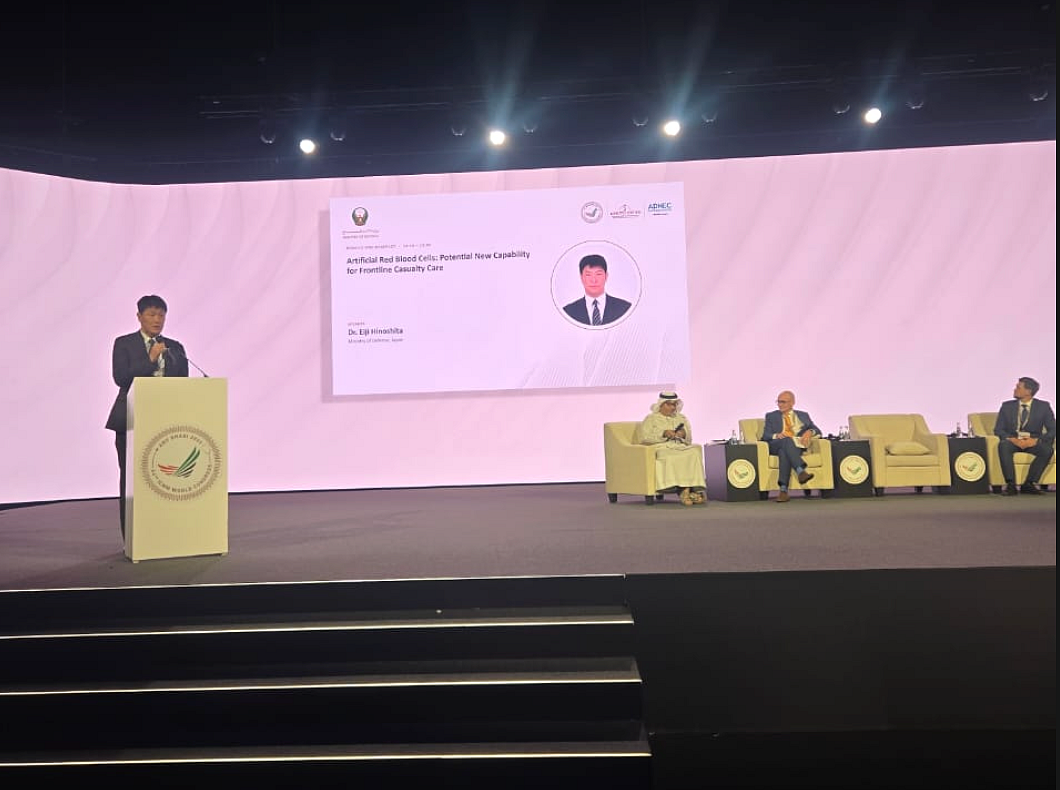
Recommended For YouPresenting the research at the International Congress of Military Medicine in Abu Dhabi, Dr Eiji Hinoshita, director-general for health and medicine at Japan's Ministry of Defence, said conventional blood transfusions remained essential in combat casualty care, but transporting sufficient supplies to the point of injury could be difficult.
Stay up to date with the latest news. Follow KT on WhatsApp Channels.
Logistical constraints, limited transportation and the conditions on the frontline can prevent blood from reaching severely wounded personnel quickly enough, creating a potentially fatal gap between injury and definitive treatment.
Japan is therefore looking at artificial blood as a possible additional capability, rather than a replacement for conventional donated blood.
The research was presented at the 46th World Congress of Military Medicine, which is being held at the ADNEC Centre in Abu Dhabi until November 13.
Organised in the UAE under the supervision of the International Committee of Military Medicine, the congress has brought together military medical professionals, researchers and defence health experts from more than 120 countries to discuss challenges ranging from battlefield trauma and emergency surgery to mental health and medical preparedness.
Unlike regular blood, the haemoglobin vesicles do not require blood-type matching. Their potential for longer-term storage could also make them suitable for stockpiling and use during military operations, disasters and other emergencies when conventional blood supplies are disrupted.
Hinoshita explained that the product is designed to reduce the toxicity associated with free haemoglobin while retaining its ability to transport oxygen.
The research has produced encouraging results in animal experiments. In one study involving rabbits with severe haemorrhagic shock, eight of the 10 animals given the artificial blood survived. None of the 10 animals receiving only a plasma expander survived, while all 10 animals given conventional red blood cells and plasma components survived.
The findings provide preliminary evidence that the artificial product could offer temporary oxygen-carrying support when conventional blood is unavailable. However, the results do not establish that it is as effective as donated blood or that it can yet be used to treat wounded soldiers.
The technology has also entered early-stage human safety testing. A Phase Ib clinical trial registered in Japan is assessing haemoglobin vesicles in healthy adult volunteers, with planned doses of up to 400ml. The study is designed to examine safety and how the product behaves in the body, rather than test its effectiveness in treating bleeding patients.
Japan's interest in the technology is part of a broader effort to strengthen military medical readiness. Hinoshita said the country's 2022 National Security Strategy identified the need to secure blood and other essential medical supplies for combat casualty care.
An expert panel on transfusion in combat casualty care was subsequently established in August 2023 to advance the development of a system for producing, securing and stockpiling blood supplies.
The artificial blood research is intended to address a limitation that stockpiling conventional blood alone cannot necessarily overcome: getting the right product to a casualty at the right time.
If further testing establishes its safety and effectiveness, haemoglobin vesicles could eventually provide military medics with another option when access to conventional transfusions is delayed.
ALSO READ- Ukraine war exposes risks of military medical evacuations, Abu Dhabi congress hears UAE medical evacuations surge as conflict raises demand for emergency response

Legal Disclaimer:
MENAFN provides the
information “as is” without warranty of any kind. We do not accept any
responsibility or liability for the accuracy, content, images, videos,
licenses, completeness, legality, or reliability of the information
contained in this article. If you have any complaints or copyright issues
related to this article, kindly contact the provider above.


Comments
No comment