


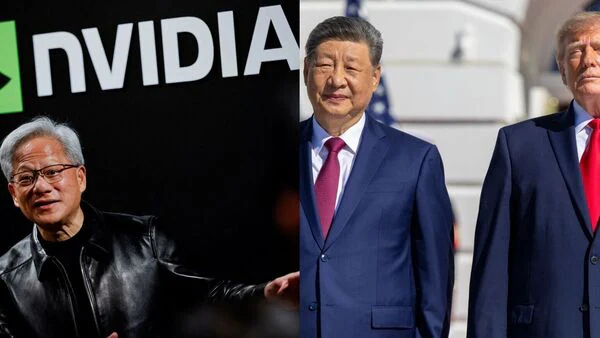
Jensen Huang's Nvidia Exit Ahead Of APEC: Could The China Spy Controversy Complicate Trump's Meeting With Xi Jinping?


The developments come at a crucial time, with the Asia-Pacific Economic Cooperation (APEC ) Economic Leaders' Meeting scheduled to take place in Shenzhen on November 18–19. US President Donald Trump is expected to meet his Chinese counterpart, Xi Jinping, on the sidelines of the summit, raising questions about whether the controversy surrounding Huang could cast a shadow over the high-stakes engagement.
Several reports claimed that Trump had been informed about Huang's alleged relationship with Alice Huang. However, the US President has denied having prior knowledge of the matter, while also expressing sympathy for the Nvidia chief, who has grown increasingly close to him.
Quick answers to key questions
.5 QUESTIONS1Why did Jensen Huang step down as Nvidia CEO?⌵Huang resigned amid reports of extramarital relationships, including one involving Alice Huang, who has been suspected by US officials of links to Chinese intelligence. A report said Nvidia's board acted after a second alleged affair surfaced.
2Have allegations that Alice Huang was a Chinese spy been confirmed?⌵No. The Justice Department said it had not concluded whether Alice Huang was a spy, and the FBI was investigating reports of her alleged links to the Chinese government. The allegations have not been independently established.
3Could the Jensen Huang controversy complicate the Trump-Xi meeting at APEC?⌵It could add complexity to the meeting because it comes amid tensions over semiconductor exports, AI and technology competition. Analysts cited in the article said the controversy was unlikely to immediately change Trump's approach to Beijing.
4Why are Nvidia AI chips a point of contention between the US and China?⌵Nvidia's advanced AI chips are central to the global race to develop powerful AI systems, making access to them a major issue for Washington and Beijing. Huang had urged the US to ease restrictions on chip sales to China.
5Will the Nvidia controversy lead to tighter US chip export controls on China?⌵The article does not say that tighter controls are certain. It says the controversy has increased pressure from lawmakers in both parties to scrutinise Nvidia's China sales and consider stricter limits on advanced AI chip exports.
Also Read | Chinese spy used ties with Nvidia CEO to move 240,000 chipsIn an interview with Salem News Channel on Thursday (local time), Trump said, "Well, we gave it to Jensen, frankly, that was a little before - but what a horrible thing that is, that's so sad to see that happen."
Bloomberg and The New York Times also reported that Trump had contacted Huang on separate occasions, urging him to remain in his position and checking on him following the controversy.
With Huang's departure coming just days before the Trump-Xi meeting, a key question is whether the allegations involving the Nvidia chief could complicate the US President's engagement with Beijing, particularly amid tensions over semiconductor exports, artificial intelligence and technology competition.
Why is Nvidia important to US-China relations?Nvidia and its former CEO, Jensen Huang, have become important figures in US-China technology relations. The company's advanced artificial intelligence chips are central to the global race to develop increasingly powerful AI systems, making access to its technology a major point of contention between Washington and Beijing.
Huang, who co-founded Nvidia in 1993, pushed Washington and Trump to ease restrictions on the sale of advanced AI chips to Beijing, arguing that wider access to the technology would help the country maintain its lead in AI development.
In December 2025, the US President allowed sales of the H200, the chipmaker's second-most powerful AI chip, with roughly 25% of the proceeds going to the US government. Trump went ahead with the decision despite resistance from China hawks across both Republican and Democratic ranks.
Also Read | The Jensen Huang scandal is testing Taiwan's devotion to its hometown heroHuang was unexpectedly included in Trump's delegation to Beijing in May, as the administration sought to revive stalled sales of Nvidia's H200 chips. However, even after Trump approved the exports, shipments remained limited as Chinese authorities were slow to grant import clearances, reportedly to encourage the growth of domestic chip manufacturers.
The latest controversy surrounding Huang could therefore complicate an already delicate US-China technology relationship, just days before Trump and Xi are expected to meet at the APEC summit.
Will Trump take a tougher stance against China amid the Nvidia scandal? What we knowTrump is unlikely to immediately change his approach towards Beijing because of the controversy, according to analysts cited by Al Jazeera. Huang's departure from Nvidia is a "stalemate at best", Singapore-based geopolitical analyst Steve Okun told the publication, suggesting that the scandal is unlikely to significantly affect relations between Washington and Beijing.
Beijing has rejected the espionage allegations, accusing Washington of using them as a pretext to restrict China's technological development. On Thursday, Chinese Foreign Ministry spokesperson Mao Ning said, "The US side should stop fabricating such 'spy' narratives as a pretext for imposing a technological blockade."
Also Read | 'He did nothing about it': US lawmaker accuses Trump of shielding HuangHowever, the controversy is increasing pressure on Trump and his administration at home, with lawmakers from both Republicans and Democrats calling for greater scrutiny of the company's dealings with China and the administration's handling of semiconductor exports. On Thursday, House Speaker Mike Johnson said there was a growing consensus in Congress on limiting semiconductor chip exports to China, adding that recent developments had strengthened the case for restrictions. Some lawmakers are also pushing for tighter controls on advanced AI chip sales to Beijing.
This comes as US Attorney General Todd Blanche said the Department of Justice (DOJ) had yet to conclude whether Alice Huang was a Chinese spy, while the FBI was investigating reports that she had worked for the Chinese government. Singapore has also clarified that its investigation involving Alice Huang was not related to espionage.
The controversy may therefore not immediately change Trump's approach towards Beijing, but it could intensify domestic pressure for a tougher US technology policy. With Congress and hawkish voices within the administration calling for tighter export controls, the issue could add another layer of complexity to the upcoming Trump-Xi meeting.

Legal Disclaimer:
MENAFN provides the
information “as is” without warranty of any kind. We do not accept any
responsibility or liability for the accuracy, content, images, videos,
licenses, completeness, legality, or reliability of the information
contained in this article. If you have any complaints or copyright issues
related to this article, kindly contact the provider above.


Comments
No comment