


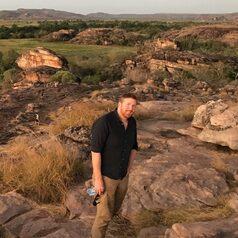
Chris Clarkson


- Professor, Chair of Rock Art and Archaeology, Griffith University
Professor Chris Clarkson is an archaeologist based at the Australian Research Centre for Human Evolution, Griffith University. His research interests span early human dispersals, stone tool technology, Indigenous heritage, and cultural change across regions including Arnhem Land, South Asia, Indonesian, Africa, Arabia and Europe. Clarkson's most significant discovery came through his leadership of new excavations at the Madjedbebe rock shelter in Arnhem Land. His team, in partnership with Mirarr Traditional Owners and the Gundjeihmi Aboriginal Corporation, unearthed over 190,000 artifacts-including the world's oldest ground-edge stone axes, the oldest seed-grinding tools outside of Africa and intensive early ochre-processing-dating human occupation in northern Australia to approximately 65,000 years ago. This groundbreaking research, published in Nature, has reshaped understanding of human migration out of Africa and the antiquity of Aboriginal occupation of Sahul. He has pioneered quantitative 3D methods for analyzing lithics, offering new insights into cultural lineages and technological convergence in Homo sapiens migrations, has published leading research on the impact of the Toba super eruption on human populations in India, and investigated the relationship between climate change and human technological responses across multiple continents.
Clarkson has current ARC Discovery Grants on the evolution of projectile technology and the evolving toolkit of human dispersal out of Africa to Sahul. He is engaged in multidisplinary research investigating long term human occupation of the Greater Red Lily Lagoon Area, Western Arnhem Land, the responses of lithic technology to post-glacial climate change in Indonesia, and interglacial dispersals of modern humans in the Empty Quarter of Arabia.
He is a fellow of the Society of Antiquaries of London and was elected a Fellow of the Australian Academy of the Humanities in 2024 for his transformative work at Madjedbebe. Professor Clarkson has authored over 110 journal articles and book chapters, and his 2007 book Lithics in the Land of the Lightning Brothers remains a key reference on stone tool reduction and Wardaman archaeology. He won the Shanghai Archaeology Forum Field Discovery Award for his work at Madjedbebe in 2017.
He earned his BA Hons in Archaeology at the University of Queensland before completing a PhD in 2004 at the Australian National University focusing on long-term technological change in Wardaman Country, Northern Territory. After a postdoctoral fellowship at the Leverhulme Centre for Human Evolution at the University of Cambridge, focusing on the Southern Dispersal Hypothesis with Profs Marta Lahr and Robert Foley, Clarkson returned to UQ as an ARC Fellow and became a lecturer in 2005, progressing to Professor in 2017. He has held various fellowships over the course of his career, including an ARC Early Career Research Fellowship, an ARC QEII Fellowship, an ARC Future Fellowship and a Beaufort Professorial Fellowship at St Johns College, University of Cambridge. Prof Clarkson joined the Australian Research Centre for Human Evolution at Griffith University in 2025 and was appointed the Rock Art Australia Chair of Rock Art and Archaeology in 2026.
Experience- –present Professor, Chair of Rock Art and Archeology, Australian Research Centre for Human Evolution, Griffith University
- 2004 Australian National University, PhD Archaeology
- 2021 Pandanus nutshell generates a palaeoprecipitation record for human occupation at Madjedbebe, northern Australia, Nature Ecology & Evolution 2021 Stochastic models support rapid peopling of Late Pleistocene Sahul, Nature COmmunications 2020 Human occupation of northern India spans the Toba super-eruption~ 74,000 years ago, Nature Communications 2020 The first Australian plant foods at Madjedbebe, 65,000–53,000 years ago, Nature Communications 2020 Papuan mitochondrial genomes and the settlement of Sahul, Journal of Human Genetics 2017 Human occupation of northern Australia by 65,000 years ago, Nature 2011 Pelagic fishing at 42,000 BP and the maritime skills of modern humans, Science 2009 Population increase and environmental deterioration correspond with microlithic innovations in South Asia ca. 35,000 years ago, PNAS 2007 Lithics in the Land of the Lightning Brothers: 15,000 years of Technological and Cultural Change in Wardaman Country, Northern Territory, Terra Australis 2007 Middle Palaeolithic assemblages from the Indian sub-continent before and after the Toba super-eruption., Science
- 2026 ARC Centre of Excellence 'Transforming Human Origins Research' Role: CI Funding Source: Australian Research Council 2026 Human responses to post-glacial sea level rise at Red Lily, Arnhem Land Role: Lead CI Funding Source: Australian Research Council 2025 Subsurface imaging and augering at 10 archaeological sites around Red Lily Lagoon Role: Lead CI Funding Source: Rock Art Australia 2024 Sea level rise and impact on humans in Indonesia Role: CI Funding Source: Rock Art Australia 2024 High-speed projectiles and the global origins of projectile technology Role: Lead CI Funding Source: Australian Research Council 2024 The stone toolkit of the first Homo sapiens from Africa to Australia Role: Lead CI Funding Source: Australian Research Council 2023 Dating prehistoric human occupation at Malangangerr, Kakadu National Park, 2023 excavations Role: Lead CI Funding Source: Australian National Science and Technology Organisation 2023 The effects of post-glacial sea level rise on Indonesian archaeology and rock art Role: Lead CI Funding Source: Rock Art Australia 2022 Pigment processing at Madjedbebe Role: Lead CI Funding Source: Rock Art Australia 2022 Rock art, archaeology and climate change in the Meikinj Valley, Western Arnhem Land' Role: Lead CI Funding Source: Rock Art Australia 2019 New excavations at Malangangerr, Arnhem Land Role: Lead CI Funding Source: National Geographic Society 2017 New Archaeological Investigations at Ancient Sites in Kakadu National Park Role: Future Fellow Funding Source: Australian Research Council 2011 Modern Human Origins and Early Behavioural Complexity in Australia and South East Asia Role: QEII Fellow Funding Source: Australian Research Council 2011 Archaeology of rock art in Jawoyn country, western Arnhem Land Role: CI Funding Source: Australian Research Council 2009 Assessing lithic evidence for the impact of the Toba super-eruption (74,000 years ago) on long-term cultural, biological and ecological histories of the Indian Subcontinent Role: Lead CI Funding Source: Australian Research Council 2007 Tracing African Dispersals to Australia Role: Post-Doctoral Fellow Funding Source: Australian Research Council
Fellow of the Australian Academy of Humanities; Fellow of the London Society of Antiquaries


Legal Disclaimer:
MENAFN provides the
information “as is” without warranty of any kind. We do not accept any
responsibility or liability for the accuracy, content, images, videos,
licenses, completeness, legality, or reliability of the information
contained in this article. If you have any complaints or copyright issues
related to this article, kindly contact the provider above.


Comments
No comment