(MENAFN- Thousandaire) >
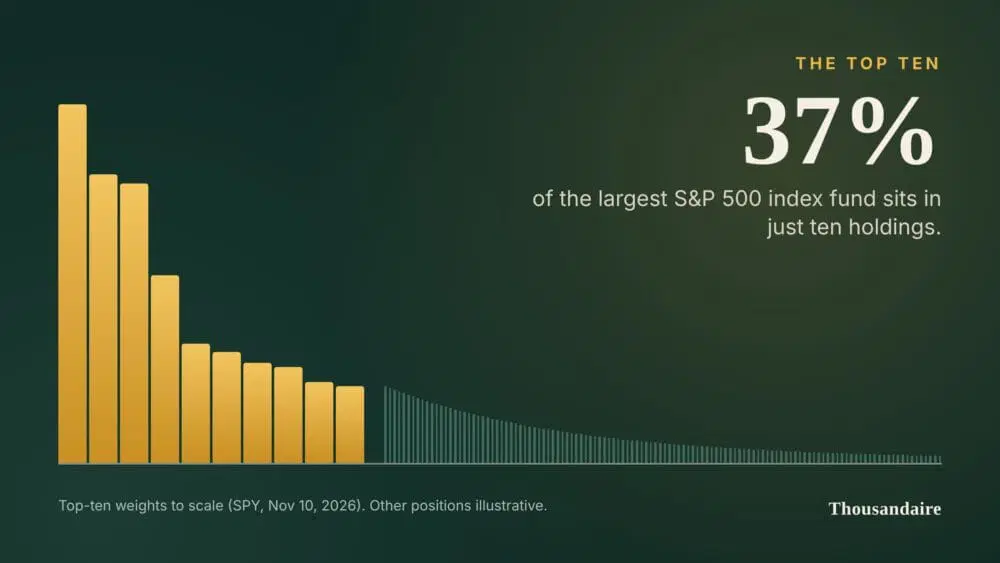
On November 10, 2026, the largest S&P 500 index ETF listed its ten biggest positions: Apple at 7.84%, NVIDIA at 6.30%, Microsoft at 6.10%, Amazon at 4.10%, Alphabet's two share classes at 2.60% and 2.09%, Broadcom at 2.43%, Meta at 2.18%, Eli Lilly at 1.77%, and Berkshire Hathaway at 1.67%, per the SPDR S&P 500 ETF Trust fund page. Add them up and nine companies make up 37.08% of a fund that holds 504 positions. The same page puts the information technology sector at 35.69% of the fund.
A story going around this week put that into dollars: a $500,000 401(k) in an S&P 500 fund, the top ten holdings fall 25%, everything else stays flat, and the account loses close to $49,000. The arithmetic holds up. What it doesn't tell you is what to do about it, and the fixes most people reach for first do less than you would expect.
Why your index fund got this top-heavy
The S&P 500 is“float-adjusted market capitalization weighted,” in the fund sponsor's words. You own each company in proportion to its market value. When the biggest companies grow faster than the rest, they take up more of the fund automatically, and nothing in the index trims them back.
Index funds are built to work this way. It is also why FINRA warns that“simply holding only funds doesn't shield you from concentration risk,” which it defines as“the risk of amplified losses that may occur from having a large portion of your holdings in a particular investment, asset class or market segment relative to your overall portfolio” (FINRA, Concentrate on Concentration Risk ).
Now put the headline scenario in plain terms. If 37.08% of the fund falls 25% and the rest stays flat, the fund drops 0.3708 × 25% = 9.3%. That's a real loss. It is also a stock-market-sized loss, the kind any all-stock portfolio has to be able to absorb. The useful question is whether your portfolio is built so that a 9% hit to one fund doesn't become a 9% hit to everything you own.
Three fixes, run on the same portfolio
Assumptions for this illustration: $200,000 invested, all of it in an S&P 500 index fund today. The stress test is the same one as the headline: the ten largest holdings fall 25%, nothing else moves. These are round numbers to show the method, not a forecast.
Starting point. Top-ten exposure is $200,000 × 37.08% = $74,160. A 25% drop costs $18,540, or 9.3% of the portfolio.
Fix 1: switch to a total-market fund
This is the most common suggestion, and it helps less than it sounds. A total U.S. market fund like the iShares Core S&P Total U.S. Stock Market ETF held 2,442 stocks as of October 23, 2026, versus 505 for the iShares Core S&P 500 ETF. But the total-market fund's information technology weight that week was 35.76%, against 37.86% for the S&P 500 fund. Roughly 1,900 extra companies moved the tech weight by about two points.
The reason: the S&P 500 already“covers approximately 80% of available market capitalization,” according to S&P Dow Jones Indices. The extra companies share the remaining slice. If the top ten are about 80% as heavy in a total-market fund, top-ten exposure falls to roughly 29.7%, or about $59,300, and the 25% stress test costs about $14,800, or 7.4% [VERIFY: confirm the top-ten weight from the ITOT holdings file; this is an estimate scaled from the 80% coverage figure]. A total-market fund is a fine core holding. It is not a concentration fix.
Fix 2: move to an equal-weight S&P 500 fund
The S&P 500 Equal Weight Index gives every company“a fixed weight” of 0.2%“of the index total at each quarterly rebalance.” Right after a rebalance, the same nine companies are 9 × 0.2% = 1.8% of the fund instead of 37%, and the stress test barely registers.
The catch is that this is a different strategy with its own risks. Every quarter it sells whatever went up and buys whatever went down, and it gives the smallest company in the index the same weight as Apple. That tilts the fund toward smaller companies and away from the ones that drove recent returns, which can win or lose for years at a stretch. Equal-weight funds also usually charge more than plain S&P 500 funds [VERIFY: current expense ratios of RSP versus SPY, IVV, and VOO from the fund pages]. If you buy one, buy it as a deliberate bet on smaller companies, sized as a slice of your stock money, not as insurance.
Fix 3: set an asset allocation and hold it
This is the fix that does the most work. Say you decide on 80% stocks and 20% bonds, with the stock side split 70% U.S. and 30% international. U.S. stocks are now 0.80 × 0.70 = 56% of the portfolio, or $112,000.
Top-ten exposure is $112,000 × 37.08% = $41,530. The 25% stress test costs $10,382, or 5.2% of the portfolio. That's a bit more than half the starting hit, and the rest of the money is spread across other countries and a different asset class rather than across more of the same U.S. companies.
The SEC's investor education office describes asset allocation as“dividing your investments among different assets, such as stocks, bonds, and cash” (Investor, Asset Allocation and Diversification ). Your mix should come from your timeline and how much of a drop you can sit through without selling, not from this week's headline. International funds carry their own large positions too, so check their top holdings the same way [VERIFY: top-ten weight of a broad international index fund such as IXUS or VXUS].
| Approach |
Top-ten exposure on $200,000 |
Loss if the top ten fall 25% |
Share of portfolio |
| 100% S&P 500 fund |
$74,160 |
$18,540 |
9.3% |
| 100% total-market fund (estimate) |
about $59,300 |
about $14,800 |
about 7.4% |
| 80/20 with 30% international |
$41,530 |
$10,382 |
5.2% |
| Equal-weight fund, right after rebalance |
$3,600 |
$900 |
0.45% |
The equal-weight row looks best and is the hardest to live with. Look at what it gives up before you look at what it protects against.
Check for overlap before you change anything
Most people who feel concentrated aren't holding one S&P 500 fund. They're holding three funds that own the same companies. Investor puts it directly:“even if you hold several mutual funds or ETFs and think you are diversified, you should check the top holdings of the funds.”
A common setup: a target-date fund in the 401(k), an S&P 500 fund in a Roth IRA, and a large-cap growth fund in a brokerage account. Each fund page lists its top holdings. Multiply each fund's weight in Apple, NVIDIA, and Microsoft by the dollars you hold in that fund, then add across accounts. If those three companies come to more than you would ever deliberately put in three stocks, that's your answer, regardless of what any single fund looks like.
What not to do
Don't sell in a taxable account just to fix this. Selling an S&P 500 fund with large gains in a brokerage account triggers capital gains tax [VERIFY: IRS Topic 409, capital gains and losses]. Trades inside a 401(k) or IRA don't [VERIFY: IRS Publication 590-B or 401(k) plan guidance on taxation at distribution]. Do the reshuffling inside retirement accounts, and point new contributions in the taxable account toward whatever is underweight.
Don't make it a one-time panic trade. Investor notes that“rebalancing tends to work best when done relatively infrequently.” Pick a target, write it down, and check it once or twice a year.
Don't confuse a smaller top ten with lower risk. A total-market or equal-weight fund is still 100% stocks. Bonds and cash are what lower the size of a drawdown. Spreading among stocks mostly changes which stocks cause it.
What to do this week
List every fund you own across your 401(k), IRAs, HSA, and brokerage accounts, with the dollar amount in each.
Pull each fund's top-ten holdings from its fund page and total your real dollar exposure to the largest five or six companies.
Run the stress test: multiply that total by 25%. Decide whether you could watch that amount disappear without selling.
If the answer is no, set a written allocation (stocks, bonds, and the U.S. and international split) and move toward it inside tax-advantaged accounts first.
Leave equal-weight funds for a deliberate side bet, if you want one at all, and keep it to a slice you have sized on purpose.
Sources
State Street Global Advisors, SPDR S&P 500 ETF Trust (SPY) fund page, top holdings, sector breakdown, and fund characteristics as of November 10, 2026
BlackRock iShares, iShares Core S&P 500 ETF (IVV) fund page, holdings count and sector weights as of October 23 and 26, 2026
BlackRock iShares, iShares Core S&P Total U.S. Stock Market ETF (ITOT) fund page, holdings count and sector weights as of October 23, 2026
S&P Dow Jones Indices, S&P 500 index overview
S&P Dow Jones Indices, S&P 500 Equal Weight Index overview
FINRA, Concentrate on Concentration Risk
U.S. Securities and Exchange Commission, Investor, Asset Allocation and Diversification
Thousandaire Editorial Team
The Thousandaire Editorial Team creates practical, evidence-based personal finance content for people building real wealth. We break down investing, retirement, taxes, real estate, and other wealth-building decisions with clear explanations, real numbers, and no hype
MENAFN12112026008494017819ID1111954356





Comments
No comment