


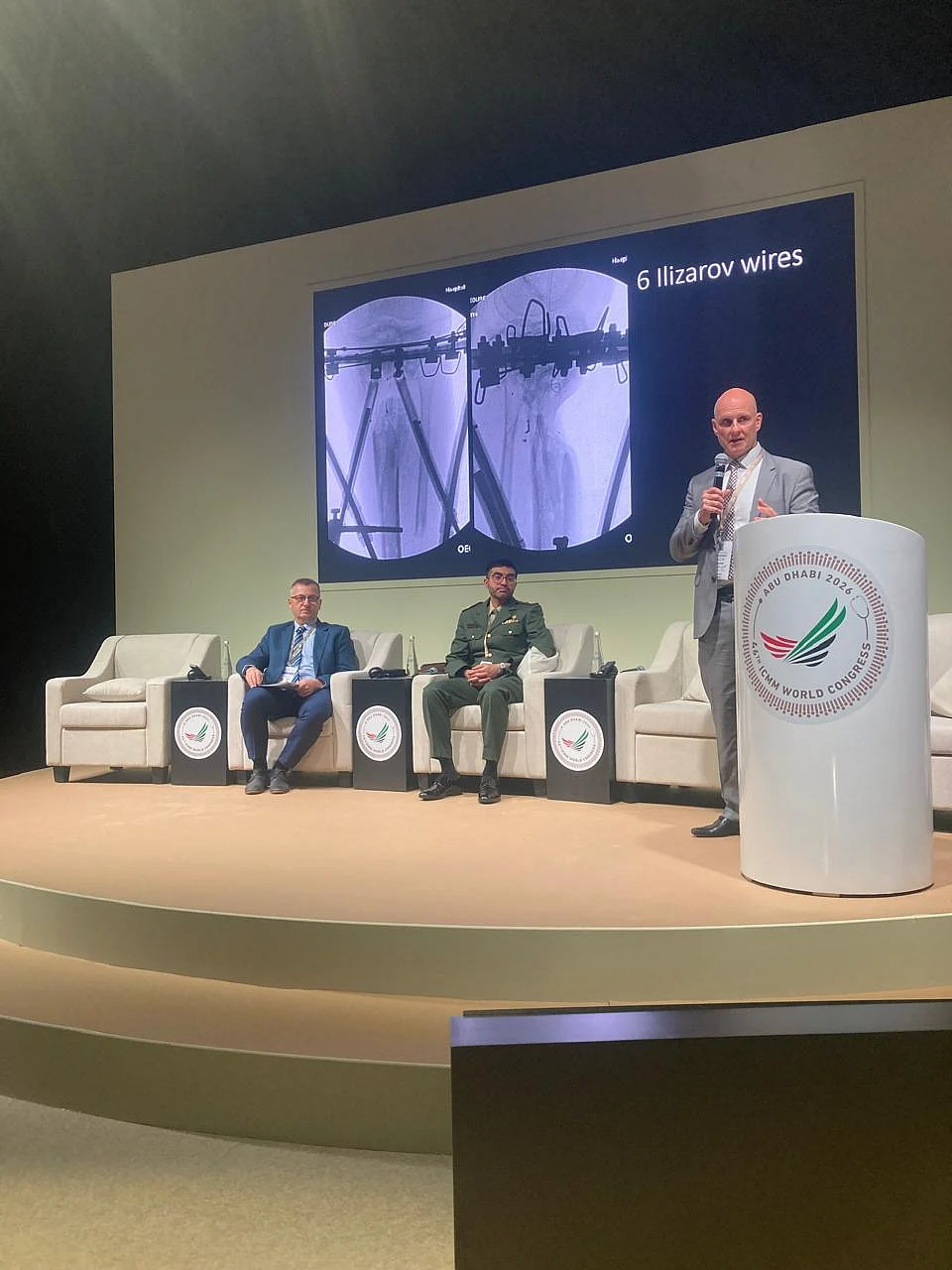
Military Medicine Congress In Abu Dhabi: New Techniques Help Patients Avoid Amputation


Dr Austin Fragomen of the Hospital for Special Surgery in the United States presented several techniques used to reconstruct severely damaged limbs, including cases involving soldiers and patients with complicated fractures, infections and extensive soft-tissue injuries.
Recommended For YouSpeaking at the International Congress for Military Medicine in Abu Dhabi, Fragomen said bone transport was among the techniques used to address large bone defects that cannot be adequately treated with conventional bone grafting.
Stay up to date with the latest news. Follow KT on WhatsApp Channels.
The procedure involves cutting a section of healthy bone and gradually moving it across the missing section. As the bone is transported, new bone forms behind it, progressively filling the defect.
One of the established methods uses a circular external fixation device, based on the Ilizarov technique, to guide the movement and support the bone as it heals.
Fragomen also described more modern computer-assisted external fixation systems that help surgeons control the direction of bone movement and ensure the transported section reaches the intended position.
However, newer techniques are increasingly allowing surgeons to carry out bone transport using internal devices, reducing the time patients need to spend wearing external frames.
In one case, he described treating a soldier with a severely damaged knee, repeated infected surgical reconstructions and a large bone defect. The patient had faced the possibility of an above-knee amputation but wanted to pursue limb salvage.
Fragomen used an internal bone-transport nail, supported by an external fixation system, to gradually move a section of bone across a defect measuring approximately 15cm.
The transported bone was moved at a rate of about half a millimetre a day until it reached the other side of the defect. Once the bone had docked, further procedures could be carried out to help it heal.
He said the approach reduced the amount of time the patient needed to spend with external fixation compared with traditional methods.
In another example, Fragomen described an internal bone-transport nail being used to address an 11cm defect. The system allows surgeons to plan the reconstruction and gradually move the bone segment using a mechanism built into the implant.
The surgeon also outlined techniques for managing infected wounds where closing damaged skin and soft tissue can be as challenging as rebuilding the bone itself.
In some cases, temporarily shortening the bone can allow surgeons to close a wound without placing excessive tension on the surrounding skin. The limb can then be gradually lengthened and reconstructed once the infection has been brought under control.
He described cases in which this approach helped avoid the need for more complex plastic surgery, including free-flap procedures to cover exposed bone.
Another technique involves using antibiotic-loaded material inside the bone canal to help control infection while supporting the biological process of bone regeneration during lengthening.
Fragomen said the choice of reconstruction technique depends on several factors, including the size and location of the defect, the condition of the surrounding soft tissue, the presence of infection and the patient's overall circumstances.
The techniques are particularly relevant to complex military injuries, where patients may have extensive bone loss, damaged soft tissue and infections following multiple operations.
Rather than relying on a single approach, surgeons can combine bone transport, temporary shortening, internal fixation and soft-tissue management to preserve a limb that might otherwise be considered for amputation.
ALSO READ- UAE's 'Step of Hope' to provide prosthetic limbs to Gaza war victims 98-year-old in critical condition undergoes surgery at Abu Dhabi hospital Dubai doctors rebuild man's face after severe accident leaves complex fractures

Legal Disclaimer:
MENAFN provides the
information “as is” without warranty of any kind. We do not accept any
responsibility or liability for the accuracy, content, images, videos,
licenses, completeness, legality, or reliability of the information
contained in this article. If you have any complaints or copyright issues
related to this article, kindly contact the provider above.


Comments
No comment