


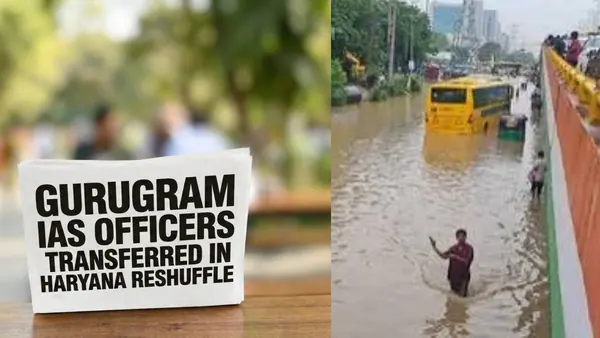
Gurugram News: IAS Officers Transferred In Haryana Reshuffle After Monsoon Mayhem, Amid Worsening AQI Who Are They?


The changes come months after severe monsoon waterlogging brought Gurugram to a standstill, leaving school buses carrying children stranded on flooded roads, and amid deteriorating air quality across Delhi-NCR. The Commission for Air Quality Management (CAQM) has also invoked Stage III of the Graded Response Action Plan (GRAP) across the region.
According to a Haryana government order dated November 10, Phool Chand Meena, a 2004-batch IAS officer who was heading the GMDA and Faridabad Metropolitan Development Authority (FMDA), has been moved to the posts of Commissioner and Secretary in the state's Human Resources and General Administration departments.
Quick answers to key questions
.5 QUESTIONS1Who replaced Phool Chand Meena as CEO of the GMDA?⌵Dusmanta Kumar Behera, a 2007-batch IAS officer, replaced Meena as CEO of both the Gurugram Metropolitan Development Authority and the Faridabad Metropolitan Development Authority.
2Who became the new Municipal Commissioner of Gurugram?⌵Pankaj, a 2020-batch IAS officer who was Municipal Commissioner of Panipat, took over as MCG Commissioner and District Municipal Commissioner of Gurugram.
3Why did the Gurugram civic reshuffle draw attention after the monsoon?⌵It followed severe August waterlogging that disrupted traffic and left school buses carrying children stranded for hours. The flooding also raised concerns about drainage infrastructure and accountability.
4What does GRAP Stage III restrict in Gurugram?⌵Stage III includes restrictions on non-essential construction and demolition, along with measures from earlier GRAP stages. The CAQM also called for dust-control measures.
5What AQI did Gurugram record during the GRAP Stage III period?⌵NISE Gwal Pahari recorded an AQI of 359 at around 5 am. An AQI between 301 and 400 falls in the 'very poor' category.
Dusmanta Kumar Behera, a 2007-batch IAS officer who was holding these two departmental positions, will replace Meena as CEO of both the GMDA and FMDA.
At the MCG, Commissioner Pradeep Dahiya has been transferred as Managing Director of the Haryana State Federation of Cooperative Sugar Mills and Director of the State Audit Department. Pankaj, a 2020-batch IAS officer who was serving as Municipal Commissioner of Panipat, took over as the new MCG Commissioner and District Municipal Commissioner of Gurugram.
Also Read | Why could a weak monsoon derail India's ambitious ethanol blending programme?Mohd Imran Raza has been appointed Additional CEO of the GMDA, while Ankita Choudhary has been moved from the MCG to take charge as Municipal Commissioner of Panipat. The reshuffle also includes changes in other IAS and HCS postings.
Why Gurugram's civic reshuffle comes into focus after monsoon chaosThe transfers come after city's alleged failure to cope with heavy monsoon rainfall in August. On August 24, intense showers inundated several arterial roads, underpasses and residential areas, disrupting traffic and leaving children travelling home from school stuck in buses for hours.
Gurugram recorded around 75 mm of rainfall between 8 am and 5 pm that day, according to district administration data. Subhash Chowk was among the worst-affected locations, with school buses stranded in waterlogging and traffic congestion.
On August 25, hundreds of schoolchildren had remained inside buses for hours. Parents struggled to reach them as flooded roads and traffic snarls blocked access to several areas. The district administration subsequently invoked the Disaster Management Act and issued a standard operating procedure (SOP) to regulate school transport during heavy rainfall.
Also Read | Gurugram Police takes 'action' against Home Guard after viral cash-seeking video14 school buses had remained stranded for up to six hours during the August waterlogging. Children were inside the buses as water accumulated around the vehicles.
The flooding also triggered questions over drainage infrastructure and accountability.
On September 8, Union Minister of State and Gurugram MP Rao Inderjit Singh wrote to Chief Minister Nayab Singh Sain seeking a vigilance inquiry into the waterlogging. He raised concerns about encroachments on natural drains and the lack of action despite notices being issued to builders, according to ThePrint.
A senior Haryana government officer told ThePrint that the transfers were part of a routine process and should not be read as having any specific significance.
Gurugram AQI amid GRAP Stage III restrictionsThe administrative changes also come as air pollution remains a major concern across Delhi-NCR. On November 12, Delhi recorded an average AQI of 321 at 7 am, placing it in the 'very poor' category, according to CPCB data. Gurugram also reported elevated pollution levels, with NISE Gwal Pahari recording an AQI of 359 at around 5 am, according to readings.
Also Read | Gurugram teen builds solar-assisted three-wheeler to help low-income familiesThe CAQM invoked Stage III of GRAP across Delhi-NCR on November 6 after Delhi's daily average AQI reached 382. The commission said forecasts from the India Meteorological Department (IMD) and the Indian Institute of Tropical Meteorology indicated that air quality was likely to deteriorate into the 'severe' category.
Stage III measures include restrictions on non-essential construction and demolition activities, alongside measures under the earlier stages. The CAQM has also called for dust-control measures and urged citizens to follow its advisory.

Legal Disclaimer:
MENAFN provides the
information “as is” without warranty of any kind. We do not accept any
responsibility or liability for the accuracy, content, images, videos,
licenses, completeness, legality, or reliability of the information
contained in this article. If you have any complaints or copyright issues
related to this article, kindly contact the provider above.


Comments
No comment