


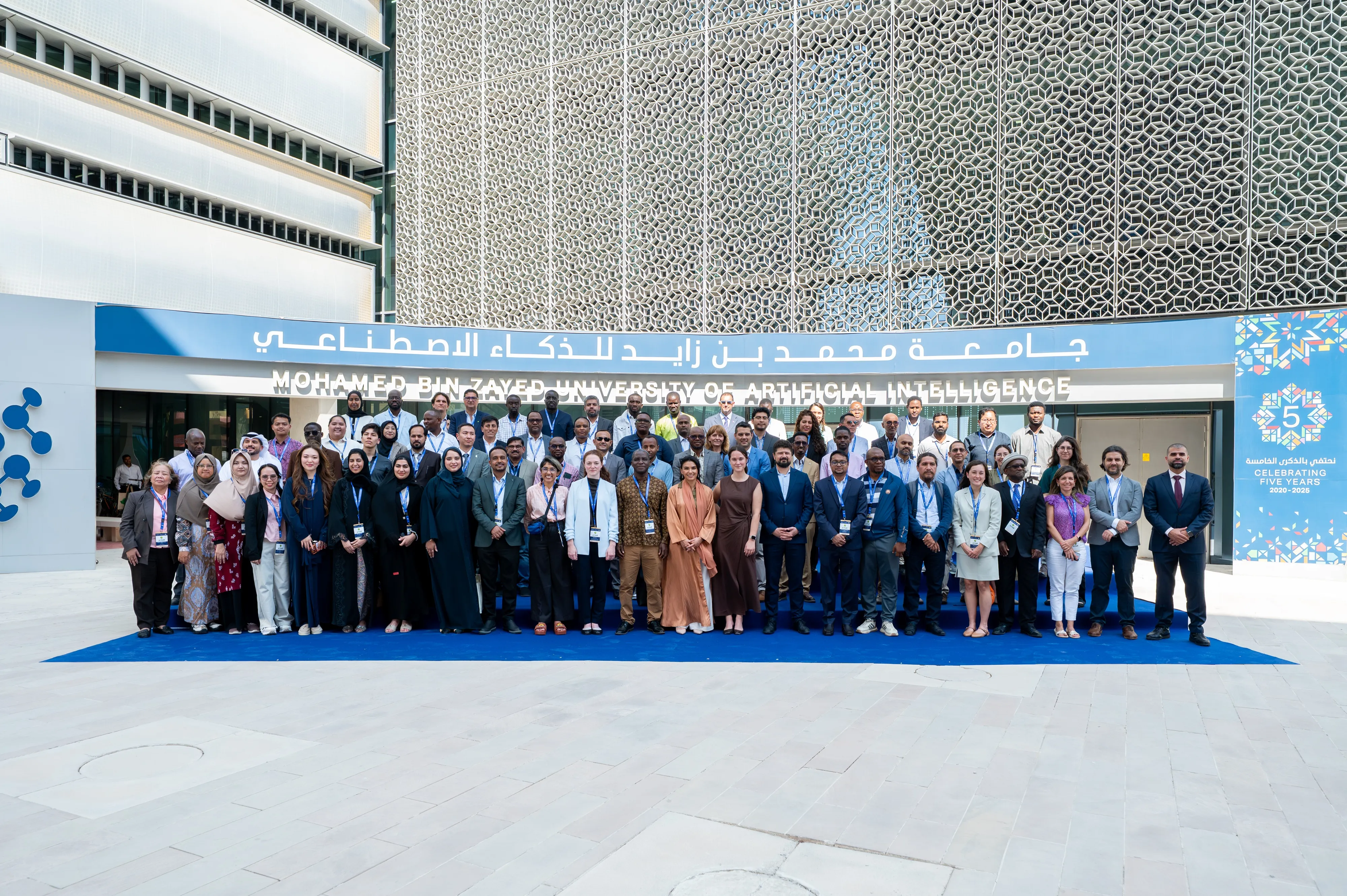
INTERNATIONAL AFFAIRS OFFICE AT THE UAE PRESIDENTIAL COURT HOSTS OFFICIALS FROM 15 COUNTRIES FOR AI WEATHER FORECASTING TRAINING TO SUPPORT FARMERS GLOBALLY


(MENAFN- Mid-East Info) The International Affairs Office at the UAE Presidential Court convenes government officials
from 15 countries, including the UAE, and nations across Africa, Asia, and Latin America, in
Abu Dhabi for a specialized training program on AI-powered weather forecasting for
agriculture. Borderless Finance. AI-Native.
forecasting and agricultural advisory services to support more informed decision-making and
strengthen agricultural resilience.
● The program strengthens Abu Dhabi's position as a leading global hub for the application of
AI in agriculture. Abu Dhabi, United Arab Emirates – Government officials from 15 countries including the UAE, and
nations across Africa, Asia, and Latin America, are participating in the“AI Weather Forecasting for
Agriculture Training Program,” hosted in Abu Dhabi from November 9 to 13, 2026, to strengthen
knowledge exchange and international collaboration in leveraging AI to improve weather forecasting
and support the agricultural sector. The five-day program is convened by the International Affairs Office at the UAE Presidential Court
and jointly organised by Mohamed bin Zayed University of Artificial Intelligence (MBZUAI) and the
University of Chicago, in collaboration with the Agricultural Innovation Mechanism for Scale (AIM for
Scale) and the National Center for Meteorology (NCM). The program aims to equip representatives from national meteorological and hydrological services
and ministries of agriculture with the knowledge and practical skills to use AI-powered forecasting
tools and translate weather data and forecasts into practical agricultural advice that supports
smallholder farmers in making informed decisions and adapting to climate change. H.E. Dr. Abdulla Ahmed Al Mandous, Chairman of WMO and the National Center of Meteorology
(NCM), said:“Artificial intelligence is transforming the future of weather forecasting, creating new
opportunities to deliver more accurate, timely, and actionable information, particularly for sectors
such as agriculture that are highly sensitive to weather and climate conditions. We are pleased to
host this international training program at NCM, bringing together participants from different
countries, alongside our own specialists, to exchange knowledge and explore the practical
applications of AI in meteorology. This initiative reflects our commitment to advancing scientific
collaboration, strengthening national and international capabilities, and supporting the development
of innovative weather services that contribute to agricultural resilience and food security.” The training builds on an inaugural cohort in 2025 involving Bangladesh, Chile, Ethiopia, Kenya and
Nigeria. This year, representatives from those countries are joined by officials from the UAE, Bolivia, Colombia, Indonesia, Pakistan, Peru, the Philippines, Rwanda, Senegal and Sierra Leone. The
program aims to build capacity across 30 countries by 2028. Fatema AlMulla, Head of International Relations at the International Affairs Office, UAE
Presidential Court, said:“The true value of artificial intelligence lies in our ability to turn scientific
innovations into practical solutions that make a tangible difference in farmers' lives. Achieving this
requires building institutional capacity and strengthening international cooperation, enabling
countries to use advanced technologies to address climate challenges and strengthen the resilience
of their agricultural sectors.” The training focuses on two complementary tracks: running AI weather forecasting models and
evaluating their performance against existing systems and local observations, and using their
outputs to develop agricultural advice that supports crop management and preparation for extreme
weather events. Each country team is expected to develop an initial roadmap for integrating AI-
powered weather forecasting into national services, identifying technical requirements, institutional
responsibilities and implementation steps. Professor Souhaib Ben Taieb, Director of the M.Sc. and Ph.D. programs in Statistics and Data
Science at MBZUAI, said:“At MBZUAI, we are committed to advancing AI research that can address
real-world challenges. Weather forecasting for agriculture is a clear example of how AI can make a
meaningful difference by improving weather predictions and supporting more informed agricultural
planning. Through this program, we are bringing our expertise in AI and data science to an area with
significant potential for global impact.” The training program forms part of the Abu Dhabi AI Ecosystem for Global Agricultural Development,
launched in December 2025 and built on the USD 200 million partnership between the UAE and the
Gates Foundation announced at COP28. The ecosystem brings UAE institutions and international
partners together to scale innovative solutions, supporting AIM for Scale and its partners' ambition
to reach 100 million smallholder farmers with AI-powered weather information by 2030. “AI can give low- to middle-income countries weather forecasts that meet the same gold standard as
forecasts in countries with advanced economies,” said Katie Kowal, director of AI for Weather at
the Data Science Institute and at the University of Chicago's Human-Centered Weather Forecasts
Initiative.“But accurate forecasts alone are not enough. They need to provide timely and useful
information to the people who can act on them. We're excited to be working with countries to help
them build the tools and expertise needed to harness these opportunities for their people.”
NVIDIA has also donated 14 Dell Pro Max GB10 Workstations to participating government
institutions, providing the computing resources needed for continued testing and evaluation after
participants return home. “AI is creating an extraordinary opportunity to transform how countries produce and deliver
weather forecasts, but the real measure of success is what these advances mean for farmers,” said
Paul Winters, Executive Director of AIM for Scale and Professor at the University of Notre Dame's
Keough School of Global Affairs.“By ensuring that national institutions have the tools, expertise,
and partnerships to harness these innovations, we can help more farmers have access to the timely,
actionable information they need to make better decisions, improve productivity, and strengthen
their livelihoods. Our ambition is to turn this technological breakthrough into lasting national
capabilities and reach hundreds of millions of farmers.” About the International Affairs Office at the UAE Presidential Court
The International Affairs Office at the UAE Presidential Court is a specialised office established to
advance and deliver strategic international projects, with a particular focus on science, research, and
diplomacy. It serves as a platform for high-impact initiatives that call for integrated vision and a
multidisciplinary approach, producing sustainable outcomes with tangible impact. The Office also
plays a pivotal role in strengthening international cooperation, building strategic partnerships, and
supporting the exchange of knowledge and expertise on the global stage. About the Mohamed bin Zayed University of Artificial Intelligence (MBZUAI)
Mohamed bin Zayed University of Artificial Intelligence (MBZUAI) is a research university in Abu
Dhabi. Founded in 2019, it enrolled its first graduate students in 2021 and opened a highly selective
undergraduate program in 2025. Recognized globally for its research excellence, it has nearly a
thousand students from more than 70 countries. Learn more at ac. About the National Center of Meteorology NCM
The National Center of Meteorology (NCM) is the UAE's national authority responsible for
meteorological services, playing a vital role in weather and climate monitoring, forecasting, and early
warnings to support public safety and protect lives and property. NCM operates an advanced
network of meteorological observation systems, weather radars, satellite technologies, and
numerical weather prediction models, while integrating artificial intelligence to enhance forecasting
accuracy and service efficiency. The Center also advances scientific research, specialized capacity
building, and regional and international cooperation in meteorology, climate science, and rain
enhancement, contributing to sustainable development and improved resilience to climate-related
challenges. Website: AIM for Scale:
The Agricultural Innovation Mechanism for Scale (AIM for Scale) works with governments,
multilateral development banks, and research partners to scale evidence-based, cost-
effective innovations, with the objective of improving livelihoods and food security for millions
of farmers across low- and middle-income countries. Through funding to the University of
Notre Dame, it is supported by the International Affairs Office of the UAE Presidential Court,
the Gates Foundation, and the OpenAI Foundation. Learn more at aimforscale.
The Agricultural Innovation Mechanism for Scale (AIM for Scale) works with governments,
multilateral development banks, and research partners to scale evidence-based, cost-effective
innovations, with the objective of improving livelihoods and food security for millions of farmers
across low- and middle-income countries. Through funding to the University of Notre Dame, it is
supported by the International Affairs Office of the UAE Presidential Court, the Gates Foundation,
and the OpenAI Foundation. Learn more at aimforscale About the University of Chicago
The University of Chicago's role in this program spans two complementary initiatives. The AI for
Climate Initiative-a joint initiative of the Institute for Climate and Sustainable Growth and the Data
Science Institute-aims to accelerate and transform climate research using the latest innovations in
AI with a focus on both scientific advances and societal impacts. The University of Chicago's Human-
Centered Weather Forecasts Initiative leverages the power of artificial intelligence to evaluate and
build weather forecasts alongside National Meteorological Services that can target what countries
need to know for farming, health, and heat. The team of climate scientists, AI experts and
economists work with low- and middle-income countries to disseminate forecasts, test
dissemination strategies, refine based on user feedback, and scale them up.
from 15 countries, including the UAE, and nations across Africa, Asia, and Latin America, in
Abu Dhabi for a specialized training program on AI-powered weather forecasting for
agriculture. Borderless Finance. AI-Native.
Your digital companion for smarter everyday choices. Built for how you live, earn, and grow. Move money at your pace with AI-powered finance, all in one tap.
Join the waiting list. Earn ● The traning is designed to equip participants with practical skills in AI-powered weatherforecasting and agricultural advisory services to support more informed decision-making and
strengthen agricultural resilience.
● The program strengthens Abu Dhabi's position as a leading global hub for the application of
AI in agriculture. Abu Dhabi, United Arab Emirates – Government officials from 15 countries including the UAE, and
nations across Africa, Asia, and Latin America, are participating in the“AI Weather Forecasting for
Agriculture Training Program,” hosted in Abu Dhabi from November 9 to 13, 2026, to strengthen
knowledge exchange and international collaboration in leveraging AI to improve weather forecasting
and support the agricultural sector. The five-day program is convened by the International Affairs Office at the UAE Presidential Court
and jointly organised by Mohamed bin Zayed University of Artificial Intelligence (MBZUAI) and the
University of Chicago, in collaboration with the Agricultural Innovation Mechanism for Scale (AIM for
Scale) and the National Center for Meteorology (NCM). The program aims to equip representatives from national meteorological and hydrological services
and ministries of agriculture with the knowledge and practical skills to use AI-powered forecasting
tools and translate weather data and forecasts into practical agricultural advice that supports
smallholder farmers in making informed decisions and adapting to climate change. H.E. Dr. Abdulla Ahmed Al Mandous, Chairman of WMO and the National Center of Meteorology
(NCM), said:“Artificial intelligence is transforming the future of weather forecasting, creating new
opportunities to deliver more accurate, timely, and actionable information, particularly for sectors
such as agriculture that are highly sensitive to weather and climate conditions. We are pleased to
host this international training program at NCM, bringing together participants from different
countries, alongside our own specialists, to exchange knowledge and explore the practical
applications of AI in meteorology. This initiative reflects our commitment to advancing scientific
collaboration, strengthening national and international capabilities, and supporting the development
of innovative weather services that contribute to agricultural resilience and food security.” The training builds on an inaugural cohort in 2025 involving Bangladesh, Chile, Ethiopia, Kenya and
Nigeria. This year, representatives from those countries are joined by officials from the UAE, Bolivia, Colombia, Indonesia, Pakistan, Peru, the Philippines, Rwanda, Senegal and Sierra Leone. The
program aims to build capacity across 30 countries by 2028. Fatema AlMulla, Head of International Relations at the International Affairs Office, UAE
Presidential Court, said:“The true value of artificial intelligence lies in our ability to turn scientific
innovations into practical solutions that make a tangible difference in farmers' lives. Achieving this
requires building institutional capacity and strengthening international cooperation, enabling
countries to use advanced technologies to address climate challenges and strengthen the resilience
of their agricultural sectors.” The training focuses on two complementary tracks: running AI weather forecasting models and
evaluating their performance against existing systems and local observations, and using their
outputs to develop agricultural advice that supports crop management and preparation for extreme
weather events. Each country team is expected to develop an initial roadmap for integrating AI-
powered weather forecasting into national services, identifying technical requirements, institutional
responsibilities and implementation steps. Professor Souhaib Ben Taieb, Director of the M.Sc. and Ph.D. programs in Statistics and Data
Science at MBZUAI, said:“At MBZUAI, we are committed to advancing AI research that can address
real-world challenges. Weather forecasting for agriculture is a clear example of how AI can make a
meaningful difference by improving weather predictions and supporting more informed agricultural
planning. Through this program, we are bringing our expertise in AI and data science to an area with
significant potential for global impact.” The training program forms part of the Abu Dhabi AI Ecosystem for Global Agricultural Development,
launched in December 2025 and built on the USD 200 million partnership between the UAE and the
Gates Foundation announced at COP28. The ecosystem brings UAE institutions and international
partners together to scale innovative solutions, supporting AIM for Scale and its partners' ambition
to reach 100 million smallholder farmers with AI-powered weather information by 2030. “AI can give low- to middle-income countries weather forecasts that meet the same gold standard as
forecasts in countries with advanced economies,” said Katie Kowal, director of AI for Weather at
the Data Science Institute and at the University of Chicago's Human-Centered Weather Forecasts
Initiative.“But accurate forecasts alone are not enough. They need to provide timely and useful
information to the people who can act on them. We're excited to be working with countries to help
them build the tools and expertise needed to harness these opportunities for their people.”
NVIDIA has also donated 14 Dell Pro Max GB10 Workstations to participating government
institutions, providing the computing resources needed for continued testing and evaluation after
participants return home. “AI is creating an extraordinary opportunity to transform how countries produce and deliver
weather forecasts, but the real measure of success is what these advances mean for farmers,” said
Paul Winters, Executive Director of AIM for Scale and Professor at the University of Notre Dame's
Keough School of Global Affairs.“By ensuring that national institutions have the tools, expertise,
and partnerships to harness these innovations, we can help more farmers have access to the timely,
actionable information they need to make better decisions, improve productivity, and strengthen
their livelihoods. Our ambition is to turn this technological breakthrough into lasting national
capabilities and reach hundreds of millions of farmers.” About the International Affairs Office at the UAE Presidential Court
The International Affairs Office at the UAE Presidential Court is a specialised office established to
advance and deliver strategic international projects, with a particular focus on science, research, and
diplomacy. It serves as a platform for high-impact initiatives that call for integrated vision and a
multidisciplinary approach, producing sustainable outcomes with tangible impact. The Office also
plays a pivotal role in strengthening international cooperation, building strategic partnerships, and
supporting the exchange of knowledge and expertise on the global stage. About the Mohamed bin Zayed University of Artificial Intelligence (MBZUAI)
Mohamed bin Zayed University of Artificial Intelligence (MBZUAI) is a research university in Abu
Dhabi. Founded in 2019, it enrolled its first graduate students in 2021 and opened a highly selective
undergraduate program in 2025. Recognized globally for its research excellence, it has nearly a
thousand students from more than 70 countries. Learn more at ac. About the National Center of Meteorology NCM
The National Center of Meteorology (NCM) is the UAE's national authority responsible for
meteorological services, playing a vital role in weather and climate monitoring, forecasting, and early
warnings to support public safety and protect lives and property. NCM operates an advanced
network of meteorological observation systems, weather radars, satellite technologies, and
numerical weather prediction models, while integrating artificial intelligence to enhance forecasting
accuracy and service efficiency. The Center also advances scientific research, specialized capacity
building, and regional and international cooperation in meteorology, climate science, and rain
enhancement, contributing to sustainable development and improved resilience to climate-related
challenges. Website: AIM for Scale:
The Agricultural Innovation Mechanism for Scale (AIM for Scale) works with governments,
multilateral development banks, and research partners to scale evidence-based, cost-
effective innovations, with the objective of improving livelihoods and food security for millions
of farmers across low- and middle-income countries. Through funding to the University of
Notre Dame, it is supported by the International Affairs Office of the UAE Presidential Court,
the Gates Foundation, and the OpenAI Foundation. Learn more at aimforscale.
The Agricultural Innovation Mechanism for Scale (AIM for Scale) works with governments,
multilateral development banks, and research partners to scale evidence-based, cost-effective
innovations, with the objective of improving livelihoods and food security for millions of farmers
across low- and middle-income countries. Through funding to the University of Notre Dame, it is
supported by the International Affairs Office of the UAE Presidential Court, the Gates Foundation,
and the OpenAI Foundation. Learn more at aimforscale About the University of Chicago
The University of Chicago's role in this program spans two complementary initiatives. The AI for
Climate Initiative-a joint initiative of the Institute for Climate and Sustainable Growth and the Data
Science Institute-aims to accelerate and transform climate research using the latest innovations in
AI with a focus on both scientific advances and societal impacts. The University of Chicago's Human-
Centered Weather Forecasts Initiative leverages the power of artificial intelligence to evaluate and
build weather forecasts alongside National Meteorological Services that can target what countries
need to know for farming, health, and heat. The team of climate scientists, AI experts and
economists work with low- and middle-income countries to disseminate forecasts, test
dissemination strategies, refine based on user feedback, and scale them up.

Legal Disclaimer:
MENAFN provides the
information “as is” without warranty of any kind. We do not accept any
responsibility or liability for the accuracy, content, images, videos,
licenses, completeness, legality, or reliability of the information
contained in this article. If you have any complaints or copyright issues
related to this article, kindly contact the provider above.


Comments
No comment