


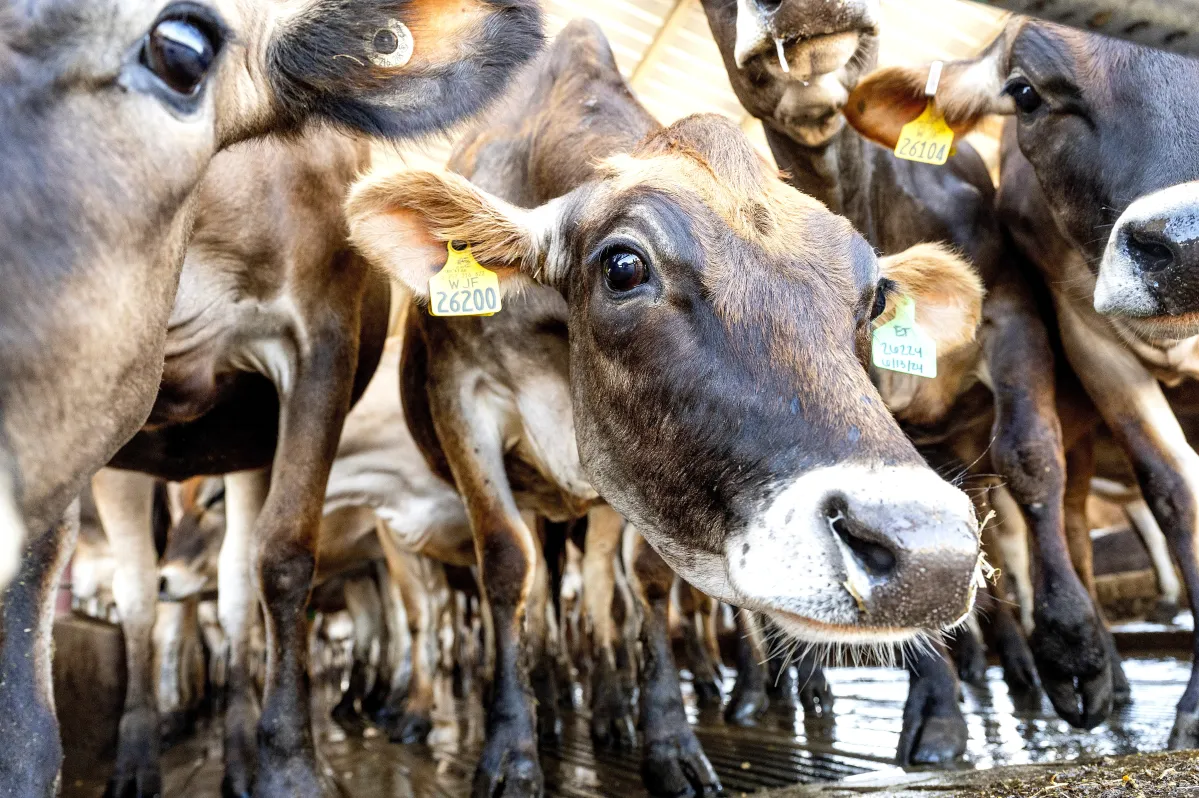
Reducing Methane From Cows: The Challenge Of A Swiss Startup


I cover climate change and energy through reportages, articles, interviews and in-depth reports. I am interested in the impacts of global warming on everyday life and solutions for an emission-free planet. Passionate about travel and discovery, I studied biology and other natural sciences. I have been a journalist for SWI swissinfo for more than 20 years.
-
More from this aut
Italian Departm
-
العربية
ar
شركة سويسرية ناشئة تسعى لخفض انبعاثات مزارع تربية الأبقار
Read more: شركة سويسرية ناشئة تسعى لخفض انبعاثات مزارع تربية الا
中文
zh
减少奶牛打嗝甲烷排放:瑞士初创企业的一场硬仗
Read more: 减少奶牛打嗝甲烷排放:瑞士初创企业
Русский
ru
Как швейцарский стартап решает метановую проблему
Read more: Как швейцарский стартап решает метановую про
Strategies to tackle the climate crisis tend to focus on reducing carbon dioxide emissions from fossil fuels. This priority is justified, as CO2 is the main greenhouse gas responsible for global warming. But it isn't the only one.
Methane also contributes significantly to rising global temperatures. Although it's present in the atmosphere at lower concentrations and remains there for a shorter period than CO2, methane's warming effect is much stronger. Yet historically, this gas, produced largely by agriculture and the oil and coal industries, has received relatively little attention in climate mitigation discussions. Keeping global warming well below 2°C, as envisioned by the United Nations' Paris Agreement on Climate Change, will not be possible without a sharp reduction in methane emissions. According to some Swiss researchersExternal link, cutting these emissions is one of the most effective measures for limiting climate change in the short term.
Sixteen44, a startup based at the Swiss Federal Institute of Technology Lausanne (EPFL) Innovation Park in Lausanne, seeks to eliminate methane directly at the source: cow farms. The sector is responsible for around one-third of global anthropogenic methane emissionsExternal link, but the low concentrations of the gas found in barns (less than 5%) make it difficult to capture and reuse economically.
“This is the situation for most of the methane emitted around the world,” William Ramsay, chemist and co-founder of Sixteen44, told Swissinfo.
The startup recently tested its technology – a device that captures methane directly from cows – at the Strickhof experimental farm in Lindau, canton Zurich. According to Sixteen44, this is the world's first demonstration plant capable of treating the highly diluted methane emissions typical of cattle farming.
“We need to tackle this low-concentration methane if we want to make a meaningful impact on the climate,” Ramsay says.
Cutting methane emissions from cows by 60-70%Methane is produced by bacteria in the digestive systems of cattle and other ruminants. The gas forms mainly during the fermentation of plant fibers and is released primarily through the animal's mouth when it exhales or belches.
Unlike CO2, methane is chemically inert and difficult to capture directly from the air, Ramsay explains. For this reason, Sixteen44 has fitted cows with a device that looks like a ventilation unit (see picture below). Inside, a plasma oxidation process occurs: An electrical discharge generates highly reactive particles that convert methane (CH4) into water and carbon dioxide. This reaction also occurs naturally, but in this case it is accelerated by a catalyst.“The main advantage of methane oxidation is that methane can be converted simply by bringing it into contact with a heated catalyst,” Cyril Brunner, an expert in greenhouse gases and CO2 removal at federal technology institute ETH Zurich, told Swissinfo. There is no need to separate methane from the air first, a step that requires large amounts of energy and represents one of the main limitations of carbon capture technologies.
Sixteen44's device reduced methane levels in the barn by 60-70%, according to Ramsay. Unlike other technologies designed to remove low-concentration methane, it operates at around 40°C rather than 400-500°C, resulting in lower energy consumption.
Methane oxidation, Ramsay says, is complementary to feed additives incorporated into livestock diets. These substances, such as seaweed or clove-based preparations, reduce the amount of methane produced during digestion.
>> Food additives added to animal feed can reduce emissions from cattle:
More More Climate solutions Swiss farmers trial methane-busting feed for cowsThis content was published on Oct 15, 2022 Additives in cow feed could reduce methane emissions and encourage more sustainable farming. But there are questions about the effects on animals.
Read more: Swiss farmers trial methane-busting feed for
Legal Disclaimer:
MENAFN provides the
information “as is” without warranty of any kind. We do not accept any
responsibility or liability for the accuracy, content, images, videos,
licenses, completeness, legality, or reliability of the information
contained in this article. If you have any complaints or copyright issues
related to this article, kindly contact the provider above.


Comments
No comment