


Catriona Millar: The Stories, Emotions, And Unexpected Beauty Behind The Canvas


Photo courtesy of the artist
Catriona Millar's paintings draw the viewer in with vibrant colours, intricate patterns, and intriguing characters. Yet beneath their decorative richness lies a world of subtle emotions, unspoken relationships, and stories waiting to be discovered. Working primarily with a palette knife, Millar creates expressive, richly textured compositions in which humour, longing, vulnerability, and hope exist side by side.
Having returned to art later in life, she has developed a distinctive visual language that continues to evolve. From imaginative figurative scenes populated by mysterious animal companions to her abstract Botannica series, her practice reflects a willingness to experiment and follow intuition. In this conversation, Millar discusses the life experiences behind her work, the stories her characters hold, her fascination with colour and texture, and the unexpected directions her artistic journey has taken.
A Life of Experiences, A World of StoriesYou returned to your artistic career later in life, bringing with you a wealth of personal experiences. How has this different perspective shaped the way you approach painting and the stories you tell?
I first went to art school as a teenager, and at that time my art followed a traditional figurative path. When I returned to painting later in life, I wasn't sure what to expect. However, restarting my artistic career took me in an entirely different direction because I now had a wealth of experience to draw upon.
I had encountered many different personalities, emotions, and relationships. I had adult children and had witnessed moments of joy, vulnerability, tension, humour, and sadness. Gradually, all these experiences found their way into my work. Life had provided me with a rich visual and emotional vocabulary long before I fully understood how I might express it through paint.
I think age also gave me the confidence to trust my instincts rather than worry too much about convention or external expectations. When I began to devote myself seriously to painting, I felt less concerned with following a prescribed path and more willing to discover my own way of working. That freedom allowed me to experiment, take risks, and accept that uncertainty and imperfection could be essential parts of the creative process.
Restarting my career has therefore never felt like a disadvantage. In many ways, it gave me the patience to observe, the courage to work instinctively, and the life experience necessary to understand that people cannot be reduced to simple narratives. Every painting carries traces of those accumulated encounters, yet remains open enough for viewers to recognise something of themselves within it.
Your paintings combine vivid colours and intricate patterns with emotions such as longing, hope, and joy. How do you use these visual elements to create such an intriguing emotional contrast?
I use colour and pattern almost as an emotional language within my work. Bright, vivid colours can express joy, warmth, and hope, while the figures' gestures, expressions, and relationships often suggest something more reflective – a sense of longing, vulnerability, or quiet expectation. I'm fascinated by the way these emotions can coexist within a single image, creating a tension between what is immediately attractive and what is gradually revealed.
I'm particularly drawn to the contrast between decorative beauty and emotional complexity. At first, the viewer may respond to the richness of the colours, the intricacy of the patterns, or the theatrical quality of the scene. But beneath that surface, there is often a more private narrative unfolding. The figures may appear connected, yet emotionally distant, or poised as though waiting for something to happen. Their stories are never fully explained, allowing viewers to bring their own experiences and interpretations to the work.
Pattern also plays an important structural and psychological role. It creates energy, rhythm, and movement, guiding the eye around the composition. At the same time, it can surround, frame, or even contain the figures, suggesting the pressures of their environment or the boundaries of their inner worlds. In this way, colour and pattern are not simply decorative elements; they help communicate the emotions that remain unspoken and invite the viewer to look beyond the surface.
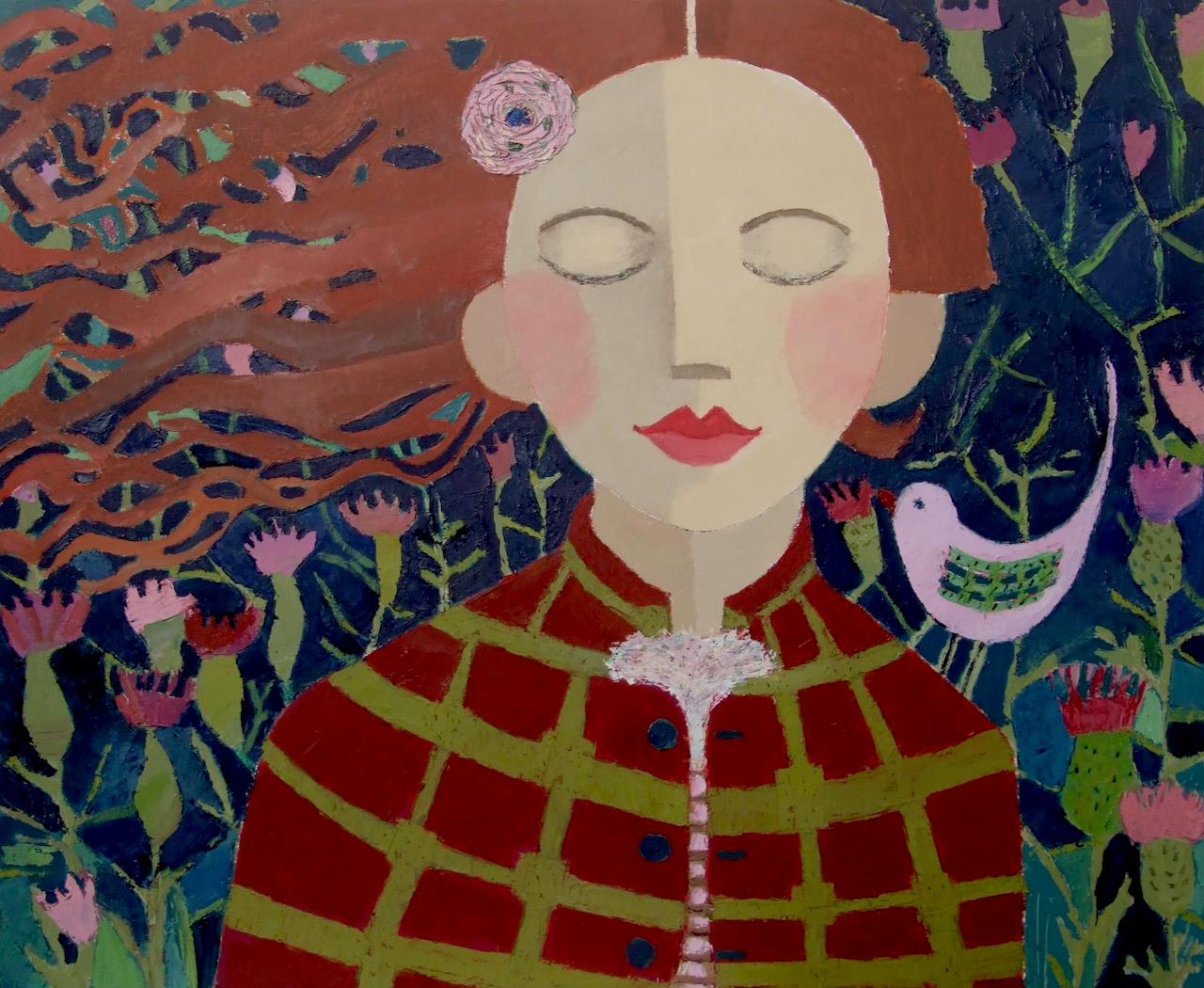
Isobel and Little Wing
Photo courtesy of the artist
Animals frequently appear alongside the people in your paintings, particularly birds perched on their shoulders. What do these unexpected companions bring to your compositions, and what might they reveal about the characters?
I don't have any pets, and I do wonder if I'm conjuring them in paint. They are often companions, confidants, or silent witnesses to the figures and the emotions within the painting. They can express something the human figure is unable – or unwilling – to reveal, whether that is loyalty, vulnerability, instinct, or protection. Sometimes they bring humour and warmth; at other times, they deepen the sense of mystery. I like them to remain open to interpretation, allowing viewers to create their own relationship between the figure and the animal and, perhaps, their own story.
I often place birds on my subjects' shoulders to enrich their personalities and suggest an intimate, unspoken story. I consider myself a people painter, and people, patterns, and the ways they interact are central to my work. The animals may be real companions, but they can also possess a talismanic or symbolic quality. Perched close to the face, a bird can resemble a confidant or become an outward expression of the figure's thoughts, memories, and emotions. It may suggest intuition, freedom, or a private inner voice.
Birds also introduce humour and eccentricity, keeping my portraits playful despite their undertones of longing and melancholy. Rather than having one fixed meaning, I think each bird adds mystery and invites the viewer to imagine the relationship between the person and their unusual companion.
The Art of ExperimentationYou work with a palette knife rather than a traditional brush, building up thick, expressive layers of oil paint. What does this technique bring to your work, and how does it influence the creative process?
Using a palette knife allows me to work with greater freedom and spontaneity. Unlike a brush, which can encourage more precise or deliberate marks, the knife invites a direct, physical engagement with the paint. I can apply the colour thickly, spread it across the surface, scrape it back, and then build it up again.
This process creates layers that record the development of the painting, giving the finished surface a tangible physical presence that would be difficult to achieve in quite the same way with a brush. The palette knife also produces unexpected marks, sharp edges, and broken textures. Paint can catch on the surface or blend in ways that I could not have planned, so there is always an element of surprise. Those accidental moments are often where the painting begins to find its own character. A single scrape or ridge of colour can suggest the curve of a cheek, the weight of a garment, or a fleeting expression, leading the work in a direction I had not anticipated.
I enjoy that lack of complete control. Rather than forcing the image towards a fixed conclusion, I respond to what emerges and allow the painting to guide me. There is a constant tension between intention and accident, control and instinct. I may begin with an idea of the figure I want to create, but the repeated layering, scraping, and reshaping gradually reveal something more individual.
The thickness of the paint also gives the figures a sense of depth and substance. Light catches on the raised surfaces, while scraped areas expose traces of earlier colours beneath them. These layers suggest history, emotion, and personality, as though each figure has been formed through a process of discovery. The palette knife keeps the painting alive, giving the figures an energy and individuality that comes not from perfect control, but from allowing uncertainty to remain visible.
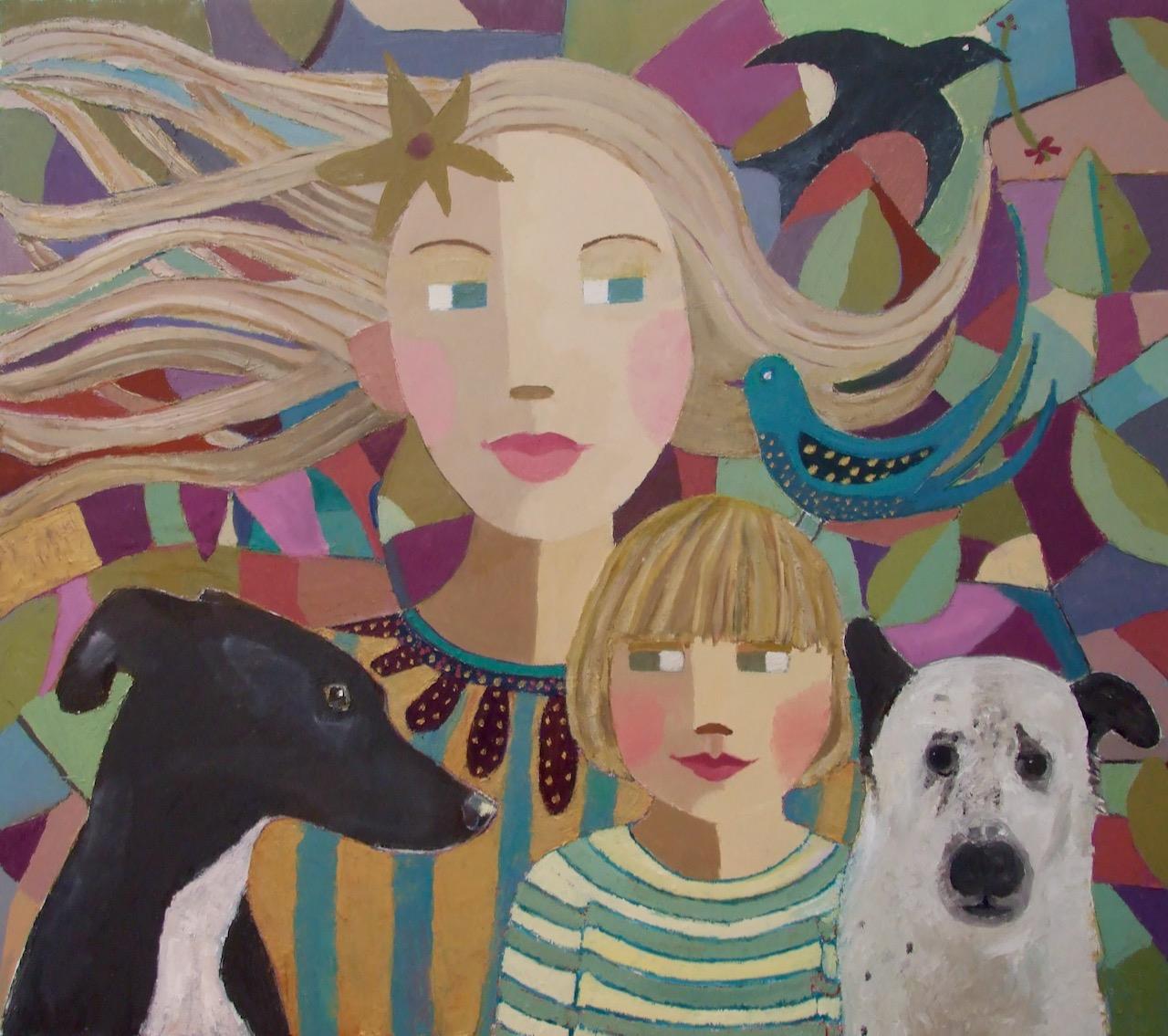
The Fantastic Four
Photo courtesy of the artist
Many of your paintings feel like glimpses of a larger story, with characters whose lives remain partly hidden from the viewer. Do you imagine their stories before you begin, or do they unfold as the painting takes shape?
I rarely know the whole story in advance. I may begin with a particular expression, colour, or feeling, but the characters gradually reveal themselves as I work. Their relationships, personalities, and circumstances emerge through the painting process, often surprising me along the way. I prefer not to make the narrative too definite, because ambiguity gives the viewer space to bring their own memories and imagination to the work. In that sense, the story continues beyond the canvas.
Commissions are different because they are based on real people and animals. Although I work from photographs, the portraits are expressive interpretations rather than conventional likenesses. I aim to capture personality and relationships through facial expression, gesture, rich colour, pattern, and symbolic details.
In 2025, you began your abstract Botannica series, moving away from the figurative work that had previously defined much of your practice. What prompted this change, and what did exploring abstraction allow you to discover?
The Botannica series grew from a desire to challenge myself and explore colour, pattern, and texture without relying on the human figure, which had previously been central to much of my work. Stepping momentarily away from figurative painting encouraged me to reconsider the way an image could communicate through rhythm, surface, and atmosphere alone. It was both liberating and unsettling, as I had to trust the materials and allow the paintings to develop without the familiar structure of a face or body.
Although abstraction felt like a significant development, it allowed me to work more freely and instinctively. Rather than beginning with a fixed composition, I responded to each mark as it appeared, allowing one colour, shape, or texture to suggest the next. The natural world became a starting point rather than something I wanted to represent literally. Botanical forms, petals, leaves, and tangled growth offered a visual language, but the paintings evolved through the movement of the palette knife, the layering and scraping back of colour, and the unexpected forms that emerged during the process.
My partnership with the couturier Ruth Groundwater also encouraged me to think differently about the relationship between painting, fabric, and design. Her sensitivity to material, construction, and decorative detail opened up new possibilities in my own practice. I became increasingly interested in the way colours could interact like patterned textiles, and how repeated marks, layered surfaces, and contrasting textures might create a sense of movement across the canvas and ultimately across fabric and ceramics. I had never considered it before, but now I love the idea of someone wearing my work as a garment.
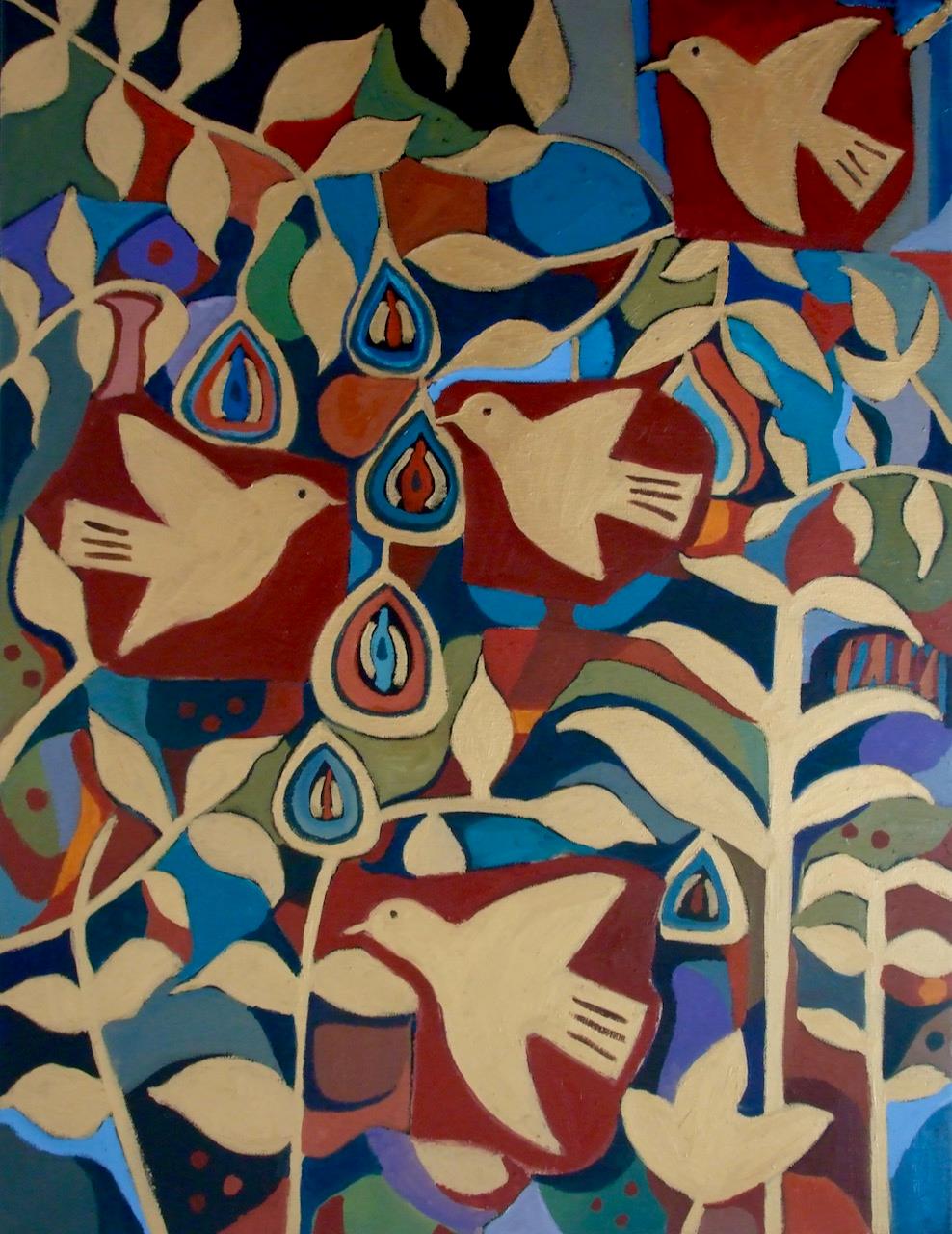
Pear Tree
Photo courtesy of the artist
Your paintings seem to invite viewers from different ages and cultural backgrounds into their own interpretations. What do you think gives art the ability to connect people across these boundaries?
I think art crosses boundaries when it connects with emotions we all recognise – love, loneliness, hope, humour, vulnerability, and the need to belong. These feelings are universal, even though the circumstances surrounding them may differ greatly. Viewers can come from completely different countries, age groups, cultures, and backgrounds, yet still recognise something familiar in a painting: a gesture, an expression, a relationship, or a moment that reminds them of themselves or someone they know.
For me, that emotional recognition is where the connection begins. A painting does not necessarily need to provide a complete narrative or a definite answer. In fact, I try not to explain the stories behind my work too fully, because I want to leave room for the viewer.
That openness allows each person to bring their own memories, experiences, and imagination to the image. Someone may see humour where another person senses sadness or unease. A figure who appears lonely to one viewer might seem peaceful or independent to someone else. The meaning can shift according to who is looking and what they have lived through. I find that fascinating, because the painting continues to evolve beyond my original intention. That freedom to create a personal connection – without language, explanation, or shared experience – is part of art's enduring power.
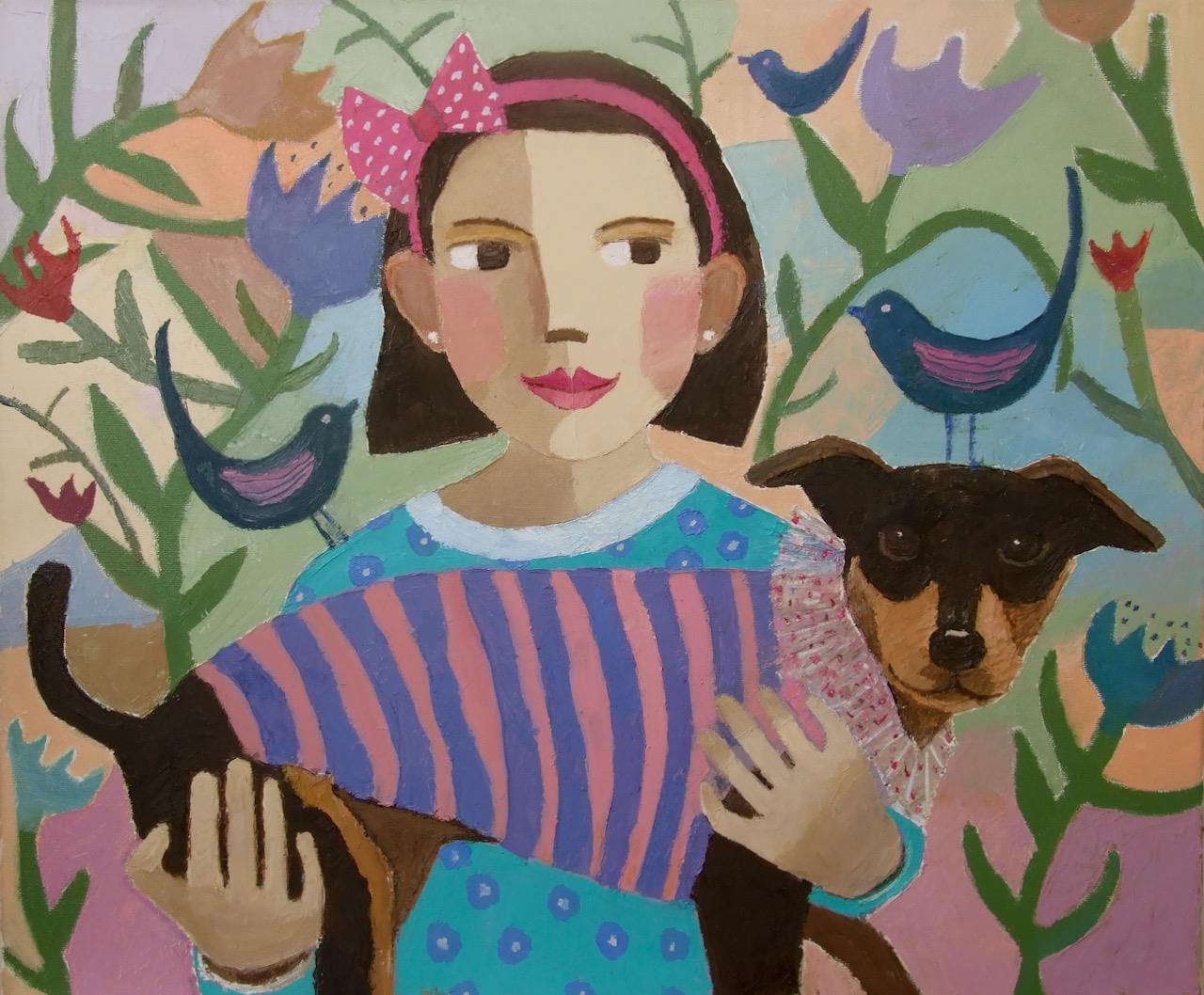
Three Little Birds
Photo courtesy of the artist
You have donated paintings to charity auctions, including initiatives supporting cancer care. How important is it to you that your work can make a difference beyond the art world?
It means a great deal to know that something I have created can contribute to helping others. As an artist, you spend so much time working alone in the studio, often without knowing where a painting will eventually find a home or what it might come to mean to another person. To see that work become part of something larger and genuinely worthwhile is incredibly moving.
Art can bring comfort, joy, and a sense of connection. It can lift the spirits, awaken memories, or simply offer a moment of escape during a difficult day. Through these auctions, however, it can also provide practical support for people facing incredibly challenging circumstances.
A painting becomes more than an object on a wall; it becomes a way of raising vital funds, increasing awareness, and reminding people that they are not alone. Cancer has touched so many lives, whether personally or through family, friends, and loved ones. Donating a painting feels like a small but meaningful way for me to give something back and to show my support for those affected.
There is also something very special about artists and collectors coming together for a shared purpose. If my work can encourage someone to contribute, help raise essential funds, or offer even a small sense of hope, then it has achieved something lasting and important beyond the canvas.
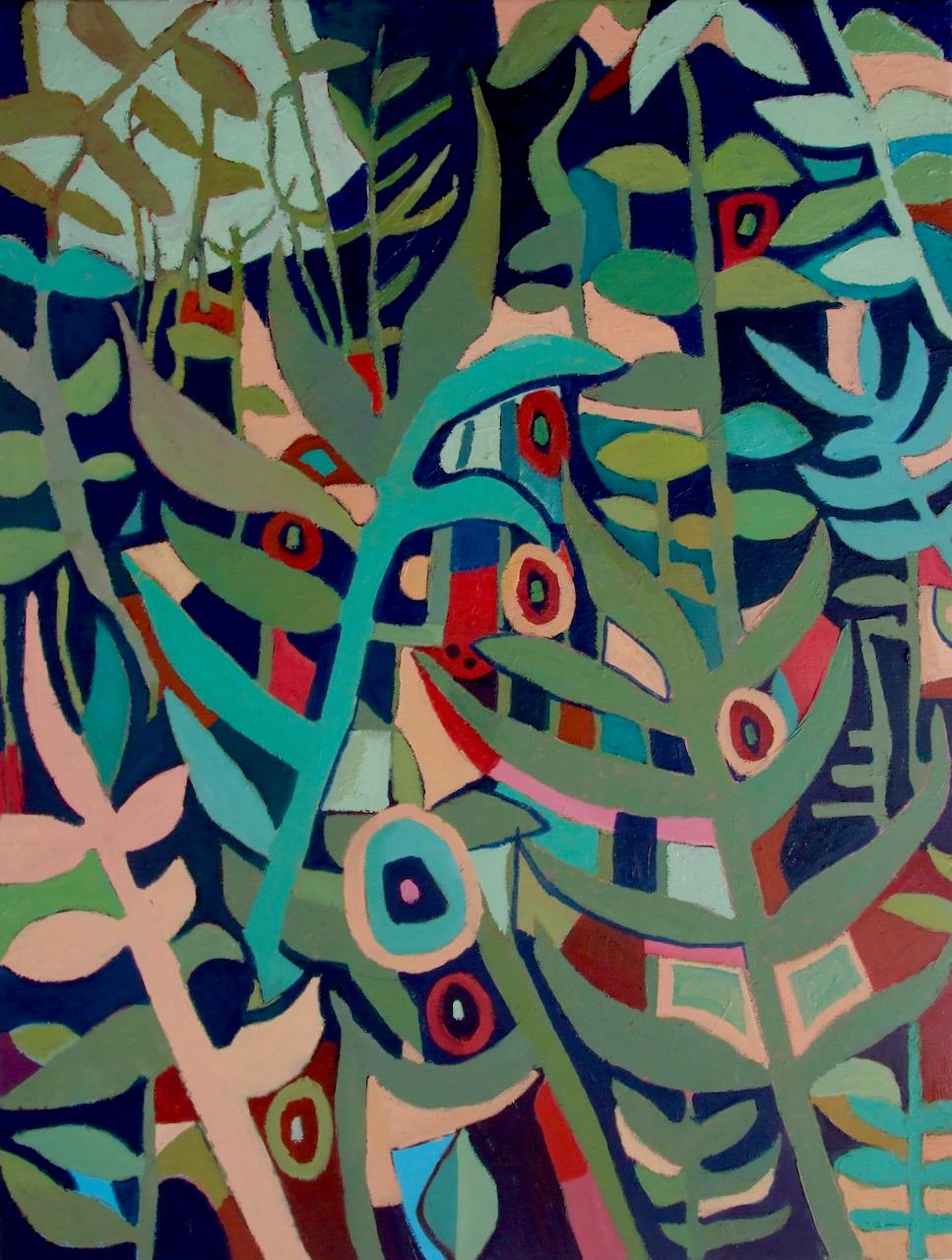
Beanstalk
Photo courtesy of the artist
When someone encounters one of your paintings for the first time, what would you hope stays with them after they have walked away?
I would like viewers to feel an immediate sense of connection with the paintings – perhaps recognising an emotion, a relationship, or something familiar within themselves. It might be a particular expression, a gesture, or the way two figures relate to one another. Even when the characters are imaginary, I hope they possess something emotionally truthful that allows people to see a reflection of their own lives, memories, or relationships.
I want my paintings to encourage viewers to pause, look more closely, and become curious about the story unfolding before them. The characters may appear to be caught in the middle of a conversation, a private thought, or an important moment, but I deliberately leave much of the narrative unresolved.
I enjoy creating that sense of mystery because it gives each viewer the freedom to imagine what might have happened before the scene and what could happen next. Different people may interpret the same expression or relationship in completely different ways, depending on their own experiences. That personal response is an essential part of the work.
Most of all, I would like viewers to leave with a feeling of warmth, humour, and optimism – as though they have briefly encountered a character they somehow recognise, and whose personality and unfinished story remain with them long after they have walked away.
Discover more of Catriona Millar's artwork on her official website.

Legal Disclaimer:
MENAFN provides the
information “as is” without warranty of any kind. We do not accept any
responsibility or liability for the accuracy, content, images, videos,
licenses, completeness, legality, or reliability of the information
contained in this article. If you have any complaints or copyright issues
related to this article, kindly contact the provider above.


Comments
No comment