


Wolfgang Koethe: The Power Of Images, The Freedom Of Painting, And The Art Of Seeing


Image courtesy of artist Wolfgang Koethe
For German artist Wolfgang Koethe, becoming a painter began with an unexpected moment of self-discovery. From his studies in Düsseldorf and Berlin to his years in London, his artistic journey has been shaped by experimentation, curiosity, and a willingness to question traditional ideas of painting.
Working with photographs, newspaper imagery, unusual materials, and the traces of the creative process itself, Koethe explores how images shape our perception of the world. His paintings move between recognizable subjects and open-ended forms, inviting viewers to look more closely and discover something unexpected. In this conversation, he reflects on the experiences that shaped his practice, the influence of art history, and why he believes art remains essential to society.
An Unexpected BeginningYou have described the beginning of your artistic journey as something of a surprise, even to yourself. How did you first find your way to painting?
I would like to begin with a day in Düsseldorf in 1969. One Sunday morning, my parents asked me,“What will you do with your life after your final exams?” Someone in the room said,“Kunst” – art. It wasn't my parents, so it turned out that I was the one who had said it. I was quite surprised myself.
I enrolled at the Düsseldorf Academy of Art in Joseph Beuys's class. That year was very interesting for an 18-year-old, but I did not learn how to paint. My next stop was West Berlin. West Germany was investing enormous amounts of money in a city populated by very old people and very young students. I was fortunate to meet Professor Johannes Geccelli, who taught me the basic principles of painting and became my teacher. We developed a very friendly relationship, and I owe him a great deal.
Later, I applied for a British Council scholarship in London and received one to study at St Martin's School of Art. In the autumn of 1978, I began exploring London. I did not have a studio, but a friend lent me his space for a while.
I poured white powder onto the floor, creating what I called“white shadows”: medieval knights, footballers, ski jumpers, and other figures. I had read about Native American and Far Eastern religious traditions in which coloured powders were sprinkled on the ground and swept away once a meditation was over.
I also made drawings on paper using highly pigmented chalk. Eventually, my painting materials arrived from Berlin, and I rented a studio in London, where I began painting again.
The images I worked with were often anonymous shadows – figures taken from newspapers such as The Guardian, advertising, and photographs. The world is full of images. Access to pictures and photographs has become so easy in recent years that, in my opinion, we may be losing our respect for the image itself.
I particularly enjoyed using photocopies as starting points for paintings. They offered very high contrast, reduced to black and white – a little like woodcuts. The results were dramatic, with hard edges, a certain absurdity, and a strong visual presence.
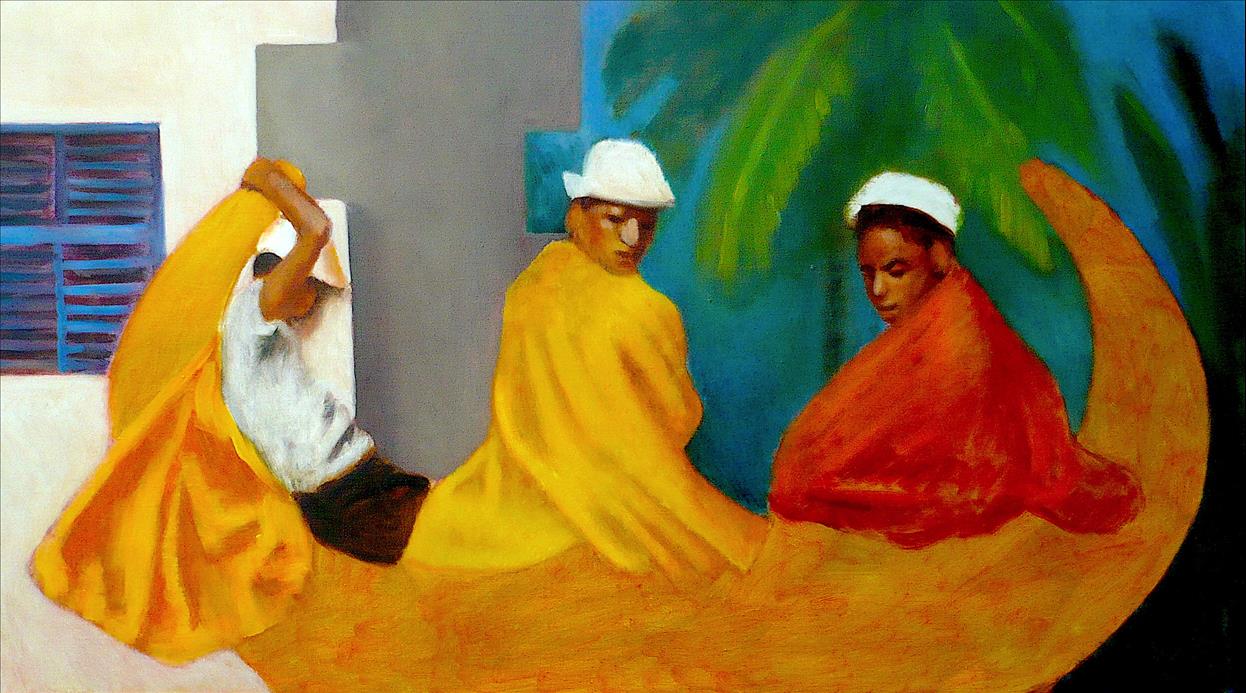
Close Buddies
55 × 100 cm
Image courtesy of artist Wolfgang Koethe
Early in your career, you experimented with unusual materials and created works beyond the traditional canvas. What encouraged you to move away from conventional painting techniques?
In the 1970s, many art students in Germany were moving away from traditional painting. I was among them at first. I melted beeswax for encaustic painting and worked on rough wooden surfaces. I also experimented with powder paint outdoors, and in Scotland I let water freeze together with primary pigments.
At the time, painting almost seemed forbidden, particularly figurative painting in the traditional style. Some professors simply did not know what to do with painting, because it was not especially welcome in West Germany during the 1970s.
Images, People, and the SpectatorYou often use photographs, newspaper images, and other existing visuals as starting points for your paintings. How do you decide which images are worth exploring?
That is easy. I think there simply weren't as many pictures available in the 1970s as there are today, so there was less to choose from.
Selfies have flooded the portrait market, and it can be exhausting to keep finding similar photographs on your smartphone, deleting them, only to create even more visual clutter all over again.
I paint images of people, not portraits. Although I have painted figures such as Albert Einstein, James Joyce, Thomas Mann, Sigmund Freud, and Yuri Gagarin, I am interested in the image rather than producing a conventional likeness.
An image is promising when I do not know in advance what the final painting will look like. I still enjoy surprises. If a painting turns out somewhat differently from what I expected, I consider that a good sign.
Technical ability is not the main point for me; attitude is. The German word Haltung describes how I approach my work and take it seriously. How do I respond to what is already there? What can I remove, and what can I add or transform? How do I relate to the marks that already exist?
My favourite painters include Caravaggio, Velázquez, Vermeer, Delacroix, and Beckmann, as well as Jasper Johns and Robert Rauschenberg.
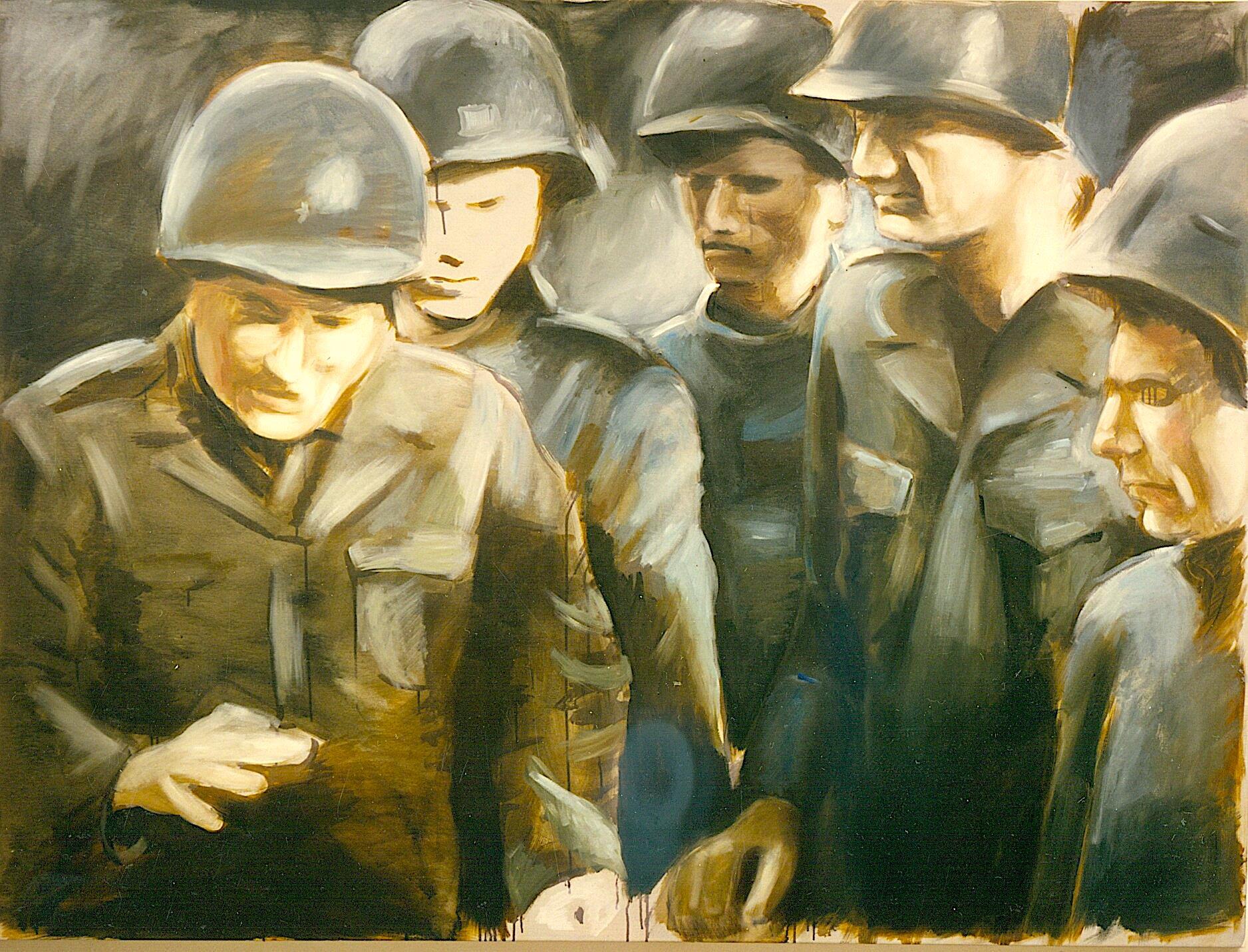
The Americans, 1987, 150 x 200 cm, Oil/Cotton Duck
Image courtesy of artist Wolfgang Koethe
Sports and major public events appear in several of your works. What draws you to these subjects, and how do you translate their energy into painting?
My grandfather, who lived in East Germany, used to take me to a small football ground in the summer. I remember the deep green grass and a team wearing deep red jerseys. I have never forgotten that image.
My football paintings show players waiting for a game to begin or presenting trophies at the end. Colour can be used like heraldry: to identify regions, important figures, and countries. Or it can bring us closer to nature, without imitating or falsifying it.
One night in London, something else inspired me. When an Irish pub closed at eleven, a policeman came in and locked the door from the inside. Suddenly, there were shouts, loud grunting, and people flying through the air. The television was showing the Super Bowl between the Washington Redskins and the Los Angeles Raiders.
That night stayed with me, and I felt compelled to do something with what I had witnessed. Several paintings emerged from that experience, some of them quite large. There was Caravaggio, and there was Golgotha.
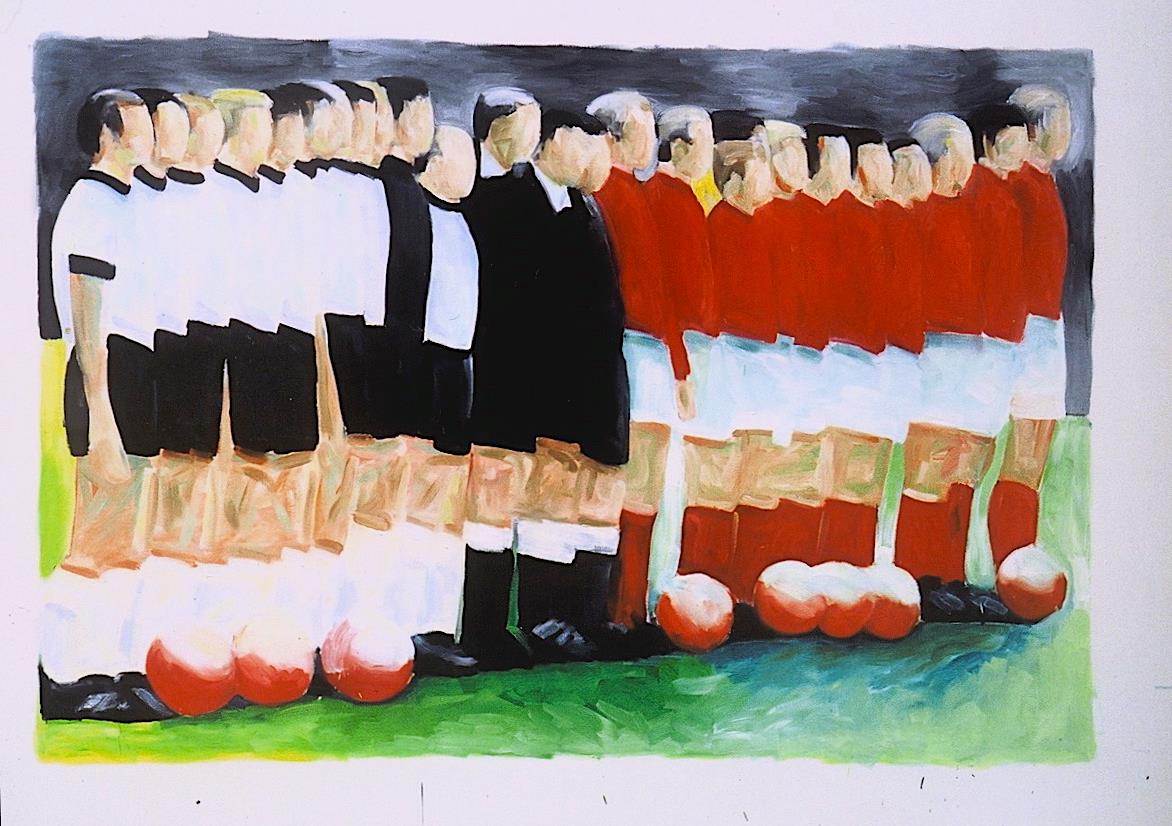
1966, 1983, 150 x 210 cm, Oil/Cotton Duck
Image courtesy of artist Wolfgang Koethe
Your paintings can look quite different depending on how and from where they are viewed. How important is the viewer's response to your work?
My early paintings were made alla prima: I worked on them while the paint was wet for four days, then allowed them to dry for two weeks before making corrections.
The paintings of the Super Bowl heroes were created in three layers, using increasingly rich mixtures of medium and oil. More or less, I still paint this way today.
I welcome any response from viewers if it leads to a conversation. I have little interest in casual small talk when it comes to painting. I prefer to get into the nitty-gritty. I believe that ordinary people can be very good conversation partners, and I am always willing to explain my work when I sense genuine interest.
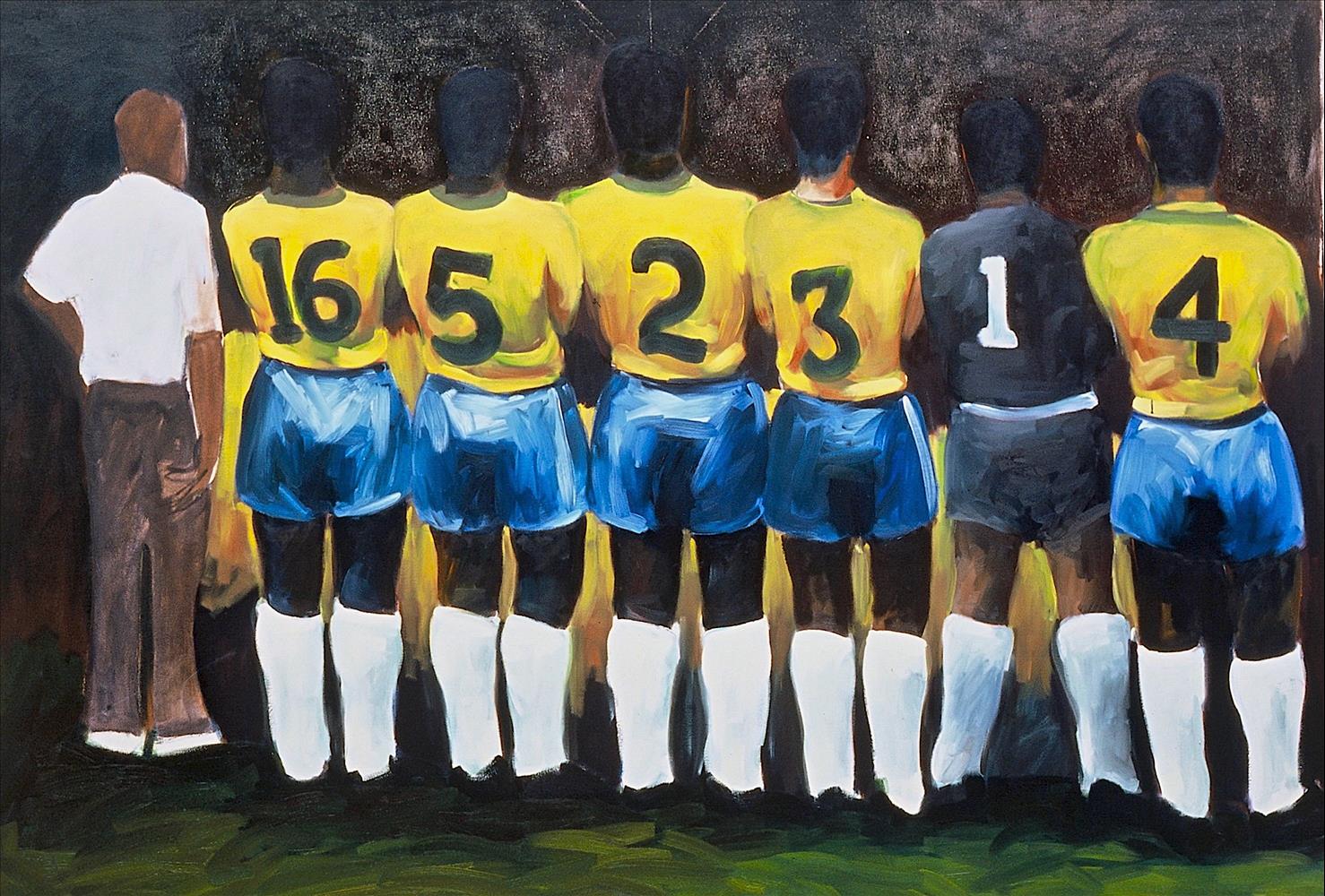
Brazil, 1983-84, 150 x 210 cm, Oil/Cotton Duck
Image courtesy of artist Wolfgang Koethe
You sometimes leave parts of an image unfinished or allow traces of the painting process to remain visible. Why is it important for you to preserve this sense of openness in a finished work?
It took me some time to stop trying to paint everything accurately or“perfectly”. Working alone in front of a canvas, I learned to relax. It is as relaxing as having an unexpectedly good idea during a conversation.
Oil paint does not always dry quickly, so working in several layers can be an advantage. Leaving some surfaces open makes the whole picture more vivid.
There is also the wonder of perception: you can show someone a half-open circle, and they will see a complete ring.
It is simply a result of how the optic nerve works. The artwork is real, but perception is not something fixed – it happens inside the brain of each individual viewer.
I have heard people say that I“do not paint the last layer”. For me, leaving something unresolved can increase interest and present a challenge to the viewer.
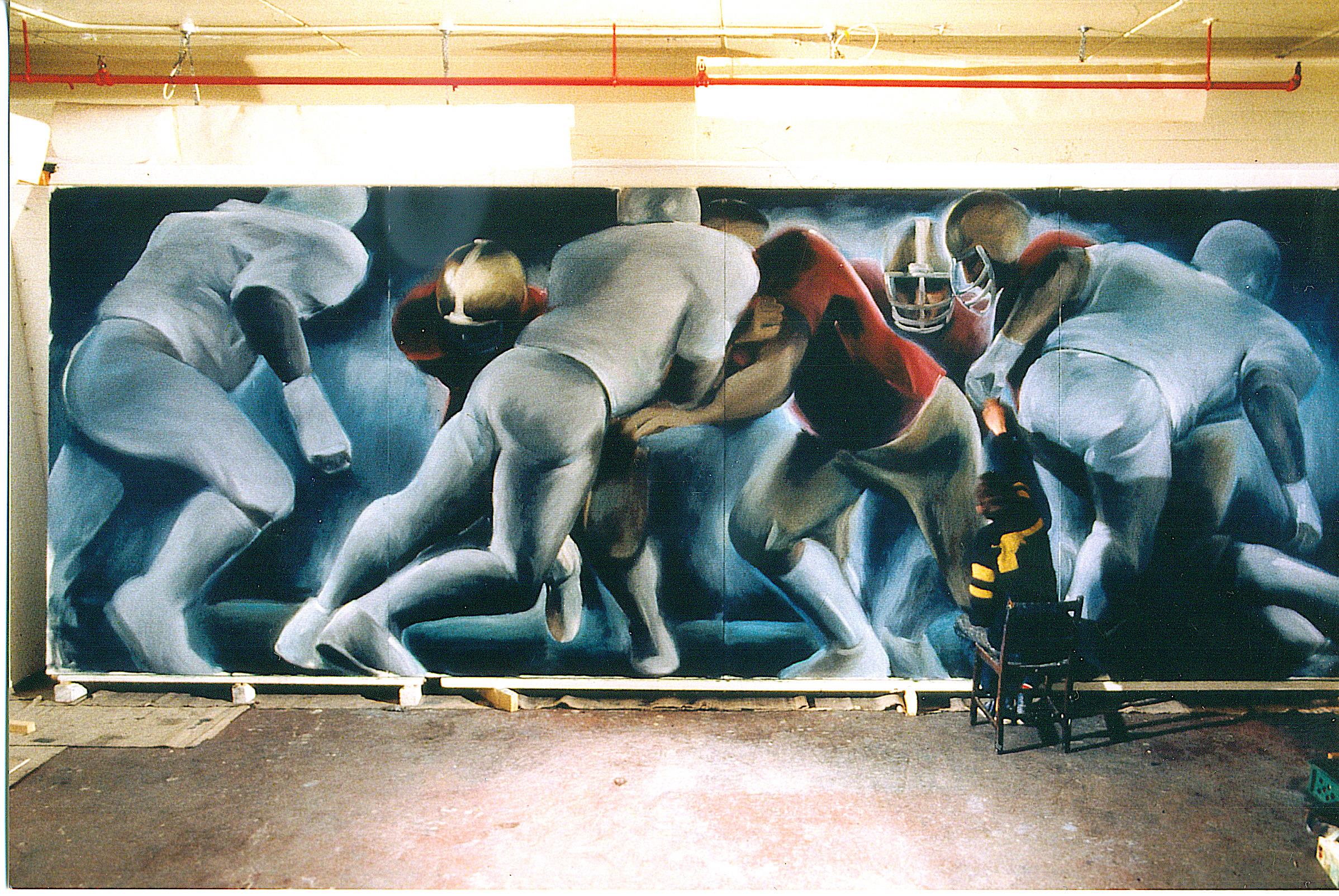
The American Night, 1985, 270 x 750 cm, Oil/Cotton Duck
Image courtesy of artist Wolfgang Koethe
How important is it to you that art engages with society, for example through charitable or social projects? Do you believe artists can influence society in this way?
Society needs art, whether people believe it or not. There are only certain very restrictive countries where art is unwelcome. They fear that people might begin to have more confidence in their lives, as well as in their own perceptions and judgments.
Good art is liberating, and that makes it a great danger to some very bad people around the world. I do not think artists are“influencers”, but sometimes we produce meaning.
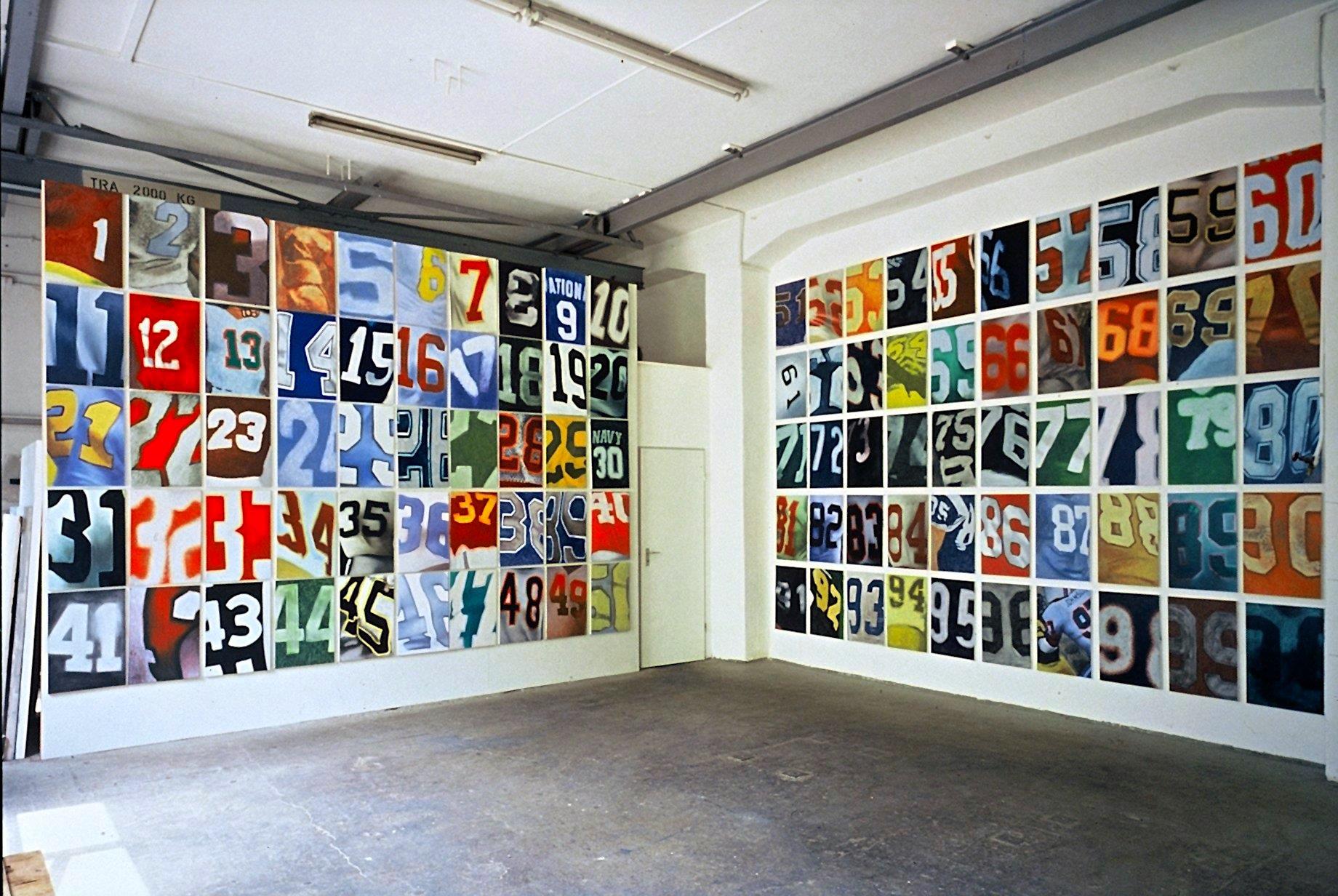
Inside the Studio
You have been working as an artist for many years. What has changed most in your approach to painting, and what continues to keep you curious about the process?
At the beginning, I had this idea that I should use only a few“good” colours and ignore the rest. But something eventually made me experiment with the other colours as well, and I have become less dogmatic about my choices.
I think that openness to experimentation is important. I do not want to know exactly what a painting will look like before I begin. The possibility of surprise is still part of what makes painting interesting to me.
The East-Grinstead Debating Society, 1991, 140 x 250 cm, Oil/Cotton Duck
Image courtesy of artist Wolfgang Koethe
Explore more of Wolfgang Koethe's artwork on his official website.

Legal Disclaimer:
MENAFN provides the
information “as is” without warranty of any kind. We do not accept any
responsibility or liability for the accuracy, content, images, videos,
licenses, completeness, legality, or reliability of the information
contained in this article. If you have any complaints or copyright issues
related to this article, kindly contact the provider above.


Comments
No comment