


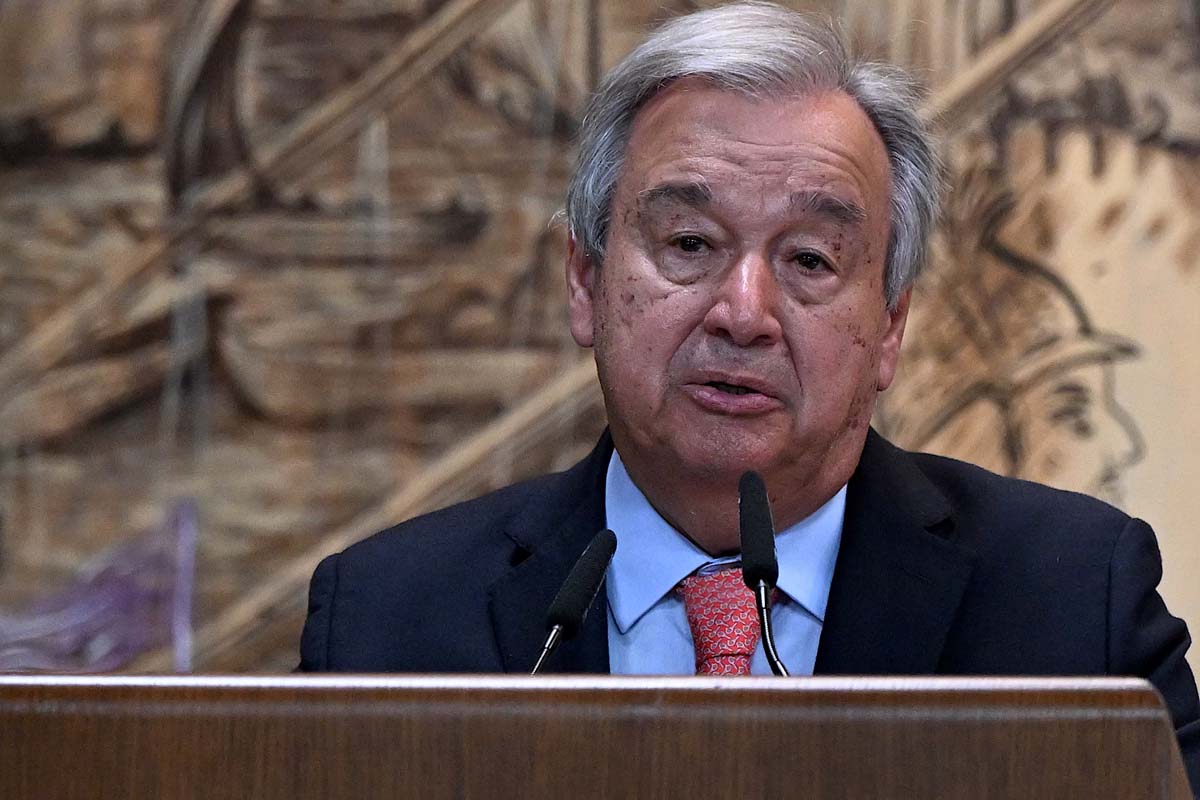
Guterres Demands Climate Justice Compact as Overshoot Looms at COP31


(MENAFN) UN Secretary-General Antonio Guterres on Wednesday urged world leaders at COP31 to adopt a “Climate Justice Compact,” pressing them to speed the exit from fossil fuels and unlock vast sums of climate finance.
“We need a new Climate Justice Compact, based on shared responsibility, shared security and shared benefits,” Guterres told the UN Climate Conference Leaders’ Summit in Türkiye. He stressed that every country must meet its obligations under the principle of common but differentiated responsibilities.
The plan stands on four pillars: accelerating a “just transition” from fossil fuels, shielding vulnerable populations, securing sufficient financing and favoring cooperation over geopolitical fragmentation.
Guterres cautioned that trade barriers, technology monopolies and geopolitical rivalries are slowing the energy shift and driving up costs, leaving “billions behind.”
“We do not need countries to agree on everything. But we do need them to cooperate on the things no country can solve alone,” he said.
He also called for a new generation of national adaptation plans backed by international funding. “Every person on Earth must be covered by an early warning system, and every community protected from floods, droughts and rising seas.”
Overshoot now unavoidable
The UN chief conceded that temporarily breaching the 1.5C (2.7F) warming limit set under the Paris Agreement can no longer be prevented. He called for firm leadership to keep the breach a “temporary breach, not a permanent sentence.”
“Science tells us an overshoot above that level is now inevitable. But science is not telling us to surrender. It is telling us to fight harder,” he said.
Staying within the 1.5C threshold, Guterres noted, requires global renewable capacity to triple from 2025 levels by 2035 and unabated coal power to fall by at least 75%.
Clean energy surges as fossil fuel case weakens
Pointing to a decade of clean energy gains, Guterres said solar power has grown from 1% of global electricity generation to covering nearly three-quarters of the growth in global electricity demand last year. Electric vehicles, he added, have climbed from one in 100 cars sold to nearly one in three this year.
Arguing that “the case for fossil fuels is collapsing,” he said roughly three-quarters of humanity lives in countries reliant on fossil fuel imports, leaving people vulnerable to price shocks and cost-of-living crises.
“Fossil fuels must go the way of the dinosaurs,” Guterres said, accusing the fossil fuel lobby of working to “distort the science” while stalling policy, action and accountability.
Emissions gap and financing demands
Global emissions must drop by about 6% a year, Guterres warned, yet current national climate plans deliver at most one-third of the cuts required. That leaves the world on course for warming above 2.5C over pre-industrial levels by the end of the century.
He urged developed countries to provide at least $300 billion annually by 2035. He also proposed a tax on windfall profits of major oil companies, whose nine largest collected $95 billion last quarter, to fund “vulnerable countries.”
“Those who profit most from fossil fuels must help foot the bill for the damage they have caused,” he said.
Guterres pressed multilateral development banks to exceed their $120 billion annual Baku commitment by 2030. “Shareholders must empower them to lend more. Mobilize more private investment. Take more risk.”
Climate disasters are “pounding lives, livelihoods and economies” worldwide, he warned, describing the current trajectory as a “path to mutually assured destruction.”
“Either plan this just transition, or pay for it in chaos and lost livelihoods,” Guterres warned.
Türkiye is hosting COP31, the UN Climate Change Conference, in the southern city of Antalya. Guterres thanked Turkish President Recep Tayyip Erdogan for “wonderful hospitality and the excellent organization” of the conference.

Legal Disclaimer:
MENAFN provides the
information “as is” without warranty of any kind. We do not accept any
responsibility or liability for the accuracy, content, images, videos,
licenses, completeness, legality, or reliability of the information
contained in this article. If you have any complaints or copyright issues
related to this article, kindly contact the provider above.


Comments
No comment