


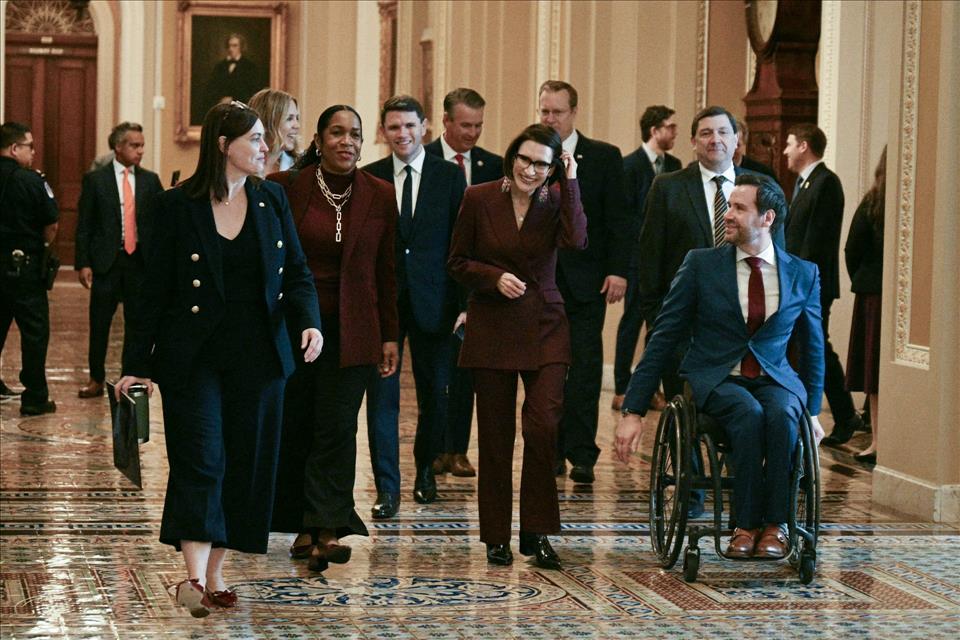
Democrats' Agenda Will Be Set By Their Ability To Organize And Compromise - Not By The Socialist, Progressive Or Centrist Factions All Claiming Victory


Candidates spent much of the past year differentiating their positions from the mainstream Democratic coalition. The result is a freshman class filled with as many progressive liberals as moderate problem solvers.
By the morning after Election Day, pundits and current Democratic members across the political spectrum were quick to claim their ideologically aligned candidates as the“majority makers” – the group most responsible for the large victory.
Centrist Democrats pointed to pragmatic moderates flipping Trump-won seats. Liberal voices highlighted the enthusiasm and turnout driven by a new, progressive vision.
As a result, days after the election the focus had turned toward January: Who will become the majority maker within Congress?
Party caucus leaders have already started building their roster: The Progressive Caucus claims at least 25 new members in their ranks, growing their membership to over 100 Democratic members. The moderate Blue Dog Caucus doubled in size, from 10 to 20 new members. And in the middle, the center-left New Dems are projecting a caucus of over 140 members.
I'm a political scientist who has worked in and now studies Congress. Figuring out the dynamics and direction of the 120th Congress requires looking at more than the ideological positions of the candidates who won. Instead, focusing on the number of candidates who won can provide insight into the direction of the party as a whole.
The large – and at the time of writing, still growing – margins of Democratic control in the 120th Congress are the biggest since 1993, before Congress became consistently competitive and increasingly polarized. Those large margins provide essential context for understanding how this new ideological coalition will work in Congress.
Size mattersWhile history demonstrates that an ideologically diverse party can be hard to wrangle, the size of the new Democratic majority provides some breathing room for policy negotiation and procedural debates.
Unlike the current Republican Caucus that is reliant on keeping historically narrow majorities together to pass party goals, future Democratic leadership can stand to lose a few votes. With a minimum of 254 seats in the House and 54 seats in the Senate, small-scale Democratic defections are irrelevant.
This breathing room provides the potential for negotiation, while also limiting any mandate an ideological group may claim.
For instance, the 120th Congress will have eight members in the House who are backed or affiliated with the Democratic Socialists of America, known as the DSA. In raw terms of political power, when the majority has at least 36 votes to spare on any given party-line bill, this group may not matter in policymaking.
But big numbers do matter.
If a group – say, the entirety of the Progressive Caucus' 100-plus membership – decides to stick together, leadership will be forced to listen. Thus, the potential power of ideological factions depends not only on their ideas but their own organizational skills.
When groups in Congress develop practices such as confidential meetings or binding rules that require members vote together on certain votes, the legitimacy of group demands can be strengthened. This is a strategy that has been employed with relative success by the far-right Republican Freedom Caucus since it was formed in 2014.
Details matterThe overarching policy goals for newly elected Democrats are consistent across the ideological spectrum: lowering the cost of living and rooting out corruption.
This was highlighted in acceptance speeches by Democrats from South Carolina to Texas to Michigan. All emphasized the same policy-focused promise: Instead of fighting left versus right, the fight should focus on the top versus the bottom.
This shared vision is no doubt important. My research has shown that a cohesive message is a key part of winning and maintaining majority control.
However, the“blue tsunami” was powered by voters with very specific policy demands. And as is always the case with policymaking, the details matter. Does healthcare reform mean reinstating the Obamacare subsidies set to expire on Jan. 1, 2027? Or does it mean something bolder, such as Medicare for All?
While there is power in numbers, the organizational strength and ultimate success of ideological groups in Congress depends on how unified they can be around specific policy goals and proposals.
First hurdle: Pick a leaderThis means that who is doing the unifying also matters.
The success of any potential legislative package heavily relies on congressional leaders' knowledge of congressional rules and their willingness to incorporate member viewpoints.
This necessity of having leadership in place to get legislation moving is epitomized by the order of operations for a new congressional session. In the coming weeks, both parties will hold closed-door, secret-ballot elections to select their new party leaders. That's well before any legislation is even drafted.
With a Democratic caucus filled with anti-establishment candidates across the ideological spectrum, and external pressure from political pundits to dump current Democratic leadership, the future of the Democratic Party has been projected onto this otherwise ritualistic vote.
But the power and success of congressional leadership lies in its procedural acumen, not its ideological vision. Some already in Congress have noted New York Democratic Rep. Hakeem Jeffries' experience and working relationships in discussions of whether he should be house speaker. Furthermore, groups can extract concessions during leadership selection in exchange for their support, such as seats on powerful committees or an agreement on policy agenda items.
Sen. Chuck Schumer, the longtime New York lawmaker aiming to lead Senate Democrats again, faces more public criticism from his party. While no one has yet stepped up as an alternative, momentum is building for Maryland Sen. Chris Van Hollen, who has said he is“in listening mode.”
Credit to allTo external observers, the selection of party leadership seems like a defining point for the party. But whether a new caucus translates to new leaders or new rules ultimately depends on the organizational power of new members and their already-serving co-workers – and what a party leader can offer them in terms of policy goals and procedural capabilities. Who is chosen as leader is not necessarily a signal of what the party's policy goals will be.
That picture is not yet clear – and it may not be for some time. After all, the new Democratic margins in Congress are a result of a collection of majority makers. The margins of victory tell a story about more than presidential backlash. Across the country, progressive enthusiasm and moderate appeal turned voters toward the Democratic Party. And while everything is local, national enthusiasm matters, too.
The 120th Congress will include progressives and moderates and the establishment candidates in the middle that are all required parts of the same whole. Or as political scientist E.E. Schattschneider argued in 1960 in his seminal work“The Semisovereign People,” it would be a mistake to give credit to one group for the success of an election. Rather, achieving a consequential majority in America requires coalition building – and maintenance.


Legal Disclaimer:
MENAFN provides the
information “as is” without warranty of any kind. We do not accept any
responsibility or liability for the accuracy, content, images, videos,
licenses, completeness, legality, or reliability of the information
contained in this article. If you have any complaints or copyright issues
related to this article, kindly contact the provider above.


Comments
No comment