


IAEA Review Finds Jordan's Nuclear Safety Framework Robust, Recommends Improvements


Amman, Nov. 10 (Petra) -- An International Atomic Energy Agency (IAEA) expert team has concluded that Jordan has a comprehensive and well-established regulatory framework for nuclear and radiation safety, while identifying areas for improvement to strengthen regulatory effectiveness and alignment with international safety standards.
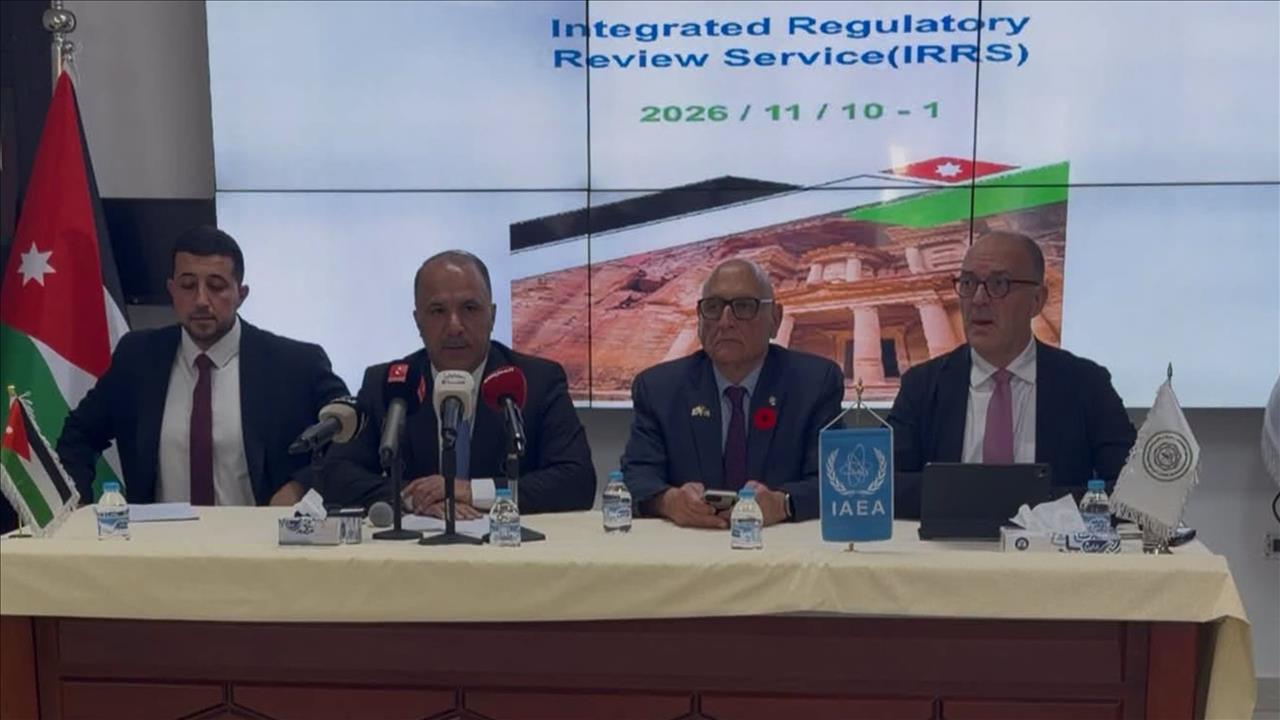
The findings were presented Tuesday at a press conference hosted by the Energy and Minerals Regulatory Commission (EMRC), following an IAEA Integrated Regulatory Review Service (IRRS) mission conducted in Jordan from Nov. 2-10.
The mission, requested by the government and hosted by EMRC, assessed the Kingdom's legislative, regulatory and institutional framework for nuclear and radiation safety against IAEA safety standards and international best practices. The review marks Jordan's second IRRS cycle, following an initial mission in 2014 and a follow-up mission in 2017.
Jordan uses radioactive sources in medical, industrial and research applications and operates a research and training reactor. The Kingdom is also considering nuclear power as a strategic option to diversify electricity generation under its national energy strategy and strengthen long-term energy security.
The mission comprised 12 international experts from Pakistan, Brazil, Portugal, Poland, Romania, Sweden, Switzerland, Finland, Croatia, Canada, Lithuania and Egypt, along with three IAEA staff members.
The team examined Jordan's governmental, legal and regulatory framework against IAEA safety standards and the Code of Conduct on the Safety and Security of Radioactive Sources.
The assessment covered the responsibilities of the government and regulatory authority, the global nuclear safety regime, the regulatory framework, integrated management systems, regulations and guidance documents, authorization procedures, regulatory review and assessment, inspection, enforcement, and emergency preparedness and response.
Experts interviewed government officials and regulatory personnel and conducted site visits to the Jordan Research and Training Reactor, radiotherapy and nuclear medicine facilities at the al-Bashir Hospital, a radioactive waste processing facility and a gamma irradiation facility used to sterilize medical products.
Seven Areas of Good Performance Identified Mission team leader Ramzi Jammal, executive vice-president of the Canadian Nuclear Safety Commission, said an effective safety framework depends not only on sound legislation, institutions and regulatory procedures but also on a sustained commitment to learning and continuous improvement.
He said the team found these essential elements in Jordan, identifying strengths that support effective regulatory oversight alongside opportunities for further improvement.
The review team highlighted seven areas of good performance, including Jordan's continued commitment to international peer reviews, transparency and continuous improvement. It also commended EMRC's accessible and inclusive communication arrangements, including sign-language interpretation and innovative outreach to children and the wider public on radiation safety.
Other strengths included enhanced radiation protection in industries involving naturally occurring radioactive materials, efforts to identify and recognize good performance among licensees, innovative radon mapping in hard-to-reach areas and a graded approach to emergency preparedness and response in transport activities.
Four Areas Recommended for Improvement The team identified four areas requiring further development, including continued improvement of the integrated management system and greater consistency and effectiveness in core regulatory functions, particularly authorization, review and assessment, inspection and enforcement.
It also recommended strengthening specific regulatory requirements and arrangements for nuclear and radiation safety, including provisions governing authorization throughout the life cycle of facilities using radioactive sources, and updating regulatory registers and recordkeeping systems.
EMRC Chair Ziad Saaideh said Jordan's participation in the mission reflects its commitment to maintaining an independent and effective regulatory system that protects people and the environment.
He said the comprehensive review of the legal and regulatory framework, including authorization, assessment, inspection and enforcement functions, provides an opportunity to draw on international expertise and identify priorities for improvement.
Saaideh added that the recommendations would help strengthen nuclear safety and radiation protection and ensure the safe and responsible use of nuclear and radiation technologies for peaceful purposes.
IAEA Regulatory Infrastructure and Transport Safety Section Head Hilaire Mansoux said the mission demonstrated Jordan's commitment to strengthening its regulatory infrastructure and reinforcing nuclear and radiation safety nationwide.
The mission is expected to submit its final report to the Jordanian government within three months.
IAEA safety standards provide internationally agreed principles, requirements and guidance for protecting people and the environment from the harmful effects of ionizing radiation.
IRRS missions are designed to strengthen national regulatory infrastructure through independent peer reviews based on these standards and international best practices, while recognizing that responsibility for nuclear safety rests with each country.
//Petra// AJ
Legal Disclaimer:
MENAFN provides the
information “as is” without warranty of any kind. We do not accept any
responsibility or liability for the accuracy, content, images, videos,
licenses, completeness, legality, or reliability of the information
contained in this article. If you have any complaints or copyright issues
related to this article, kindly contact the provider above.


Comments
No comment