


Europe Is Selling More Into The US AI Build-Out, But Losing Market Share


In our recent article on AI and the global economy, we highlighted Europe's role as a supplier of some of the equipment behind the AI build-out. Europe is therefore not simply watching the US artificial intelligence boom from the sidelines. But how much is it actually benefiting from the surge in US infrastructure investment?
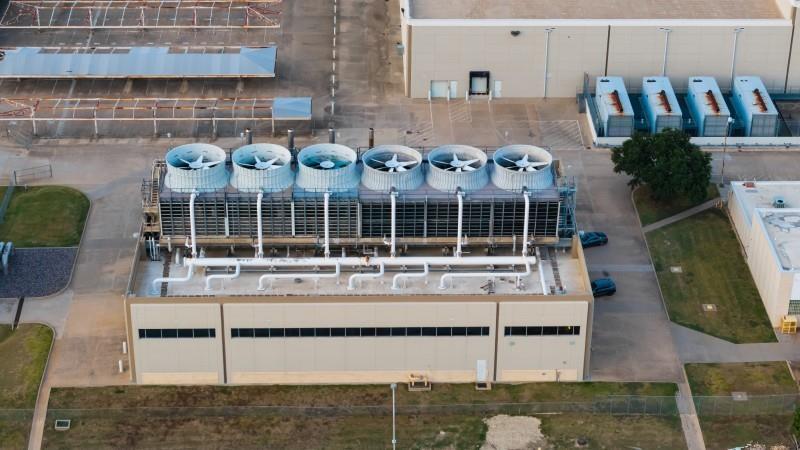
To track Europe's role in the US AI build-out, we use a selected basket of products relevant to AI infrastructure, based on Waugh (2026), including servers, transformers and cooling equipment. These products are not exclusive to AI infrastructure, so the figures do not identify exports specifically destined for AI projects. Comparing 2022 with the 12 months ending July 2026, annual EU exports of the selected products to the US increased by approximately €10bn, or 55%, in electrical power equipment; €8bn, or 77%, in compute hardware; and €3bn, or 30%, in cooling systems. European suppliers also gained shares of US imports within the selected power and cooling categories.
Yet Europe's share of the overall infrastructure basket has fallen sharply since 2024. European suppliers are gaining ground in some expanding markets, but those markets represent a shrinking proportion of a boom increasingly dominated by computing equipment.
A falling aggregate share does not mean Europe's established industrial strengths are failing. It does show that success in those industries is not enough to keep pace with the changing composition of US demand.
Power and cooling suppliers are gaining both exports and market shareElectrical power equipment accounts for the largest increase in European exports to the US since 2022. The category includes transformers, switchgear, static converters and generator sets. Cooling and HVAC equipment has also recorded substantial export growth.
In both categories, Europe has increased its share of US imports. The EU's electrical-power share has risen by approximately 1.6 percentage points, while its cooling share has increased by around 2 percentage points. European suppliers have therefore expanded faster than the corresponding US import markets.
Compute hardware presents a different picture. European exports have increased substantially, making computing the second-largest contributor to the growth in EU exports to the US within the infrastructure basket. However, the EU's share of US compute imports has fallen from roughly 4.5% to below 3%.
Networking exports have also increased, although by much less, while Europe's share of the corresponding US import market has declined by approximately 4 percentage points.
Speciality materials show a particularly large fall in European market share, but their small weight in the basket means they contribute little to the overall decline.
Europe's export gains come with very different market share outcomesChange in EU27 exports to the US and EU27 shares of US imports by category, 2022 to the 12 months ending July 2026.
Left: change in annual EU27 exports to the US compared with 2022, in €bn at current prices. Right: change in EU27 shares of US imports within each category, in percentage points. Selected products also have uses beyond AI and data centres. The selected product basket follows the Waugh (2026) classification of goods used in the construction and operation of AI infrastructure.Source: Eurostat Comext, USITC, ING Economic Research
"> Computing is taking a much larger slice of the marketEurope's share of US imports in the selected infrastructure basket initially rose to nearly 10% in early 2024, then fell to about 5.7% by July 2026. The reversal began in 2024, before the broad US tariff increases on EU imports in 2025.
Instead, the turning point coincided with a sharp change in the composition of US imports. Compute and networking increased from roughly 54% of the basket in early 2024 to approximately 77% by the latest observation. Because Europe has a much smaller position in these categories than in power and cooling equipment, their growing weight has pulled down its aggregate market share.
This does not mean that US demand for supporting infrastructure is falling. Power and cooling markets continue to expand, creating substantial opportunities for European suppliers. Still, they are growing more slowly than computing and therefore account for a declining share of the total. Europe's share of compute and networking imports has also fallen, reinforcing the effect of the changing product mix.
Europe's position reversed as computing came to dominate US AI-related importsComposition of US imports (left) and EU27 share of the selected infrastructure basket (right), rolling 12 months.
Left: composition of US imports in the selected basket. Computing comprises compute hardware and networking equipment; supporting infrastructure comprises the remaining five categories. Right: EU27 share of total US imports in the basket. All shares are calculated from rolling 12-month import values. Latest observation: July 2026.Source: USITC, ING Economic Research
"> China's decline in US AI-related imports has not produced an aggregate European gainChina's share of US imports in the selected basket has fallen from around 20% in 2020 to below 5% at the latest observation. Taiwan and Southeast Asia have gained strongly, particularly in the later period. Vietnam and Thailand account for more than 90% of Southeast Asia's increase between the 2022 average and the 12 months ending July 2026. Mexico retains a large but comparatively stable position, while Europe's share rose until 2024 before reversing.
These movements should not be interpreted as direct transfers of orders from China. Some of the expansion reflects new demand for different products, while customs data identify the country of origin but not the ownership of manufacturers or the origin of upstream components.
China's declining direct share has therefore coincided with a rapidly expanding US market, but not with a stronger aggregate European position. Europe's gains remain concentrated in particular product categories.
US AI-goods imports are increasingly supplied by Taiwan and Southeast AsiaSupplier shares of US imports of selected AI-related goods, rolling 12 months.
Shares calculated from rolling 12-month US import values. EU27 countries are aggregated. Southeast Asia comprises Brunei, Cambodia, Indonesia, Laos, Malaysia, Myanmar, the Philippines, Singapore, Thailand and Vietnam. Latest observation: July 2026.Source: USITC, ING Economic Research
">The trade figures show where US demand is being met, but they do not indicate how far the resulting industrial benefits are spreading across Europe. Production data provides a tentative indication, although the industries concerned are considerably broader than the AI-related product basket used in the trade analysis.
Production gains remain uneven across EuropeDespite the export gains, output in the broader industries supplying this equipment remains below its early-2022 level across the EU as a whole. Compared with the first half of 2022, production in computer and electronic products, electrical equipment and machinery has risen strongly in the Netherlands, Sweden and Hungary. In the Netherlands, this increase is likely to be influenced by ASML and the wider semiconductor-equipment cluster. The corresponding EU27 composite, however, remains around 1.5% lower, with Germany recording a decline of approximately 9%.
These industries have substantial uses beyond AI and data centres, so the figures cannot isolate the effect of the US investment boom. Nevertheless, the divergence suggests that any production benefits are concentrated in particular industrial locations rather than visible across the EU as a whole.
Production in relevant European industries has diverged sharplyProduction index for selected manufacturing industries, latest six-month average versus the first half of 2022.
Production covers computer and electronic products, electrical equipment and machinery (NACE C26–C28). Changes compare the latest six-month average with the first half of 2022. These industries extend beyond AI-related equipment, so the figures do not isolate the impact of US AI investment.Source: Eurostat, ING Economic Research
"> Europe benefits, but its strengths lie outside computingEurope is benefiting from the US AI infrastructure boom, particularly in power and cooling equipment. Yet its share of the selected US import basket has fallen as demand shifts towards computing, and European shares within compute and networking decline. Despite higher exports, production in the broader industries supplying this equipment remains below its early-2022 level across the EU as a whole.

Legal Disclaimer:
MENAFN provides the
information “as is” without warranty of any kind. We do not accept any
responsibility or liability for the accuracy, content, images, videos,
licenses, completeness, legality, or reliability of the information
contained in this article. If you have any complaints or copyright issues
related to this article, kindly contact the provider above.


Comments
No comment