


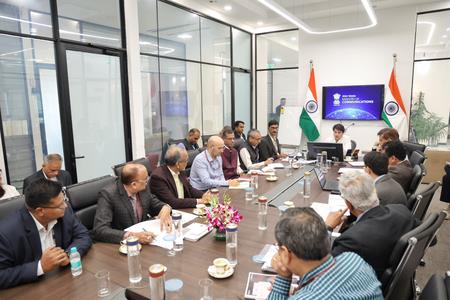
Scindia Holds Meet To Speed Up Expansion Of Telecom Infrastructure


“We remain committed to address industry concerns through coordinated policy action and strengthen the telecom infrastructure for a digitally connected India,” the minister said after the meeting.
According to GSMA, the association that represents mobile network operators and companies, the overall data consumption in India has reached a massive 700 crore GB per month fuelling the backhaul requirement for a mobile BTS site from 4 Mbps (earlier) to 300 Mbps. To sustain such a level of traffic India needs fiberisation and fiber densification.
This requires laying fiber and installing towers at speed across the length and breadth of India. Installing fiber, often underground, and majorly on public lands and areas which many a times may already be paved or developed, is an essential part in deploying broadband infrastructure and a significant part of this digging and trenching work requires access to public Rights of Way (RoW) in cities, towns.
In the 5G era, the network densification will make RoW a critical enabler in accelerating important government visions such as Industry 4.0, Smart Cities. As per a recent GSMA study investments in the 5G era will be driven by the need for a large number of small and macro cells.
Despite the Centre's Department of Telecommunications (DoT) RoW Rules, many state and union territory administrations retain non-uniform, high fee structures and misaligned local bylaws.
Laying underground optical fiber cables (OFC) requires coordinating across a diverse mosaic of land-owning authorities-including municipal bodies, the Ministry of Road Transport and Highways (MoRTH), the Ministry of Railways, and forest departments. This leads to project delays and cost escalation of projects.
While the GatiShakti Sanchar Portal has improved digital processing timelines, several regional and municipal bodies still lack single-window clearances, leading to repeated re-applications and unauthorized-construction notices even after statutory deemed-approval windows expire.
On the power front, rural and remote telecom towers frequently suffer from erratic electricity board grid supply, often lasting 6 to 12 hours a day, forcing heavy reliance on backup power.

Legal Disclaimer:
MENAFN provides the
information “as is” without warranty of any kind. We do not accept any
responsibility or liability for the accuracy, content, images, videos,
licenses, completeness, legality, or reliability of the information
contained in this article. If you have any complaints or copyright issues
related to this article, kindly contact the provider above.


Comments
No comment