


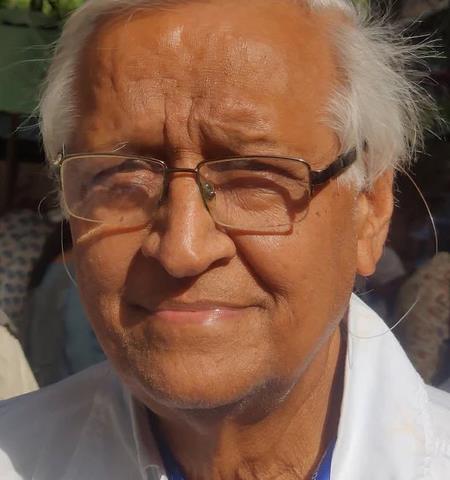
Rajasthan: Padma Shri Awardee Sanjit 'Bunker' Roy Dies At 81


He dedicated his life to rural development and empowering women through education, skill development and solar technology.
His wife, Aruna Roy, is also a prominent social activist and a leading figure in India's Right to Information (RTI) movement. Roy breathed his last at around 6:15 am at the age of 81.
Roy founded the Barefoot College in Tilonia, which became internationally recognised for its work in rural development, renewable energy and community empowerment.
He played a pioneering role in training rural women, including elderly women with little or no formal education, to become solar engineers.
His wife, Aruna Roy, is a prominent social activist who played a significant role in India's RTI movement. Former Rajasthan Chief Minister Ashok Gehlot expressed deep sorrow over Bunker Roy's demise in a post on social media platform X. Gehlot said Roy had made an extraordinary contribution to rural self-reliance, education and development by following the ideals of Mahatma Gandhi.
His entire life was dedicated to empowering villages and bringing meaningful change to the lives of disadvantaged communities. Recalling his association with Roy, Gehlot said he had known him for a long time and had recently visited Barefoot College in Tilonia to meet him and Aruna Roy.
Congress MP Shashi Tharoor also expressed condolences over Roy's demise and extended his sympathies to Aruna Roy and the family. Tharoor recalled Roy's lifelong commitment to making rural communities self-reliant.
He highlighted the contribution of Barefoot College in training village women, particularly grandmothers, in installing and repairing solar lighting systems. The initiative helped bring electricity to households in thousands of villages in India and several other countries, transforming the lives of communities that had limited access to conventional electricity.
Bunker Roy and Aruna Roy established the Social Work and Research Centre (SWRC) in Tilonia, Rajasthan, in 1972.
The organisation subsequently became widely known as Barefoot College. Rooted in Mahatma Gandhi's philosophy, the institution works on the principle that rural communities possess the knowledge and skills needed to address their own challenges. Instead of depending entirely on outside engineers and specialists, it trains local people to become problem-solvers within their communities.
Its programmes include solar energy, handpump repair, rainwater harvesting, handicrafts and other practical skills. One of its most celebrated initiatives involves training rural women, including grandmothers who have never attended formal school, to install, maintain and repair solar energy systems. These women are popularly known as 'Solar Mamas'.
The initiative has empowered women to become solar engineers and bring electricity to remote villages in India and abroad.
Born Sanjit Roy, he became internationally known as Bunker Roy. He belonged to a prominent Bengali family.
According to accounts of his early life, his childhood nickname was inspired by the name of his brother, Shankar. The two names were given a rhyming connection, and 'Bunker' eventually became the name by which he was recognised around the world. Sanjit 'Bunker' Roy was born on June 30, 1945, in Burnpur, West Bengal.
He received an elite education but eventually chose a life devoted to rural communities rather than pursuing a conventional career. Roy studied at The Doon School in Dehradun before attending St. Stephen's College in Delhi.
He was also passionate about sports and achieved considerable success in squash. In 1965, he became India's national squash champion and represented the country internationally on three occasions. The Bihar famine of 1967 proved to be a turning point in Roy's life.
Witnessing widespread hunger, poverty and suffering in rural areas profoundly affected him. The experience inspired him to work for rural communities and dedicate his life to addressing the challenges faced by disadvantaged people.
In 1972, Roy established the Social Work and Research Centre in Tilonia, Rajasthan. The institution was built around a distinctive philosophy: practical knowledge, experience and skills mattered more than formal degrees.
It trained rural residents to address local problems through locally available resources and community participation. One of Roy's most influential contributions was developing a programme to train rural women in solar technology. Women, including elderly women with little or no formal education, were trained to assemble, install and repair solar panels and lighting systems. Known as 'Solar Mamas', they helped bring electricity to remote communities.
The programme eventually expanded beyond India, enabling women from several countries to gain technical skills and contribute to their villages' development. Bunker Roy's pioneering work in rural development, renewable energy and women's empowerment earned him recognition in India and internationally.
He received the Padma Shri in 2010 for his social work. His work also brought global attention to the potential of community-led development and the importance of recognising the knowledge and capabilities of rural people.
His legacy will live on through Barefoot College and the thousands of rural women and communities whose lives were transformed by his vision.

Legal Disclaimer:
MENAFN provides the
information “as is” without warranty of any kind. We do not accept any
responsibility or liability for the accuracy, content, images, videos,
licenses, completeness, legality, or reliability of the information
contained in this article. If you have any complaints or copyright issues
related to this article, kindly contact the provider above.


Comments
No comment