


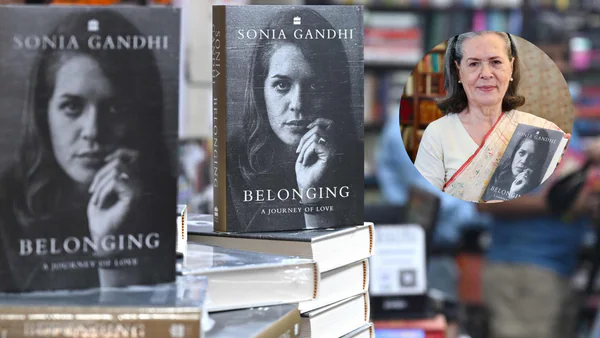
Belonging: A Journey Of Love Why Sonia Gandhi Held On To Her Italian Passport But Visited Her Parents Less Often


Published by HarperCollins in India, the memoir traces her journey from her childhood in post-war Italy to her eventual marriage with Rajiv Gandhi and rise in Indian politics.
In her book, Gandhi talks about why despite inculcating herself into the Indian way of life, she was hesitant to give up her Italian passport.
"Soon a new question arose from the changes in our lives: that of my nationality. I'd kept my Italian passport because it was the part of me that I brought to India, the Italy that my proud and patriotic father had fought for with his comrades. Also, I could visit my parents without filling in many forms, getting sponsorship letters, and so on. But my trips to Italy had become few and far between over time; I didn't relate to the way of life there anymore," she wrote.
Although Gandhi has not specified in her book the exact year in which she decided to renounce her Italian citizenship, ANI says it was in 1983, as per the records.
Also Read | Sonia Gandhi's memoir offers a glimpse into life with the Nehru- Gandhi familyShe mentions in her book that once Rajiv Gandhi became the centre of attention after winning an election in 1981, it was fitting that she adopted India as her home just like she had adapted to its culture, attire, food, and thinking.
"I could see my parents when they visited, and they had come to love India. My family, my friends were here. I had adopted Indian ways in my food and dress habits and in my way of thinking. It was my unquestioned world, and I felt rooted in it. I was, to all intents and purposes, Indian, and formal nationality seemed irrelevant. But now that Rajiv was in public life and had become the focus of attention, it seemed the right time to formalise things," she wrote while speaking of when she decided to get Indian citizenship.
Gandhi also talked about the moment an embassy officer spoke to her about the finality of the decision to renounce her Italian citizenship.
"After I'd filled up the requisite application forms, the procedure took place at the Italian ambassador's residence. An embassy official handed me a document and directed me to peruse it and understand its contents fully, then read it out before him. In declaring that I was renouncing my nationality and surrendering my passport, in his words, 'I ought to be fully aware of the finality of the action' I was about to take," she wrote in the memoir.
Also Read | Sonia Gandhi recalls meeting Rajiv Gandhi at a Greek restaurant in CambridgeShe mentions how once she read the document aloud in front of the Italian ambassador, that a part of her identity, which she had carried to India from back home, was now gone.
"I was a bit taken aback by the emphatic, almost reproachful command of the official. I had taken the decision and was well aware of its meaning, I thought. But then, reading the words aloud before the ambassador, I experienced a strong emotion. My heart began to race, my face was burning, and I could barely hide my agitation. It felt very like the disquiet I'd experienced at the time of my wedding when I had to change my name and let go of one part of my identity. Now the little that had remained of it was going forever," she wrote.
With ANI inputs

Legal Disclaimer:
MENAFN provides the
information “as is” without warranty of any kind. We do not accept any
responsibility or liability for the accuracy, content, images, videos,
licenses, completeness, legality, or reliability of the information
contained in this article. If you have any complaints or copyright issues
related to this article, kindly contact the provider above.


Comments
No comment