


Editor-In-Chief Calls For Shared Digital Platform For Global South Media


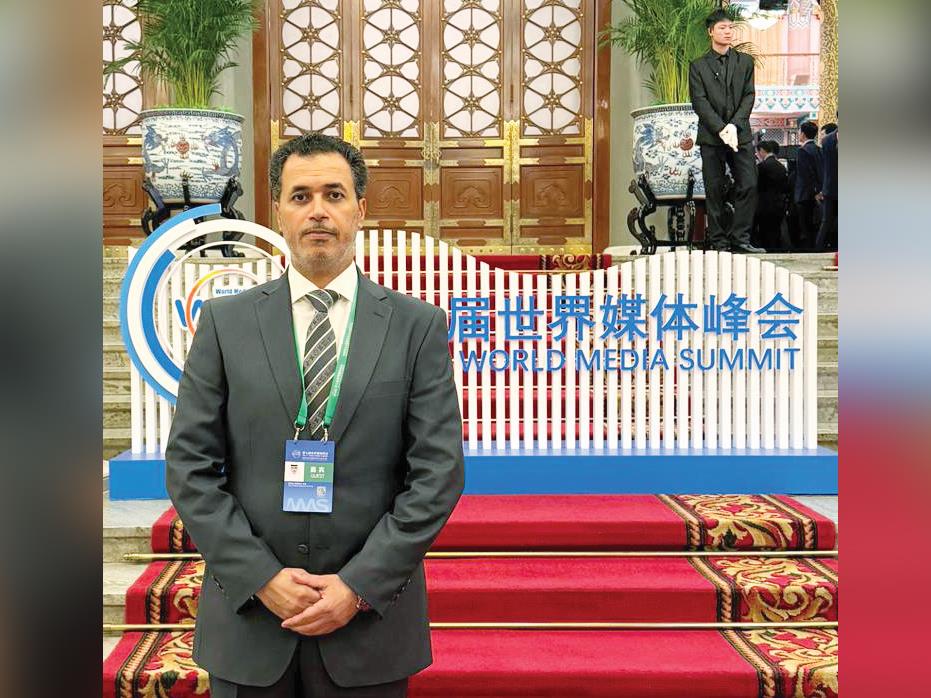
Beijing, China: Editor-in-Chief of The Peninsula Prof. Khalid Mubarak Al-Shafi attended the 7th World Media Summit held in Beijing on Saturday under the theme“Media in the Intelligent Age: From Consensus to Action.”
The 7th World Media Summit, jointly organised by Xinhua News Agency and the Beijing municipal government, drew nearly 500 representatives from nearly 330 mainstream media outlets, think tanks and government bodies from 112 countries and regions, as well as the United Nations and other international organisations.
Prof. Al-Shafi also attended a reception hosted in honour of participants of the summit in Golden Hall, Beijing Hotel where he interacted with Xinhua officials and media representatives. The Peninsula under his leadership has regularly participated in Xinhua-organised media summits for the past several years, reflecting strong partnership between the two media outlets.
Talking to Xinhua on challenges and opportunities in the era of comprehensive transformation, Prof. Al-Shafi said that the current transformation is not simply a shift from paper to digital.“It is a structural shift from the logic of institutions to the logic of platforms, and from editorial judgment to algorithmic decision-making.” On major challenges being faced by media institutions in the Global South, he observed that around 90% of news distribution in the Global South passes through a limited number of platforms.“These platforms do not merely control access to audiences; they also shape what is considered 'important news' through algorithms trained around the priorities of the Global North.”
He added,“Traditional advertising revenues are collapsing, while media institutions in the Global South lack the collective bargaining power to negotiate fair compensation from digital platforms, unlike their counterparts in the Global North, which benefit from stronger industry alliances.”A general view of the 7th World Media Summit.
He further said,“There is a growing risk that generative AI will become a factory for disinformation targeting our societies. At the same time, most AI-powered tools for detecting fake content and verifying information are trained primarily on Northern languages, making them less effective when dealing with our dialects and local languages.”
Highlighting opportunities, Prof. Al-Shafi said that the Global South no longer needs to build massive printing facilities, broadcasting networks, or satellite infrastructure.“A smartphone and a small studio are enough to reach millions of people. This has dramatically reduced the cost of producing and distributing narratives.”
“There is growing global dissatisfaction with one-sided narratives. Stories from the Global South about climate resilience, grassroots innovation, and development through non-Western approaches now have a genuine global audience and market.”
He further said,“For the first time, we have an opportunity to break down language barriers. An investigative report can be translated from Arabic into Asian languages, Bengali, or Spanish almost instantly and at virtually no cost.”
Talking on the importance of cooperation among countries of the Global South, he said:“No single media institution in the Global South can negotiate effectively with giant digital platforms, develop its own large language model, or impose its priorities on international news agencies. Fragmentation is what keeps us in the position of suppliers of raw news material, while the Global North produces the finished product and sells it. Cooperation represents a shift from being individual suppliers to becoming a collective force capable of producing and competing on equal terms.”
On media's responsibilities and cooperation in the era of intelligent transformation, he said that responsibility is not simply about telling the truth.“It is also about ensuring that the truth reaches audiences.” He also suggested,“We do not need another large, resource-intensive news agency. What we need is a shared digital platform, similar to a photo and video agency, where media institutions from the Global South can upload high-quality raw content, including footage documenting climate impacts, agricultural innovation, and cultural heritage. This content would be freely available for mutual use, supported by instant AI-powered translation.”
On algorithmic sovereignty, the Editor-in-Chief of The Peninsula said:“We should launch an alliance to develop an open-source AI model trained on the languages of the Global South, including Arabic and its dialects, Urdu, Swahili, and Malay, and grounded in our history, knowledge, and concepts. This model could be used for translation, fact-checking, and news summarisation, reducing our dependence on models that interpret the world primarily through the perspectives of the West.”
He also proposed that participants of the summit should sign a joint document outlining three key commitments: commitment to transparency; commitment to cross-border verification; commitment to solutions-based storytelling.
“We should establish a Global South Media Negotiating Bloc to engage with YouTube, TikTok, and Meta on two key issues: fairer algorithms that provide greater visibility to content produced in the Global South; and the establishment of a funding mechanism to support local journalism in the Global South, similar to the funding arrangements secured by media institutions in the Global North.”
“We should establish a three-month practical exchange programme focused not on theoretical training, but on producing joint investigative reports. For example, a team from Al Jazeera, working alongside Chinese or other Asian, African, and Brazilian broadcasters, can produce a joint investigation on topics such as“The New Grain Route” or“Climate Migration,” with the report published simultaneously in multiple languages.”

Legal Disclaimer:
MENAFN provides the
information “as is” without warranty of any kind. We do not accept any
responsibility or liability for the accuracy, content, images, videos,
licenses, completeness, legality, or reliability of the information
contained in this article. If you have any complaints or copyright issues
related to this article, kindly contact the provider above.


Comments
No comment