


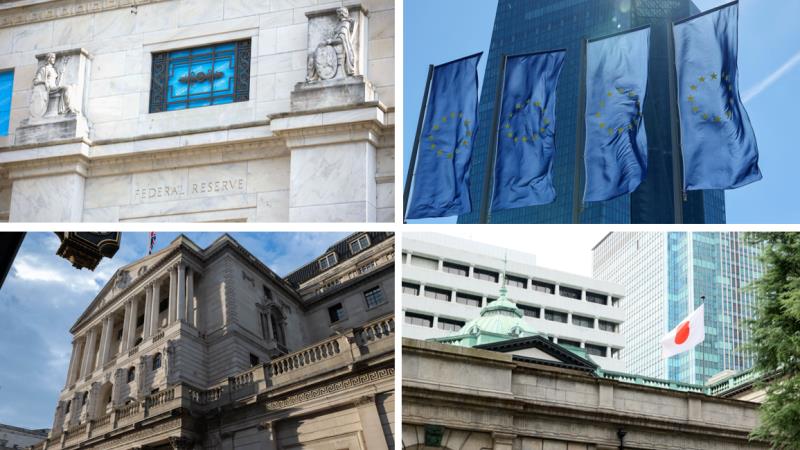
Our Latest Views On The Major Central Banks


Strong growth, low unemployment and above-target inflation prompted the Fed to hike rates in September and signal that at least one additional rate increase is likely.
This was all the ammunition markets needed to price in at least three additional 25bp moves. However, caution is creeping back into market pricing with officials skipping the October Federal Open Market Committee (FOMC) meeting despite higher-than-expected inflation prints. Instead, the near-uniform message is that the Fed is under no immediate pressure to hike amid growing evidence that interest-rate-sensitive parts of the economy are cooling while wage pressures look increasingly benign.
Additional Fed rate hikes will do nothing to ease tensions in the Middle East and likely do little to cool the strong pipeline of tech investment. We think the Fed will hike once more, at the December FOMC meeting, after which we expect a prolonged pause well into 2027.
European Central BankAnother rate hike in December looks like a done deal, but looking beyond this year, the outlook for the ECB is clearly less certain. In fact, two main factors will be crucial for the ECB in 2027. One, the intensity and duration of the war in the Middle East and, with it, the trajectory of energy prices. Two, the degree to which higher energy prices translate into broader inflationary pressures. While the ECB expects these knock-on effects to materialise in 2027, so far, actual underlying inflation has remained well-behaved.
In our base case scenario, we expect energy prices to fall in 2027, while weak final demand limits companies' pricing power. This will keep the current inflation wave mainly an energy price shock. Against this background, the ECB can keep its powder dry in 2027 and might even consider a rate cut towards the end of the year.
Bank of EnglandWe expect one more rate hike in February, after the BoE hiked rates for the first time since 2023 in early November. Yet we don't rule out a hike sooner in December, if the energy crisis worsens. Inflation is headed above 4% and the Bank is worried that the crisis has now reached sufficient depth and longevity to justify further action.
Still, there's little evidence so far of second-round effects. Food inflation is remarkably benign. Our gauge of "energy intensive" inflation is actually down this year. And the jobs market is sufficiently cool, meaning wage pressures are unlikely to build materially. For now, it's too early for the Bank to let its guard down.
The data through winter and early spring will be crucial, particularly the April CPI report released in May, which is heavily affected by annual price resets. If by then there are still minimal signs of second-round effects, we think the Bank will feel comfortable turning more dovish by the summer. Ultimately, this could enable the BoE to cut rates before the end of 2027.
Bank of JapanBoJ policy normalisation will continue. In October, the BoJ reached a milestone: finally hitting its 2% inflation target. That target had been set in 2013. The BoJ openly admits that real interest rates are negative. The debate naturally moves on to how quickly the 1.25% policy rate will be taken to neutral – commonly seen in the 1.75-2.00% area. We now look for 25bp hikes at the December and March meetings as the quarterly tightening cycle continues.
Market expectations are a little more aggressive than our view, looking for a 2.00% policy rate next summer. Our take is that 1.75% may be sufficient before government support measures weigh on headline inflation from next April. At the same time, government pressure to avoid excessive tightening will ramp up as it tries to keep the cost of capital low in what should be a big year for Japanese investment.
People's Bank of ChinaThe PBoC will remain in easing mode despite global tightening pressures. China's economic backdrop remains conducive to further policy easing. First, inflation remains very mild, likely to end the year under 1%, well below the 2% target set at the Two Sessions. Second, growth has moderated and become more unbalanced, raising risks for the economy. Domestic activity data weakened to the worst levels since the pandemic, and could clearly benefit from further policy support. Third, the labour market looks soft, with lower wage growth and high youth unemployment.
The PBoC has preferred targeted easing measures rather than policy rate cuts. Bank net interest margins hit record lows and global central banks shifted into rate hike mode in 2026. We still see scope for both in 2027, especially if external demand starts to show signs of weakening. We currently look for a 10bp rate cut in mid-2027.
Our view on the major central banks Source: Macrobond, ING">
Legal Disclaimer:
MENAFN provides the
information “as is” without warranty of any kind. We do not accept any
responsibility or liability for the accuracy, content, images, videos,
licenses, completeness, legality, or reliability of the information
contained in this article. If you have any complaints or copyright issues
related to this article, kindly contact the provider above.


Comments
No comment